


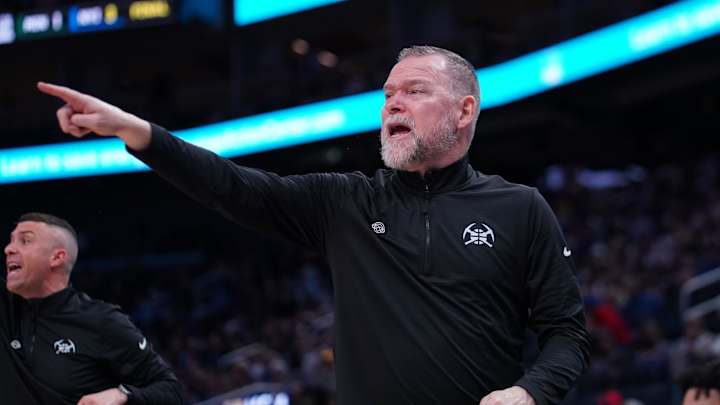
A HARSH REALITY CHECK JUST HIT CHAPEL HILL 🚨: Michael Malone’s Offseason Moves Had UNC Fans Dreaming Big—But an Early National Projection Just Revealed a Much Different Picture… And the Ranking Raising Eyebrows Across College Basketball Could Signal a Bigger Problem Nobody Wants to Admit Yet
For weeks, optimism has surrounded North Carolina Tar Heels men’s basketball.
Michael Malone’s arrival injected fresh energy into the program. International recruiting suddenly became aggressive. The roster began taking shape with long, versatile athletes. Transfer additions generated excitement. And for a moment, it felt like Chapel Hill was preparing for a rapid return to national dominance.
But now, a sobering reminder has arrived.
And it’s forcing everyone around the program to confront an uncomfortable possibility:
What if the rebuild is further away than many expected?
That conversation intensified after early national bracketology projections placed UNC in a surprisingly modest position heading into the 2026–27 season—a ranking that immediately sparked debate among analysts and fans alike.
Because while the Tar Heels have undeniably added talent, the latest projections suggest the rest of college basketball still isn’t fully buying into what Michael Malone has built so far.
And honestly?
There may be legitimate reasons why.
The Excitement Around UNC Has Been Real
To understand why this projection feels so jarring, you first have to understand how much momentum UNC appeared to build during the offseason.
After taking over the program, Malone wasted little time reshaping the roster in his own image. The Tar Heels targeted length, versatility, athleticism, and positionless skill sets. Instead of simply chasing familiar names, the staff widened its recruiting footprint internationally while also attacking the transfer portal.
The result was a roster that looked modern, intriguing, and filled with upside.
Terrence Brown brought experience and perimeter creation.
Matt Able added scoring punch and shooting potential.
Neoklis Avdalas arrived with enormous international upside.
Jarin Stevenson offered size and flexibility on the wing.
And Sayon Keita became one of the most fascinating developmental frontcourt additions in the country.
On paper, the pieces looked exciting.
Maybe even dangerous.
But paper doesn’t always translate to wins.
And that’s where the growing concern begins.
The Biggest Problem Still Hasn’t Been Solved
For all the talent UNC has added, one glaring question continues to hover over the roster:
Who anchors the middle?
The departure of Henri Veesaar to the NBA Draft created a massive void in the frontcourt—one Malone has not fully replaced with proven production.
That reality becomes difficult to ignore when evaluating UNC against the nation’s true heavyweights.
Yes, Sayon Keita possesses huge long-term potential. His mobility, athleticism, and defensive upside make him an exciting prospect. But he’s also still physically developing, adjusting to American basketball, and entering a major role far earlier than originally expected.
At roughly 215 pounds, Keita remains thin for the brutal physicality of ACC play.
And behind him?
Depth remains uncertain.
That’s the concern many analysts appear to be quietly factoring into these early projections.
Because while UNC may look dangerous in transition and versatile on the perimeter, questions about interior toughness, rebounding, and physicality could ultimately define the ceiling of this team.
The National Respect Isn’t There Yet
That’s what makes the bracketology projection sting.
Not because UNC was excluded from the tournament picture entirely—but because the projection reflected caution rather than confidence.
A middle-tier seed placement suggests analysts currently view the Tar Heels less as a national contender and more as a talented but incomplete team still searching for identity.
That’s a very different conversation from the one many fans hoped would surround Malone’s first season.
And perhaps even more frustrating is this:
The skepticism isn’t entirely unreasonable.
Michael Malone’s Vision Is Clear… But It’s Still Unproven
To Malone’s credit, there is a very obvious blueprint emerging in Chapel Hill.
UNC wants size at nearly every position.
It wants playmakers across the floor.
It wants versatile defenders who can switch defensively and attack offensively in space.
In theory, it’s exactly how modern basketball should be built.
The issue is that theories only matter if they survive real competition.
Can Terrence Brown consistently stretch defenses?
Can Matt Able become more than just a perimeter scorer?
Will Avdalas adapt quickly enough physically?
Can Stevenson hold up against stronger ACC frontcourts?
And can Keita survive the nightly punishment awaiting him inside the paint?
Those aren’t small questions.
They’re season-defining ones.
Right now, analysts seem to believe there are simply too many unknowns to confidently place UNC among the elite programs entering the season.
The Pressure Around Malone Is Quietly Growing
Fair or not, this is the reality of coaching at North Carolina:
Patience is limited.
Every offseason move is scrutinized.
Every ranking is debated.
Every projection becomes fuel for conversation.
And because Malone arrived with NBA credibility and enormous expectations, the pressure surrounding his first year has accelerated quickly.
Fans don’t just want progress.
They want proof.
Proof that the roster-building strategy works.
Proof that the international recruiting gamble can pay off.
Proof that UNC can modernize without losing its identity.
Proof that Chapel Hill can return to being feared nationally again.
Right now, those answers remain incomplete.
Why This Projection Could Actually Benefit UNC
Oddly enough, this early skepticism may end up helping the Tar Heels more than hurting them.
Because external doubt often sharpens focus internally.
The truth is, many of UNC’s most intriguing pieces still haven’t fully shown what they can become. Several players on this roster possess ceilings far higher than their current national perception suggests.
That creates opportunity.
If Keita develops faster than expected…
If Able expands his game…
If Avdalas becomes a matchup nightmare…
If Stevenson thrives physically…
Then the entire narrative around this team changes quickly.
And Michael Malone likely knows that better than anyone.
Chapel Hill Is Still Searching for Its Next Identity
Perhaps that’s the biggest takeaway from all of this.
UNC is no longer operating from established certainty.
This is a program in transition.
A program experimenting with new roster-building methods.
A program leaning heavily into international talent.
A program trying to evolve with modern basketball while carrying the weight of enormous history.
That process rarely looks smooth immediately.
And while early projections may feel disappointing to fans hoping for instant dominance, they also reveal something important:
The rest of college basketball is waiting to see whether this new version of UNC is truly ready.
Right now, nobody fully knows the answer.
Not the analysts.
Not the fans.
Not even the people inside the building.
But one thing is becoming very clear:
Michael Malone’s first season in Chapel Hill won’t simply be about winning games.
It will be about proving an entirely new vision can actually work under the brightest spotlight in college basketball.
And until that happens, the doubts are only going to grow louder.




