


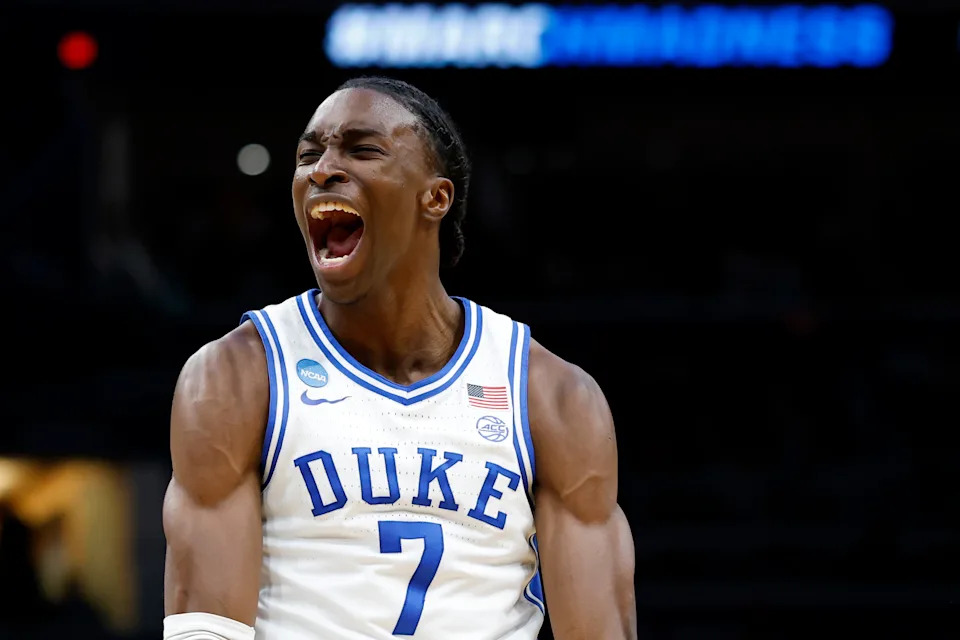
The Boston Celtics are entering another crucial offseason with an opportunity to strengthen an already talented roster. Armed with the 27th overall selection in the 2026 NBA Draft, Celtics president of basketball operations Brad Stevens once again has a chance to uncover another late first-round gem capable of making an impact in Boston’s championship-driven system.
Over the past few seasons, Stevens has built a reputation as one of the NBA’s sharpest evaluators of talent. His ability to identify players who fit the Celtics’ culture and style has paid off tremendously. Recent draft selections such as Baylor Scheierman and Hugo Gonzalez quickly proved their value by carving out meaningful roles under head coach Joe Mazzulla during the 2025-26 season.
Now, attention has shifted toward another intriguing prospect: Isaiah Evans, the talented 6-foot-6 wing from Duke University. In the latest mock draft from The Athletic analyst Sam Vecenie, Evans is projected as a strong fit for Boston at No. 27 overall.
Evans recently completed an impressive sophomore campaign at Duke, where he started all 38 games and emerged as one of the team’s most reliable offensive weapons. He averaged 15 points, 3.2 rebounds, and 1.3 assists per game while showcasing noticeable development in several key areas of his game. His ability to grow between seasons is exactly the type of trajectory NBA teams love to see from young prospects preparing for the next level.
One of the biggest reasons Evans is generating so much interest is his offensive versatility. During his freshman year, he was primarily viewed as a perimeter shooter who relied heavily on the three-point line. However, throughout his sophomore season, Evans expanded his offensive arsenal significantly. He became more aggressive attacking the basket, creating scoring opportunities off the dribble and finishing through contact with improved confidence.
Vecenie highlighted that growth in his draft evaluation, noting how Evans transformed from a one-dimensional shooter into a more complete scoring threat. That development could be critical for a Celtics team that values players capable of fitting into multiple offensive actions and maintaining spacing while also attacking defensive closeouts.
The Celtics have consistently emphasized basketball IQ, effort, discipline, and adaptability when evaluating prospects. Evans appears to check several of those boxes. His experience playing in a high-pressure environment at Duke has prepared him for the intensity and expectations that come with competing for championships in Boston.
Another factor working in Evans’ favor is Stevens’ growing preference for players who spend additional years developing in college. While many NBA teams often chase raw upside with younger prospects, Boston has found success targeting players with more experience and maturity. Those players frequently arrive in the NBA with polished skill sets and a better understanding of team basketball concepts.
Evans’ steady progression at Duke suggests he is committed to improving his weaknesses while maximizing his strengths. Scouts have praised his work ethic and willingness to embrace coaching, two qualities that align perfectly with the Celtics’ organizational culture.
Defensively, Evans also showed encouraging signs this past season. He added strength to his frame and became more competitive guarding opposing wings. Although there is still room for physical development, his length and athleticism give him solid defensive upside. In Boston’s switch-heavy defensive schemes, versatile wings who can defend multiple positions are always valuable commodities.
Of course, landing in Boston would not guarantee immediate playing time. The Celtics already possess one of the league’s deepest wing rotations, filled with experienced veterans and proven contributors. Breaking into that group would be a major challenge for any rookie, especially one selected late in the first round.
Still, the Celtics have shown patience when developing young players. Rather than rushing prospects into major roles, the organization prefers allowing them time to grow within the system. That environment could benefit Evans tremendously as he adjusts to the speed and physicality of NBA basketball.
If selected by Boston, Evans would likely begin his career focusing on specific responsibilities: floor spacing, perimeter defense, energy minutes, and second-unit scoring. Those are roles that often serve as the foundation for long-term success on championship-caliber teams.
The potential fit becomes even more intriguing when considering Boston’s emphasis on player development. Under Stevens and Mazzulla, the Celtics have created a culture where young players are encouraged to improve steadily without overwhelming pressure. Evans’ upward trajectory suggests he could thrive in that structure.
For Boston fans, the excitement surrounding Evans is understandable. The Celtics are not searching for a franchise savior with the 27th pick. Instead, they are looking for another dependable contributor who can strengthen the roster and help sustain the team’s championship ambitions for years to come.
Isaiah Evans may not be the flashiest name in the draft, but his combination of shooting ability, improving offensive versatility, defensive upside, and strong developmental curve makes him an appealing target for one of the NBA’s smartest front offices.
If Brad Stevens believes Evans can continue his upward climb, the Duke standout could very well become the Celtics’ next late-round success story.




