


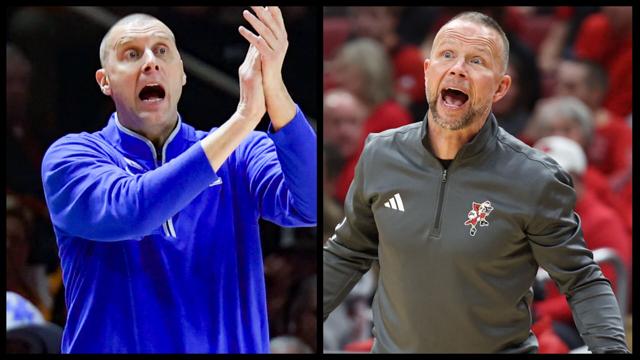
In November, Kentucky and Louisville rolled out their basketball teams like two shiny new Cadillacs on the showroom floor.
The chrome gleamed. The paint sparkled. The brochures promised horsepower.
Kentucky’s Mark Pope looked over his roster and called it an “embarrassment of riches.” He wasn’t exaggerating. On paper, the Wildcats had depth, talent, and versatility across positions. The kind of roster that could play uptempo, execute half-court sets, and dominate inside with length. For a fan base accustomed to high expectations, the preseason buzz was intoxicating.
At Louisville, where Pat Kelsey had a team ranked No. 11 in the preseason and climbing to No. 6 before the Thanksgiving turkey had been passed, the coach told its faithful the Cardinals should be “one of the most talented teams in the country.” He wasn’t wrong. Louisville returned key contributors, added high-level recruits, and boasted a mix of seasoned upperclassmen and explosive freshmen. For the first time in several seasons, Louisville fans were imagining deep March runs and banners hanging in the rafters once more.
After some lean times for these programs, the postseason promised a parade. Both rosters were built to contend. Both fan bases expected celebration. And yet, three months later, the parade route looks more like a detour.
The regular season ends today for the Commonwealth’s two proud basketball empires, and neither is arriving at the finish line quite the way anyone imagined. Between them they’ve piled up 20 losses, a trainer’s room full of injuries, and enough frustrated nights to keep sports-talk radio humming until April. Neither program was in the Associated Press Top 25 entering the final week of the season. In fact, they were tied for 27th, the basketball equivalent of sitting at the kids’ table at Thanksgiving dinner while everyone else gets the prime seating.
Louisville, picked second in the ACC preseason poll, could finish as high as fifth with a win today at Miami — or as low as eighth with a loss. The Cardinals are expected to play without freshman star Mikel Brown Jr., ruled out for a second straight game with back issues. Brown will finish the regular season as the highest-scoring freshman in Louisville history and almost certainly the program’s first one-and-done player. He’ll also have missed 10 of Louisville’s 31 games — nearly a third of the season. It’s hard to run a sports car when one of the cylinders keeps disappearing.
Kentucky’s season has taken similar detours. The Wildcats were picked second to Florida in the SEC preseason poll. They’ll face the Gators today at Rupp Arena, with Florida already having locked up the conference championship and installed as a 6.5-point favorite. With a win, Kentucky could finish in a tie for fourth in the SEC. With a loss, it could slip into a tie for ninth. Their point guard, Jaland Lowe, managed meaningful minutes in only seven games before a shoulder injury shut him down. Talented big man Jayden Quaintance appeared in only four games while recovering from a knee injury. Two rosters assembled at modern college basketball prices. Two seasons that never quite ran the way the sales brochure suggested.
Talent vs. Execution: The Frustrating Gap
It’s one thing to have talent; it’s another to get it to perform consistently on the floor. Pope has taken heat from some Kentucky fans who believe he was slow to adjust to a roster that never quite fit the fast, free-flowing style he prefers. He’s 20-15 in two seasons in the SEC, and double-digit deficits have become routine against conference rivals. What looked like a team designed to outscore anyone sometimes struggled to maintain rhythm, balance, and cohesion when the games mattered most.
Louisville coach Pat Kelsey, one year removed from being named ACC Coach of the Year, has heard some of the same grumbling. His team has gone 0-8 in Quad 1A games and has struggled to play the kind of sustained defense that would allow its offense to shine. At times, Louisville seemed unable to find its identity: a high-octane attack marred by lapses on defense, leaving even the most patient fan wondering how so much talent could result in so many losses.
Yet the numbers tell a different story. Louisville ranks No. 16 in Ken Pomeroy’s ratings and remains in the Top 25 nationally in both offensive and defensive efficiency — one of only 10 teams in the country that can say that. Kentucky, too, boasts impressive advanced stats, with scoring efficiency, pace, and rebounding numbers reflecting a roster capable of contending at the national level. But numbers don’t hang banners. Wins do. And in a season that began with talk of riches and national ambitions, both programs arrive at the final weekend still trying to figure out exactly what they are.
Injuries: The Unseen Opponent
Injuries have been the silent saboteur of both seasons. Kentucky’s Lowe and Quaintance are the most obvious examples, but injuries extended beyond marquee names. Role players, rotational pieces, and even seasoned veterans were forced to miss games or play at less than full strength. Each absence forced coaches to adjust strategies, shuffle lineups, and experiment with chemistry midstream — often to mixed results.
Louisville, too, has been battered by injury misfortune. Mikel Brown Jr.’s intermittent availability altered the team’s offensive flow. His absence in key matchups deprived the Cardinals of a dynamic scorer capable of creating his own shot, setting up teammates, and anchoring the floor. Brown’s skill set wasn’t just supplemental; it was central. Without him, Louisville often found itself relying on talent to carry them rather than cohesion, a subtle but critical difference.
The story here is less about the players’ abilities and more about the fragility of potential. College basketball is unforgiving. Depth matters, but so does timing and health. The most talented roster on paper can look ordinary on the floor when key pieces are missing.
Coaching Challenges in a Talent-Heavy Environment
Both Pope and Kelsey have faced an unusual challenge: managing rosters overflowing with talent yet peppered with limitations that required constant adjustment. For Pope, it’s been the difficulty of finding a rotation that optimizes offensive output without sacrificing defensive discipline. For Kelsey, it’s been the task of sustaining a relentless pace on offense while patching holes in a defensive scheme that struggles against elite teams.
The pressure on both coaches has been enormous. Expectations were high. Fans, alumni, and media projected deep tournament runs, and any hiccup magnified scrutiny. The paradox is that the very abundance of talent, which should have been a blessing, became a strategic conundrum. Balancing egos, managing minutes, and integrating freshmen while keeping veterans engaged has tested the patience and ingenuity of both coaching staffs.
The SEC and ACC: A Brutal Landscape
Context matters. The SEC and ACC are unforgiving environments where talent alone rarely suffices. Florida, Tennessee, and Alabama proved formidable opponents in the SEC, while ACC stalwarts like Duke, North Carolina, and Virginia presented their own challenges. Every misstep is magnified in these leagues, and injuries or inconsistent play are ruthlessly punished.
Kentucky and Louisville were built to compete at this level, but both encountered the harsh reality that modern college basketball is as much about depth, preparation, and mental toughness as it is about raw talent. Even with elite athletes, a single cold streak, foul trouble, or minor injury can cascade into losses that linger in the standings and psyche.
The Postseason Hope
Despite the frustrations, the postseason offers a lifeline. March is college basketball’s great illusionist. It can turn a struggling team into a legend in one weekend. Louisville and Kentucky both have the firepower to make statements in conference tournaments and beyond. A single hot streak could erase months of disappointment. A spectacular run in March can transform perception, rehabilitate reputations, and reward talent that has been inconsistent.
For fans, that possibility is the engine that keeps hope alive. No matter how grueling the regular season has been, both Lexington and Louisville hold onto the belief that talent, once fully realized, can still redefine the narrative. The check-engine light may be on, but the motor is still capable of extraordinary bursts.
Lessons From a Season of Unmet Expectations
So what have these two programs learned from a winter of highs and lows?
Talent is necessary but not sufficient. Even the deepest, most talented rosters require cohesion, resilience, and adaptability. Without these, potential often translates into frustration.
Health is a fragile currency. Injuries to key players can derail a season, no matter how well the roster was constructed. Depth helps, but timing matters just as much.
Coaching is an art of adjustment. Even elite programs need flexibility. Rigid adherence to a preferred style can amplify problems when the roster doesn’t fit perfectly.
March is everything. In college basketball, redemption is always possible. Talent, timing, and a bit of luck can turn a challenging season into a memorable story.
Both programs will carry these lessons forward. Kentucky and Louisville are still rebuilding, still learning, still hoping to harness the potential that had fans dreaming in November. Talent alone didn’t guarantee smooth rides, but experience, adaptation, and resilience may yet deliver the payoff.
The Final Thought
Sometimes you buy the Cadillac. And sometimes, you spend the winter wondering why the check-engine light won’t turn off.
Kentucky and Louisville entered the season with two of the most promising rosters in the nation, yet the reality has been a season of detours, frustration, and unmet expectations. Injuries, inconsistency, and the unrelenting challenge of elite competition have tested both programs.
And yet, the engine is still there. The horsepower is still there. The promise of redemption, of March magic, of a final surge, remains alive. Fans of both teams know it. Players and coaches know it. The winter may have been frustrating, but the road ahead still carries the possibility of triumph — a reminder that in college basketball, the story is never finished until the final buzzer of March has sounded.
The parade may have taken a detour this winter, but the potential for a celebration is never truly gone. All it takes is a spark, a healthy lineup, and a team willing to turn frustration into momentum. That, after all, is the magic — and the maddening truth — of college basketball in the Commonwealth.




