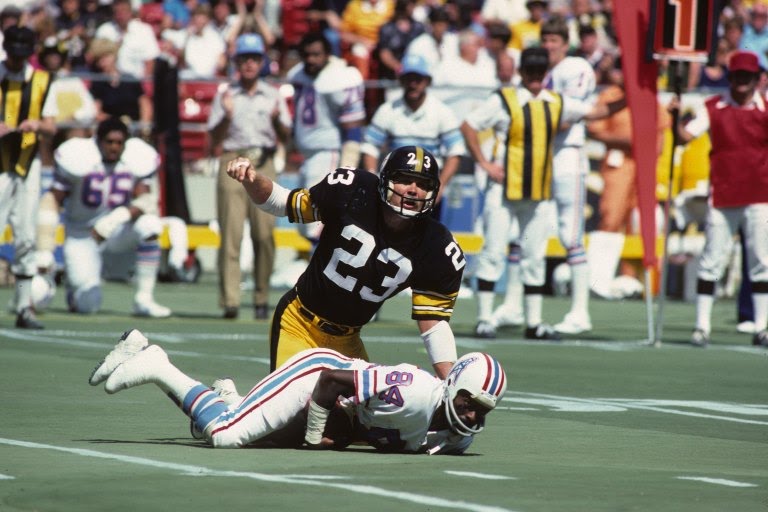
There are certain names in franchise history that echo loudly — the Hall of Famers, the headline-makers, the icons whose jerseys are worn for generations. And then there are the steady pillars, the quiet enforcers, the men who did their jobs with such consistency that their greatness sometimes blended seamlessly into the dynasty around them. This week, the Pittsburgh Steelers said goodbye to one of those pillars. Four-time Super Bowl champion safety Mike Wagner passed away at the age of 76 — and with him goes another living link to one of the greatest eras in NFL history.
The Steelers announced Wagner’s passing on social media, and soon after, tributes poured in from fans, former teammates, and the organization that he represented with pride for a full decade. For a franchise built on toughness, resilience, and unity, Wagner embodied all three.
A Steady Presence in a Legendary Secondary
When fans think of the Steel Curtain defense of the 1970s, the names that often come first are the titans of the front four — “Mean” Joe Greene, L.C. Greenwood, Dwight White, and Ernie Holmes. But championships are not won by defensive linemen alone. Behind that ferocious front was a secondary that had to be just as disciplined, just as physical, and just as reliable.
Mike Wagner was a cornerstone of that unit.
Selected in the eleventh round of the 1971 NFL Draft, Wagner did not arrive in Pittsburgh with fanfare. There were no guarantees. Late-round picks rarely carry expectations of superstardom. But what Wagner brought to training camp was something that cannot be measured by draft position: instincts, intelligence, and an unwavering work ethic.
He earned his place.
By the mid-1970s, Wagner had become a fixture in the Steelers’ defensive backfield. At safety, his role required both physicality and awareness. He had to read quarterbacks, anticipate routes, provide over-the-top help, and step into the box when needed. He did all of it — and he did it consistently.
Four Rings and a Dynasty
From 1971 through 1980, Wagner played his entire NFL career in Pittsburgh. During that span, the Steelers captured four Super Bowl titles — Super Bowls IX, X, XIII, and XIV — cementing their place as the team of the decade.
Those championships were not accidents. They were the result of cohesion and chemistry — stars who trusted role players, and role players who performed like stars when called upon. Wagner was at the heart of that formula.
In the 1975 and 1976 seasons, he reached the Pro Bowl, recognition that affirmed what teammates and coaches already knew. In 1976, he also earned All-Pro honors — a distinction reserved for the league’s very best at their position.
That 1976 season, in particular, stands out as one of defensive dominance. The Steelers defense allowed just 28 points over the final nine games of the regular season — an astonishing statistic that remains a benchmark for defensive excellence. Wagner’s awareness and ball skills were instrumental during that stretch.
He finished his career with 36 interceptions in 119 games — numbers that reflect not only longevity, but playmaking ability. Interceptions are moments of momentum. They swing games. They demoralize offenses. And Wagner had a knack for being in the right place at the right time.
More Than Statistics
Yet numbers alone cannot capture what Mike Wagner meant to the Steelers.
Steelers President Art Rooney II spoke not only of Wagner’s on-field production, but of his “steady presence” and “team-first mentality.” Those words matter. In a locker room filled with strong personalities and Hall of Fame talent, unity is not automatic. It must be nurtured. It must be protected.
Wagner was known as a professional in every sense of the word. He prepared meticulously. He understood his assignments. He did not chase headlines. Instead, he chased excellence.
Teammates trusted him. Coaches relied on him. Opponents respected him.
In an era when the NFL was bruising and unforgiving, especially for defensive backs navigating the deep passing game, Wagner played with intelligence and toughness. He was not reckless — he was calculated. He did not seek glory — he delivered results.
The Fabric of the 1970s Steelers
The greatness of the 1970s Steelers was not built overnight. It was constructed piece by piece — draft by draft, practice by practice, game by game. Wagner’s arrival in 1971 coincided with the organization’s rise from promising contender to dominant force.
Under head coach Chuck Noll, the Steelers cultivated a culture that demanded discipline and accountability. Late-round draft picks were not afterthoughts; they were opportunities. Wagner was proof of that philosophy.
He became a model of development — a player who grew within the system and flourished because of it. His story mirrors the broader Steelers narrative of that era: overlooked by some, underestimated by many, but ultimately undeniable.
A Life Devoted to One Team
In today’s NFL, where free agency and trades often define careers, it is increasingly rare for a player to spend an entire decade with one franchise — especially one that wins at the highest level. Wagner did exactly that.
From 1971 to 1980, he wore the black and gold. He experienced the grind of rebuilding seasons and the glory of championship parades. He stood on podiums hoisting Lombardi Trophies and lined up for countless snaps in regular-season battles.
He was, in every sense, a Steeler.
That loyalty deepens his legacy. Fans remember not just his interceptions or Pro Bowl nods, but his identity as part of the Steelers family. He represented stability in a league defined by physical punishment and fleeting careers.
The Human Element
When news of his passing broke, it was not just statistics that resurfaced — it was stories. Stories of a teammate who showed up early. Of a competitor who studied film late. Of a man who valued camaraderie as much as competition.
In moments like this, franchises reflect not just on championships, but on character. Art Rooney II’s words underscored that sentiment: Wagner will be remembered not only as a champion, but as a great teammate.
That distinction carries weight.
Because dynasties are not sustained by talent alone. They are sustained by trust, sacrifice, and shared purpose. Wagner embodied those qualities.
The Enduring Impact of a Quiet Champion
The phrase “Behind the Steel Curtain” evokes imagery of dominance and intimidation. It conjures the suffocating defense that defined an era. Mike Wagner operated within that curtain — often out of the spotlight, but never out of importance.
Safeties are the defense’s last line. They must think quickly and react instantly. A missed assignment can mean six points for the opposition. Wagner’s reliability meant that quarterbacks thought twice before testing Pittsburgh deep.
Even decades later, the echoes of that dominance remain part of Steelers lore.
Fans who watched the 1970s teams firsthand will remember his contributions vividly. Younger generations may know his name through record books and highlight reels. But all can appreciate the impact of a man who helped bring four championships to Pittsburgh.
Remembering the Man, Honoring the Legacy
As the Steelers community mourns, there is also celebration — celebration of a life lived with purpose and pride. Celebration of a career that helped define a golden era. Celebration of a legacy that will forever be intertwined with one of the NFL’s greatest dynasties.
The black-and-gold faithful understand what those four rings represent. They represent sacrifice. They represent teamwork. They represent history.
Mike Wagner was part of that history — permanently.
His 36 interceptions remain etched in franchise archives. His Pro Bowl seasons stand as recognition of his excellence. His All-Pro honor reflects a year when he stood among the league’s elite.
But perhaps most importantly, his name remains part of the Steelers family — a brotherhood that extends beyond the field and beyond time.
A Dynasty’s Living Links Grow Fewer
With each passing year, the living connections to the 1970s dynasty become fewer. Each loss is not just personal for families and friends — it is historical for the franchise and its fans.
Wagner’s passing reminds us that even legends are human. Time moves forward. Generations change. But legacy endures.
The Steelers’ championships of the 1970s will forever be replayed in NFL Films montages. The defensive stands, the interceptions, the celebrations — they live on. And woven into those memories is the steady presence of Mike Wagner.
He may not have always commanded the spotlight, but he commanded respect.
Farewell to a Champion
As Pittsburgh reflects, it does so with gratitude.
Gratitude for the interceptions that swung momentum. Gratitude for the steady play that anchored the secondary. Gratitude for the professionalism that strengthened a locker room.
Mike Wagner’s career reminds us that greatness is not always loud. Sometimes it is disciplined. Sometimes it is consistent. Sometimes it is quiet strength performed week after week.
Behind the Steel Curtain, he was a constant.
And now, as the Steelers mourn, they do so knowing that his legacy — four Super Bowl rings, Pro Bowl honors, All-Pro recognition, and a decade of unwavering commitment — will forever remain part of their story.
A champion. A teammate. A Steeler for life.