


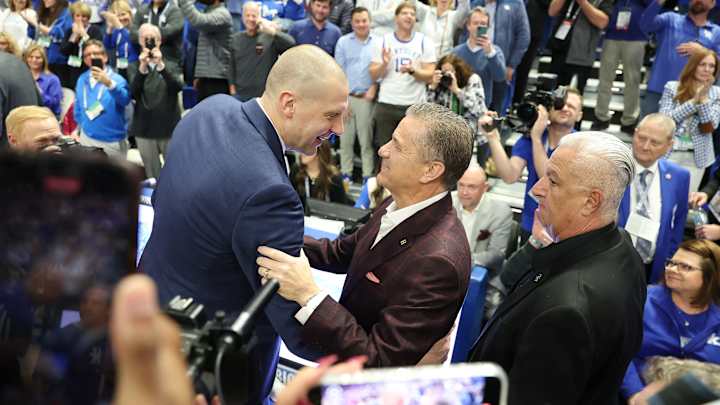
The debate sounds simple. The answer never was.
There’s a certain moment every March when the noise gets louder in Lexington. It isn’t tied to tipoff times or bracket reveals. It arrives the instant Kentucky’s season hangs in the balance — when one loss can end everything and one win can reignite belief. That’s when comparisons come rushing back, when ghosts of tournament runs past reappear, and when a familiar name keeps resurfacing in conversations about the present.
John Calipari.
For Mark Pope, Kentucky’s new head coach, that shadow has followed him from the moment he walked back into Rupp Arena — not as a beloved former player, but as the man tasked with replacing a living era of Kentucky basketball. And now, with March once again defining legacies, the question has crystallized into a single, deceptively simple line:
Does Mark Pope have to chase John Calipari in the NCAA Tournament to be considered successful?
At first glance, it feels like a fair question. But the deeper you dig, the more you realize it may be the wrong one entirely.
The Weight of the Comparison — And Why It Was Inevitable
Kentucky basketball doesn’t operate like most programs. Coaching changes aren’t just transitions; they’re philosophical resets. When Calipari left Lexington after 15 seasons, he didn’t simply vacate an office — he left behind a résumé that still defines how success is measured.
A national championship.
Four Final Fours.
Seven Elite Eight appearances.
Countless NBA draft picks.
For over a decade, Calipari’s version of success was clear: get to March, survive, advance, and reload.
So when he resurfaced at Arkansas and promptly led the Razorbacks to a Sweet 16 — beating blue-blood coaches along the way — the comparisons were unavoidable. Add in the fact that Arkansas beat Kentucky at Rupp Arena earlier in the season, and suddenly the debate intensified.
If Calipari can do it there… shouldn’t Pope be expected to do it here?
That line of thinking makes sense on the surface. But it also ignores the reality of what Pope inherited — and what Kentucky is actually trying to become.
Mark Pope Didn’t Inherit a Machine — He Inherited a Mess
One of the most overlooked elements of this debate is context.
Calipari took over Arkansas with time, control, and the benefit of experience built across decades. Pope, meanwhile, walked into a Kentucky program undergoing one of the fastest, most chaotic roster rebuilds in modern college basketball.
New coach.
New staff.
New system.
Roster assembled at warp speed.
And then came the injuries.
Kentucky didn’t just lose depth — it lost identity pieces. Rotation players. Projected stars. Continuity. Every coach preaches patience, but few are tested the way Pope has been in his first season.
Yet instead of fracturing, the Wildcats adapted.
They won ugly.
They defended late.
They leaned on toughness over talent.
This wasn’t the polished, one-and-done juggernaut Kentucky fans grew used to seeing. It was something different — and, in many ways, more revealing.
Why March Matters — But Not in the Way People Think
There’s no denying it: March matters at Kentucky. It always will. But the type of March success fans crave has evolved.
In Calipari’s later years, the frustration wasn’t about early exits alone — it was about feeling disconnected from the team, about watching seasons end before they ever seemed to start. Talent was abundant, but cohesion often wasn’t.
Pope’s first Kentucky team hasn’t been perfect — far from it. But it has something Calipari’s final teams often lacked:
A shared fight.
Players talk about roles changing nightly.
About doing “non-scoring winning things.”
About loving the grind, not the spotlight.
That doesn’t guarantee a Sweet 16. But it does signal sustainability.
And that’s where the real definition of success begins to shift.
Does Pope Need a Sweet 16 to “Win” the Comparison?
Here’s the honest answer:
No — but it would accelerate everything.
If Pope reaches the Sweet 16 in his first tournament appearance at Kentucky, it won’t just validate him — it will quiet nearly every lingering doubt. It would feel symbolic. Cathartic. Proof that Kentucky didn’t lose ground by moving on.
But if he doesn’t?
That alone won’t define failure — not in Year 1, not with this roster, and not after everything this season has demanded.
Calipari himself didn’t win the national title every year. He didn’t even reach the second weekend every year. What sustained him was consistency, identity, and belief.
Pope’s job isn’t to match Calipari’s peaks.
It’s to restore trust — and then build something that lasts.
Why the Question Was Never About Calipari at All
The deeper truth is this: Kentucky fans aren’t asking whether Pope can be Calipari.
They’re asking whether he can be Kentucky’s next long-term answer.
Can he recruit at a high level?
Can he adapt in-game?
Can he connect with players and the fan base?
Can he survive the pressure of March without losing himself?
So far, the early signs have been encouraging.
Pope doesn’t deflect blame.
He doesn’t hide from criticism.
He leans into accountability.
And perhaps most importantly, his players respond to him — not out of fear, but belief.
That’s not something you measure with a bracket.
What Success Actually Looks Like Right Now
If you strip away the noise, success for Mark Pope in this moment looks like this:
Kentucky competes every night, regardless of circumstances
Players improve over the course of the season
The locker room remains united
The fan base believes again
A deep March run would amplify those things. But it doesn’t define them.
Calipari’s success at Arkansas doesn’t diminish Pope’s progress at Kentucky — it simply reminds everyone how difficult this job is, and how unfair one-year comparisons can be.
The Bigger Picture Kentucky Fans Are Starting to See
Perhaps the most telling development is this: the conversation itself is changing.
Instead of asking “Why can’t we be what we were?”, fans are starting to ask “What are we becoming?”
That shift matters.
Because the most successful programs aren’t built by chasing ghosts — they’re built by embracing evolution.
And Mark Pope, for all the pressure surrounding him, appears comfortable doing exactly that.
Final Thought: March Will Judge the Team — Time Will Judge the Coach
March will always matter. It will always sting or soar. But one tournament does not define a coach — especially one tasked with rebuilding culture, identity, and trust.
So no, Mark Pope does not have to chase John Calipari in March.
Because Kentucky didn’t hire him to relive the past.
They hired him to build the future — and the early signs suggest that future may be closer than many expected.




