


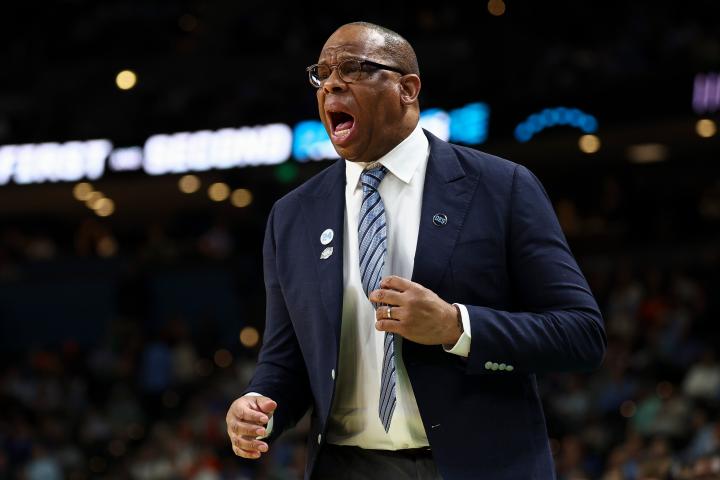
The silence around North Carolina Tar Heels men’s basketball didn’t last long — and when it finally broke, it hit harder than anyone expected. After another crushing collapse, a former champion stepped forward and said what many fans have been whispering for months… but were afraid to fully admit. Now, with serious questions surrounding Hubert Davis and the program’s direction, one powerful take has ignited a firestorm that could change everything in Chapel Hill.
The ending felt all too familiar.
For a program built on excellence, expectations, and championship pedigree, the way North Carolina’s season came to a close wasn’t just disappointing — it was deeply unsettling. Holding a commanding 19-point lead early in the second half against VCU Rams men’s basketball in the NCAA Tournament, the Tar Heels appeared to be cruising. The energy was there. The execution was sharp. Everything suggested this was a team ready to make noise in March.
And then, it all unraveled.
What followed was not just a loss, but a collapse that will linger. VCU stormed back, capitalizing on missed opportunities, defensive lapses, and a visible shift in momentum. By the time overtime arrived, the game had completely flipped. When the final buzzer sounded on an 82–78 defeat, it marked more than just the end of a game — it marked another early exit, another “what went wrong,” and another chapter in a growing conversation that’s becoming impossible to ignore.
For North Carolina, now sitting at 24–9 (12–6 in the Atlantic Coast Conference), the loss confirmed a troubling trend: back-to-back NCAA Tournament appearances ending in the first round. For most programs, that might be acceptable. For UNC, it raises alarms.
And that’s exactly where the conversation took a dramatic turn.
A Champion Speaks — And Fans Listen
When Joel Berry II speaks, Tar Heel fans pay attention.
A former guard, a national champion, and someone who lived the standard that defines North Carolina basketball, Berry’s voice carries weight. His perspective isn’t based on speculation — it’s rooted in experience, expectation, and an understanding of what it truly means to wear Carolina blue.
Appearing on Zach Gelb’s show following the loss, Berry didn’t rush to deliver a harsh verdict. Instead, he offered something more powerful: honesty, conflict, and visible concern.
“It’s a hard conversation for me because that’s someone that has coached me,” Berry admitted, referencing Hubert Davis. “I’ve seen him behind the scenes — and seen the competitiveness — and what he’s able to get out of his players.”
That part matters. Berry didn’t dismiss Davis. He acknowledged the effort, the character, and the work happening behind the scenes.
But then came the shift.
“I’m just starting to question some of just the in-game adjustments. And then I’m starting to question the roster construction.”
That’s where the tone changed — and where the real conversation began.
The Questions That Won’t Go Away
Berry’s concerns weren’t vague. They were specific, pointed, and reflective of what many fans have been noticing.
In-game adjustments have become a recurring topic. Against VCU, North Carolina struggled to respond once momentum shifted. What worked early in the game didn’t evolve as the Rams gained confidence. Defensive breakdowns weren’t corrected quickly enough. Offensive rhythm disappeared without a clear counter.
At this level, those moments matter.
March basketball isn’t just about talent — it’s about adaptability. The ability to recognize what’s changing and respond in real time often determines who advances and who goes home.
And increasingly, critics are questioning whether UNC is winning — or losing — those battles.
Then there’s roster construction.
Berry pointed directly to the absence of Caleb Wilson as a factor the team struggled to overcome. At a program like North Carolina, depth has historically been a strength. Injuries or absences, while impactful, were rarely devastating.
But this version of the Tar Heels looked vulnerable.
“North Carolina usually has players that can make up for having one of your guys out,” Berry said. “I just don’t know… my emotions are kind of mixed right now.”
That line — mixed emotions — captures the moment perfectly.
Because this isn’t just frustration.
It’s uncertainty.
The Weight of Expectations
To understand why this moment feels so significant, you have to consider what North Carolina represents.
This is a program shaped by legends like Michael Jordan, Dean Smith, and Roy Williams. It’s a place where banners hang, championships are expected, and “good” is rarely good enough.
Under Williams, consistency wasn’t a goal — it was a baseline. Deep tournament runs, conference titles, and national relevance were part of the identity.
Now, that identity feels less certain.
Under Hubert Davis, there have been moments of promise. Five straight 20-win seasons is not insignificant. A National Championship appearance shows that the ceiling can still be high.
But the inconsistency is what’s driving the conversation.
Because for every high point, there seems to be a setback.
And for a program of this stature, that balance feels off.
The Brutal Reality of Back-to-Back Exits
Two consecutive first-round NCAA Tournament exits stand out.
Not just because they happened — but because of how they happened.
In both instances, North Carolina held double-digit leads before letting games slip away. That pattern is difficult to ignore. It suggests not just isolated mistakes, but a recurring issue — whether it’s focus, adjustments, or execution under pressure.
Against VCU, the 19-point lead wasn’t just an advantage.
It was control.
Losing that level of control on the sport’s biggest stage raises legitimate questions about preparation, strategy, and mental toughness.
And when those questions start coming from within the Carolina family, they carry even more weight.
Will Change Actually Happen?
Despite the growing noise, Berry offered a measured perspective on what comes next.
“I don’t think he will be fired,” he said of Davis. “If you asked me if he gets fired today, would I be surprised? I would tell everyone, 100 percent no.”
That statement captures the complexity of the situation.
On one hand, there’s enough evidence to justify a change. The results, the trends, and the expectations all point toward a program that isn’t meeting its standard.
On the other hand, there are practical considerations.
Davis is bringing in a strong recruiting class. Financial implications, including buyouts, play a role. And perhaps most importantly, decisions like this aren’t made in the immediate aftermath of a loss — they require careful evaluation.
“You can’t just make a decision based on emotion right now,” Berry emphasized. “You’ve gotta sit down, lay all the cards on the table.”
That’s exactly what UNC’s leadership now faces.
A Program at a Crossroads
This is bigger than one game.
Bigger than one season.
North Carolina basketball is at a crossroads — a moment where decisions made now will shape the program’s trajectory for years to come.
Do they stay the course, trusting that stability and recruiting will lead to a turnaround?
Or do they make a bold move, bringing in a new voice to restore the program to its traditional standard?
Berry offered a clear opinion on that possibility.
If a change is made, he believes it should come from outside the Carolina family — a proven coach with a track record of success at the highest level.
That idea alone signals how serious the situation has become.
The Final Reality
At its core, this isn’t just about Hubert Davis.
It’s about the standard.
“The standard hasn’t been lived up to,” Berry said.
That sentence echoes louder than any statistic.
Because at North Carolina, the standard is everything.
And right now, there’s a growing belief that it’s slipping.
Final Thoughts
The North Carolina Tar Heels men’s basketball are not broken. The talent is there. The history is undeniable. The potential still exists.
But potential alone isn’t enough.
Results matter.
Consistency matters.
And in a program built on greatness, falling short — even slightly — feels significant.
Now, with voices like Joel Berry II speaking out, the conversation has shifted from quiet concern to open debate.
What happens next will define more than just a coaching tenure.
It will define the future of Carolina basketball.
And for the first time in a long time, that future feels uncertain.




