


In what has become one of the most talked-about refereeing decisions of the season, Howard Webb, the head of refereeing in England, has publicly explained the controversial red card shown to Dominik Szoboszlai during Liverpool’s match against Manchester City — an incident where the referee admitted, “I didn’t see that.” 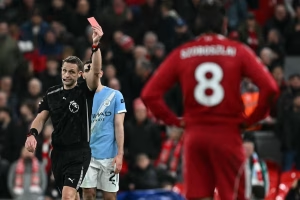
The decision did more than just hand Liverpool a numerical disadvantage; it wiped out what appeared to be a sensational late equaliser for Manchester City and ignited debate across the football world about officiating standards, VAR intervention, and the interpretation of the Laws of the Game.
The Incident in Question
Late in the match, substitute Rayan Cherki looked to have scored from wide and deep inside Liverpool’s half, with the ball creeping into an empty net as the crowd erupted. But instead of celebrating, the stadium fell into stunned silence. After a VAR check, the referee Craig Pawson disallowed the goal and, shockingly, issued a straight red card to Szoboszlai for denying a clear goalscoring opportunity.
It wasn’t immediately clear why this chain of events led to a red card and a disallowed goal. The Premier League’s pitchside check — revealed on the latest episode of Match Officials Mic’d Up — pulled back the curtain on exactly what was going through the officials’ minds.
Referee Admits ‘I Didn’t See That’
The official audio released during the Mic’d Up segment showed a rare moment of candour from referee Craig Pawson. VAR official John Brooks told Pawson there was “a clear foul on the defender [Szoboszlai]” that meant the advantage could not be applied because the subsequent action relied on an infringement. Pawson’s reply was pivotal: “Ah, I didn’t see that.”
That admission — unheard of in most Premier League officiating communications — instantly sent ripples through the football community. How could a top-level referee miss something clear enough for VAR to intervene? And why would such a pivotal moment be decided through technicality rather than common sense?
Howard Webb’s Defence of the Decision
In the aftermath, Howard Webb, now serving as head of refereeing, came forward to explain both the rationale behind the referee’s call and why the VAR recommendations had to be followed. Webb emphasised that referees cannot ignore fouls, even if play appears to advantage one side.
Webb pointed out that the rules clearly state that if an initial infringement prevents a scoring opportunity — and that infringement was missed on the field but spotted by VAR — then the referee must go back and apply the correct sanction. This meant the goal could not stand and Szoboszlai’s red card was enforced according to the regulations.
His words: “We try to apply common sense where possible, but there’s a limit to that… the ball only goes in the goal because Erling Haaland pulls Szoboszlai… so we can’t allow that goal to stand for that reason.”
Fans and Experts Speak Out
Unsurprisingly, fans, pundits, and former players have weighed in — often with contrasting views:
On social media, many supporters described the decision as unfair and lacking in “game sense,” arguing that, had the benefit of the doubt gone to the attacking team, the goal should have stood and Szoboszlai would not have been sent off.
Former players and television pundits said situations like this demonstrate how rigidly the laws are now applied, sometimes at the expense of the spirit of the game.
Others defended the refereeing team, suggesting that if VAR spots something clear and obvious that the on-field referee missed, then by law, it must be corrected.
Even Erling Haaland — involved indirectly in the tussle — expressed sympathy for Szoboszlai, emphasising that while the referee must follow the rules, the outcome still felt harsh. �
The Broader Context: VAR and Refereeing Scrutiny
This incident hasn’t occurred in isolation. Refereeing decisions across the Premier League have been increasingly scrutinised, with critics pointing to inconsistent applications of VAR protocols and differing interpretations of key moments. Whether it’s marginal offsides, contentious penalty calls, or professional fouls, fans from all clubs are growing weary of decisions that seem technically correct but emotionally flawed.
Webb’s role — once widely respected from his on-field refereeing career — now involves defending those decisions, and not all supporters are convinced by his explanations.
What This Means Going Forward
For Liverpool, losing Szoboszlai to suspension because of this red card is a blow both on and off the pitch. A key midfielder sidelined not due to a tactical misstep, injury, or poor performance — but because of a controversial subsequent decision that nullified a spectacular goal.
For the Premier League and refereeing bodies, this incident highlights the ongoing tension between human judgement and technological intervention. VAR was introduced to reduce clear and obvious errors, yet moments like this show that even when VAR intervenes, the final decision can still feel controversial and unsatisfying to many fans.
Final Thoughts
The Szoboszlai red card has reignited the debate about the place of VAR, the interpretation of the Laws of the Game, and the balance between following regulations and preserving the “flow” and emotional logic of football. Howard Webb’s explanation — honest, detailed, and rooted in rulebook logic — will satisfy some but leave others unconvinced.
One thing is clear: moments like these will continue to spark debate, and the conversation about how best to referee football in the modern era shows no signs of slowing down.




