


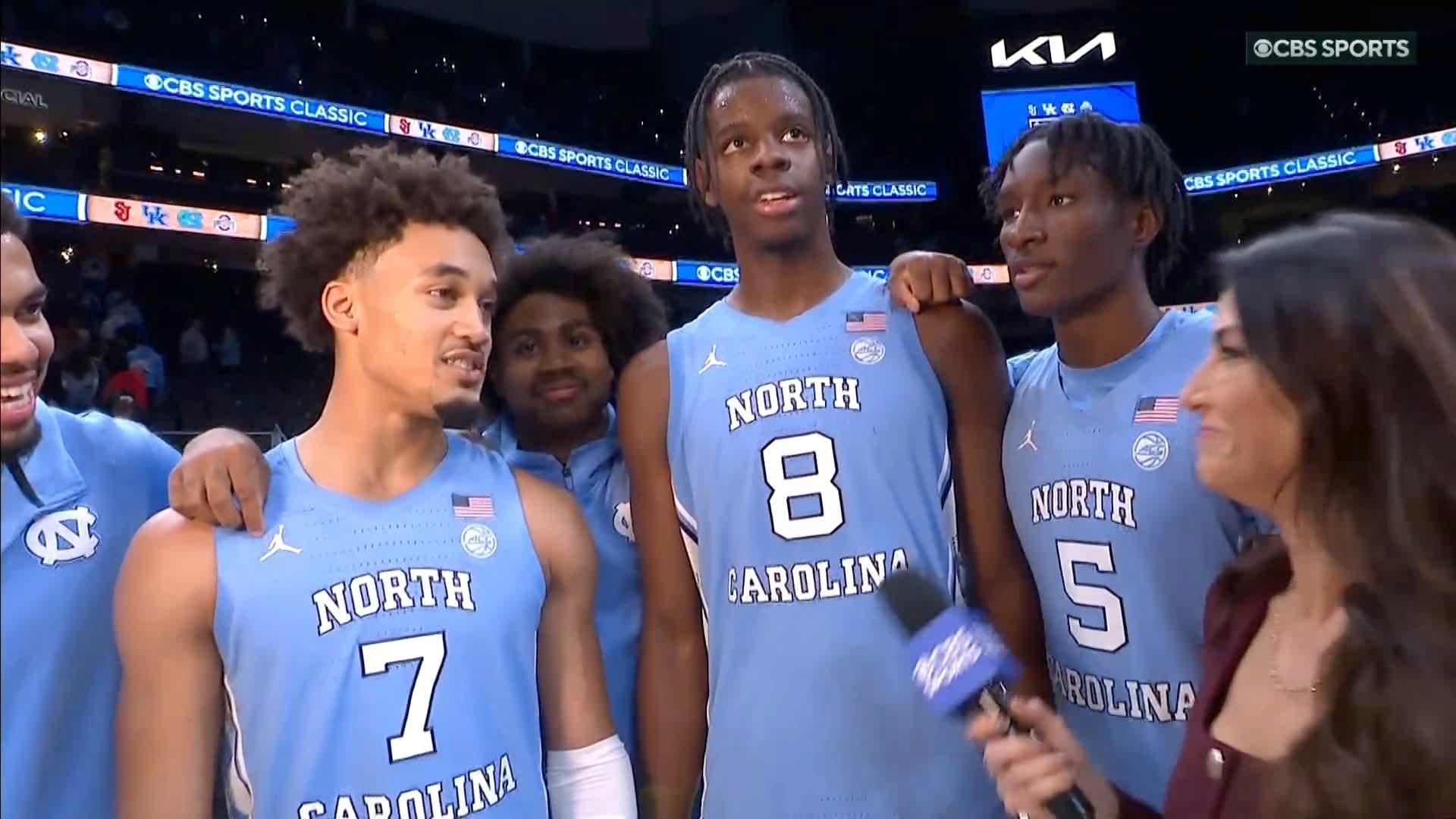
There are moments in a season that don’t show up cleanly in the final score, moments that don’t scream at you through highlights or stat lines — but you feel them. A subtle change in energy. A stretch of basketball where the pieces suddenly make sense. A few possessions that quietly tell you, this might be different now. That’s exactly what happened when Caleb Wilson, Henri Veesaar, and Seth Trimble shared the floor and began impacting the game together. It didn’t announce itself with fireworks, but for those watching closely, something unmistakable shifted for North Carolina — and it might end up meaning more than anyone realized in the moment.
A Season Defined by Searching for Balance
North Carolina’s season has been one of constant adjustment. Hubert Davis entered the year with talent, depth, and expectations, but also with questions that don’t have immediate answers. Who sets the tone defensively every night? Who stabilizes the offense when things bog down? Who brings the edge when the game tilts emotionally?
UNC hasn’t lacked ability. What it has searched for is balance — between youth and experience, offense and defense, freedom and discipline. And in that search, different lineups have flashed promise without fully locking in.
That’s why the Wilson-Veesaar-Trimble stretch felt different. It wasn’t just productive. It was coherent.
Caleb Wilson: The Calm in the Middle of Chaos
Caleb Wilson has steadily grown into his role, and what stands out most isn’t just his physical tools — it’s his composure. When he’s on the floor, UNC looks less rushed. Less frantic. Less desperate for answers.
Wilson doesn’t force the game. He reads it.
He understands spacing, timing, and when to assert himself versus when to let the play breathe. In a season where UNC has occasionally struggled with offensive flow, Wilson has quietly become a stabilizer. He moves the ball quickly, positions himself correctly, and doesn’t panic when the first option disappears.
Against pressure, Wilson stayed grounded. Against runs, he didn’t flinch. That matters more than any individual stat line.
Henri Veesaar: Physicality That Changes the Tone
Veesaar’s impact is felt immediately — and not subtly. He brings size, toughness, and a willingness to engage physically that North Carolina badly needs in stretches.
But what made his performance alongside Wilson and Trimble stand out was discipline. Veesaar didn’t hunt blocks recklessly. He didn’t chase contact for the sake of it. Instead, he anchored possessions, held his ground, and forced opponents to adjust.
When Veesaar is locked in, UNC’s defense gains structure. Guards can pressure harder knowing there’s real resistance behind them. Rebounding becomes more secure. Drives become contested rather than automatic.
He didn’t just protect the paint — he allowed UNC to defend with confidence.
Seth Trimble: The Emotional Engine
Every good team has an emotional engine, and Seth Trimble plays that role naturally. His effort is relentless, but what stood out in this stretch was how controlled it was.
Trimble didn’t try to do everything. He did the right things.
He defended with purpose. He attacked closeouts decisively. He moved without the ball and didn’t need touches to impact the game. When momentum wavered, he injected urgency. When the game threatened to slip, he dragged UNC back into the fight.
That kind of presence is contagious.
When Trimble is engaged like that, the floor lifts with him.
Why This Trio Works And Why It Matters
What makes the Wilson-Veesaar-Trimble combination intriguing isn’t star power. It’s complement.
Wilson provides calm.
Veesaar provides backbone.
Trimble provides fire.
Together, they form something UNC has been searching for — a lineup that balances emotion and execution.
There’s no redundancy here. Each player fills a different need, and none of them demand the game revolve around them. That’s rare, and it’s valuable.
More importantly, they don’t shrink when things get uncomfortable. They lean into it.
Beyond the Box Score: The Possessions That Told the Story
If you watched closely, the shift didn’t come from one big run. It came from possessions where UNC:
got multiple stops in a row
forced tough shots late in the clock
moved the ball without hesitation
rebounded collectively
didn’t unravel after mistakes
Those moments don’t always show up in postgame recaps, but coaches and players feel them.
They build trust.
Hubert Davis’ Chessboard Is Getting Clearer
For Hubert Davis, this stretch provided clarity.
Not answers to everything — but direction.
Coaches don’t just look for production; they look for reliability. Who can execute when the game script changes? Who can stay disciplined when momentum swings? Who helps others settle in?
This trio checked those boxes.
That doesn’t mean they become the solution to every problem. But it does mean Davis now has a lineup he can lean on when things get shaky.
That’s invaluable in March.
Youth, Growth, and the UNC Identity
UNC’s best teams have always shared a common trait: they grow into themselves. They don’t peak early. They figure things out in layers.
Wilson, Veesaar, and Trimble represent that process.
They’re not chasing attention. They’re chasing consistency.
They’re learning when to assert themselves and when to let the game come to them. That maturity doesn’t arrive overnight, but when it starts showing up collectively, it changes how a team looks.
This wasn’t just a good stretch.
It was a glimpse.
Why This Matters Going Forward
If UNC is going to take the next step this season, it won’t be because of one dominant scorer or one perfect game plan. It will be because lineups like this create stability.
Stability leads to confidence.
Confidence leads to execution.
Execution leads to wins.
This trio gives UNC a foundation — something to return to when things wobble.
And in college basketball, they always wobble.
Final Thoughts: A Shift Worth Paying Attention To
It’s easy to dismiss moments like this as small samples or situational success. But basketball seasons aren’t built on isolated explosions — they’re built on patterns.
And this pattern felt different.
Caleb Wilson steadied the ship.
Henri Veesaar reinforced the structure.
Seth Trimble ignited the energy.
Together, they didn’t just play well.
They made sense.
Something shifted for UNC — not loudly, not dramatically, but meaningfully.
And sometimes, those are the moments that end up shaping everything that comes next.




