


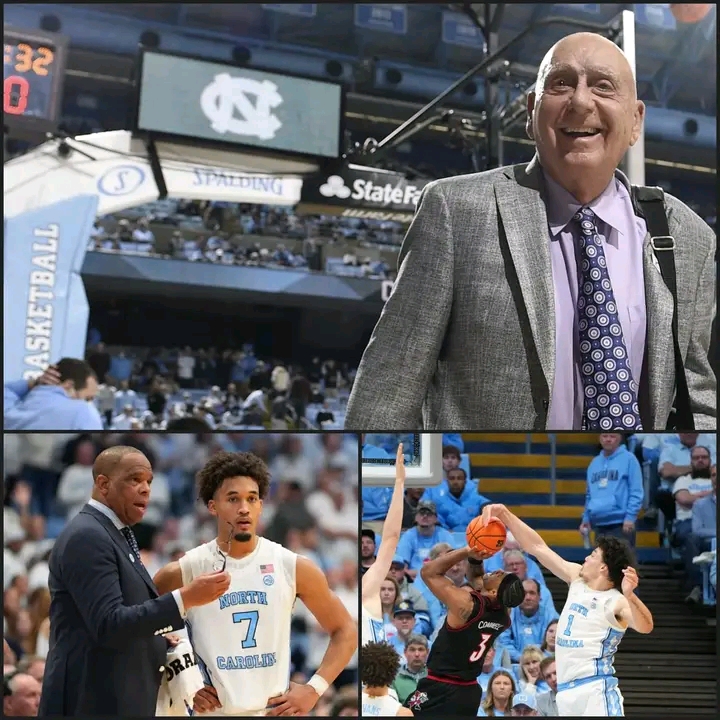
The moment didn’t feel scripted. It didn’t feel polished. It felt raw — the kind of raw emotion that only college basketball can produce on a night when everything hangs in the balance. The final horn had barely finished echoing inside the Dean Smith Center when the spotlight shifted from the scoreboard to something far deeper: heart. And at the center of it all stood Seth Trimble — exhausted, electric, and unmistakably indispensable.
After North Carolina’s emotional victory over Louisville, legendary broadcaster Dick Vitale did what he has done for decades — he let his passion speak first. But this time, it wasn’t just his signature enthusiasm. It was conviction.
“Tar Heels can afford to miss anyone on the roster… but they can’t afford to miss Seth Trimble. Without him, they simply don’t function.”
In a building that has heard iconic calls and championship roars, that statement landed differently. It wasn’t simply praise. It was acknowledgment. It was a declaration that Trimble had become more than a player — he had become the pulse.
A Game That Demanded a Hero
When the North Carolina Tar Heels men’s basketball faced the Louisville Cardinals men’s basketball, it wasn’t just another conference matchup. It was tension wrapped in 40 minutes. Every possession carried weight. Every defensive stop felt urgent. And when momentum swung, it swung violently.
Trimble didn’t just score. He steadied.
He attacked the rim when the offense stalled. He defended like the game would disappear if he didn’t. He chased loose balls as if they were oxygen. The stat sheet reflected impact, but it didn’t fully capture it. The impact was emotional. It was psychological. It was contagious.
You could see it in teammates’ eyes — the trust. The reliance. The unspoken understanding that if the moment grew heavy, Trimble would carry it.
Vitale’s Words — Bigger Than Hype
Dick Vitale has seen everything in college basketball. From buzzer-beaters to blue-blood dynasties, he’s witnessed eras rise and fall. When he singles out a player’s importance, it carries weight beyond commentary.
His statement wasn’t about numbers. It wasn’t about highlight plays.
It was about function.
Without Trimble, Vitale suggested, Carolina simply doesn’t operate the same way.
That’s a powerful thing to say about any athlete — especially in a program built by legends under names like Dean Smith and Roy Williams. At UNC, no player is supposed to be bigger than the system. Yet on this night, the system seemed to breathe through Trimble.
The Silence That Followed
Then came the moment no one expected.
After hearing Vitale’s emotional words, Trimble responded — not with a speech, not with theatrics, but with exactly ten words:
“I just play for my brothers and this jersey.”
Ten words.
No ego. No self-promotion. No grandstanding.
And for a brief second, the arena went quiet.
It wasn’t the silence of confusion. It was the silence of respect.
Because in that sentence, Trimble revealed something deeper than performance. He revealed purpose.
Why Trimble’s Presence Matters
Every championship-caliber team has a heartbeat. Sometimes it’s the star scorer. Sometimes it’s the vocal leader. Sometimes it’s the quiet competitor who refuses to let intensity drop.
For Carolina, Trimble has increasingly become all three.
When he’s on the floor, the defense tightens. The pace sharpens. The emotional edge hardens. There’s urgency in his cuts, force in his drives, and pride in every defensive possession.
And when he’s off the floor? There’s a noticeable void.
It’s not just about replacing points. It’s about replacing tone.
Vitale’s comment may have sounded dramatic — but drama often lives where truth hides.
A Program Built on Identity
At the University of North Carolina, basketball isn’t just entertainment. It’s legacy. It’s banners in the rafters. It’s generations of players who understood that wearing Carolina blue carries expectation.
That’s why Trimble’s ten words resonated so deeply.
“I just play for my brothers and this jersey.”
He didn’t say he plays for stats. He didn’t say he plays for recognition.
He said he plays for his brothers.
That’s Carolina culture distilled into one sentence.
The Viral Moment
Within minutes, clips of Vitale’s praise and Trimble’s response began circulating online. Fans debated the quote. Alumni reposted the clip. Students replayed the moment.
Was Vitale exaggerating? Possibly.
Was Trimble’s response rehearsed? Absolutely not.
The authenticity of it is what made it viral.
In an era dominated by NIL deals, transfer portals, and constant roster turnover, sincerity stands out. And Trimble’s response felt anchored in something old-school — loyalty, humility, and team-first mentality.
More Than Just One Night
One game does not define a season.
But certain nights define perception.
This victory over Louisville wasn’t just about standings. It was about identity. It was about rediscovering the emotional core of a team that sometimes searches for consistency.
Trimble didn’t just deliver points. He delivered presence.
Vitale recognized it instantly.
And when a broadcaster with decades of experience sees that kind of intangible value, it’s rarely accidental.
What This Means Moving Forward
The Tar Heels will face tougher tests ahead. Conference battles intensify. Pressure increases. Depth will matter. Rotations will adjust.
But one truth seems increasingly clear: when Seth Trimble is fully engaged, Carolina’s ceiling rises.
His value doesn’t just show up in the box score. It shows up in body language. In defensive communication. In the spark that ignites a run when momentum stalls.
That’s why Vitale’s statement resonated.
“Without him, they simply don’t function.”
Hyperbole? Maybe.
But on this night, it didn’t feel like exaggeration. It felt like observation.
The Heartbeat Remains
College basketball thrives on moments like this — raw exchanges that remind fans why they care so deeply.
A legendary voice delivering heartfelt praise.
A young player answering with humility.
A crowd absorbing it all.
And at the center of it, a reminder that sometimes the most powerful statements
are the simplest ones.
“I just play for my brothers and this jersey.”
Ten words.
But for Carolina, they sounded like a promise.




