


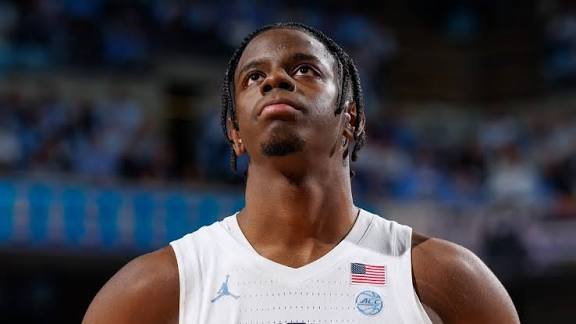
For weeks, there had been a quiet sense of anticipation surrounding the return of one of the most electrifying young players in college basketball. Inside the locker room of the North Carolina Tar Heels men’s basketball program, teammates whispered about it, coaches hinted at it, and fans waited impatiently to see it. Everything seemed to be lining up perfectly for Caleb Wilson to make his long-awaited return just as the season was reaching its most dramatic stage. But then, in a cruel twist that no one inside the program saw coming, everything changed in an instant. What was supposed to be a comeback story suddenly became one of heartbreak, leaving teammates stunned and Wilson himself grappling with the reality that his freshman season had come to an abrupt and painful end.
The news of Wilson’s season-ending injury hit the Tar Heels program like a thunderbolt. In the days leading up to the announcement, there had been growing optimism that the young star would soon be back on the court. Coaches had spoken cautiously but positively about his recovery, and teammates were eager to welcome him back into the lineup. Wilson had been working tirelessly behind the scenes, determined to rejoin the team in time for the most important stretch of the season.
Instead, the dream was shattered during a routine practice.
According to reports from within the program, Wilson suffered a broken thumb during a drill that initially didn’t appear particularly dangerous. It was the kind of moment that happens dozens of times during practices across the country — quick, physical, and seemingly harmless. But when the pain didn’t subside and medical staff evaluated the injury more closely, the diagnosis changed everything.
A broken thumb would require surgery.
And surgery meant his season was over.
For Wilson, the news was devastating. Teammates say the young forward had been counting down the days until he could return to the court and experience the electric atmosphere of postseason college basketball.
“He’s been devastated,” one teammate admitted when speaking about Wilson’s reaction.
The words echoed throughout the locker room in the hours after the team learned the full extent of the injury. Players who had watched Wilson fight through setbacks earlier in the season couldn’t hide their disappointment. Many had believed that his return would provide the spark the Tar Heels needed as they prepared for the challenges ahead.
Instead, they were left processing the loss of one of their most talented players at the worst possible moment.
For head coach Hubert Davis, the situation was particularly heartbreaking. Davis has built his program around relationships, emphasizing not just winning games but supporting players as young men navigating the highs and lows of college athletics.
When asked about Wilson’s injury, Davis didn’t immediately focus on strategy or lineup adjustments. Instead, he spoke about the human side of the situation.
His heart, he said, hurt for Wilson.
The freshman had worked tirelessly to earn his place in the rotation and had quickly become one of the most exciting players on the roster. Losing the chance to compete during the most meaningful part of the season was something no athlete ever wants to experience.
Especially a freshman who had dreamed of this moment for years.
Wilson’s impact on the team had been impossible to ignore before the injury. From the moment he stepped onto the court in a Tar Heels uniform, he brought a combination of energy, athleticism, and versatility that made him a nightmare matchup for opponents.
His ability to score in transition, attack the rim, and contribute on the defensive end made him one of the most dynamic young players in the conference. Even in a program known for producing elite talent, Wilson had quickly carved out a unique role.
Fans had begun to imagine how dangerous North Carolina could become once he fully settled into the system.
That possibility now feels painfully distant.
Statistically, Wilson had already been putting together an impressive freshman campaign. He averaged close to 20 points per game while also contributing heavily on the boards and creating opportunities for teammates. Those numbers alone would have made him one of the most important players on the roster.
But his value went far beyond the box score.
Teammates often spoke about his infectious energy — the way he celebrated big plays, encouraged others, and kept the bench engaged during tense moments. Even in games where his shots weren’t falling, Wilson found ways to impact the outcome through hustle and defensive intensity.
That kind of presence is difficult to replace.
Still, the Tar Heels understand that the season must continue.
The team had already experienced stretches without Wilson earlier in the year, and in those games they managed to stay competitive. Players stepped into larger roles, and the coaching staff adjusted the rotation to maintain balance.
That experience may prove valuable now.
Several players have already expressed their determination to finish the season strong — not just for themselves, but for Wilson as well.
Inside the locker room, the message has been clear: they plan to carry his spirit with them into every game moving forward.
For the program, this situation also highlights the unpredictable nature of sports. Injuries can strike at any moment, reshaping seasons and altering expectations in ways that no one can fully prepare for.
Just days ago, the conversation around North Carolina centered on momentum and postseason potential. Analysts debated how dangerous the Tar Heels could become if Wilson returned to full health at the right time.
Now the narrative has shifted.
Instead of discussing how Wilson might elevate the team during the postseason, the focus has turned to how the Tar Heels will adapt without him.
It’s a challenge that programs across college basketball face every year, but that doesn’t make it any easier.
For Wilson, the coming weeks will likely be filled with a mixture of emotions. On one hand, there is the disappointment of seeing his freshman season end prematurely. On the other, there is the knowledge that his future remains incredibly bright.
Many scouts already viewed him as a potential NBA prospect, and the injury is not expected to significantly impact his long-term outlook. Once the thumb heals, Wilson should be able to return to full strength and continue pursuing his basketball dreams.
In the meantime, he will remain close to the team.
Teammates say he has already expressed his commitment to supporting them from the sidelines, attending practices and games whenever possible.
That support matters more than many people realize.
College basketball seasons are emotional journeys, filled with moments of triumph and heartbreak. When adversity strikes, the bond between teammates often becomes the most important factor in determining how a team responds.
The Tar Heels are now facing one of those defining moments.
Losing a talented player like Wilson is never easy, but it can also bring teams closer together. Players understand that each of them must step up, filling the void left behind and finding new ways to contribute.
For North Carolina, that process has already begun.
Practices have taken on a slightly different tone, with coaches emphasizing resilience and adaptability. Players have been encouraged to embrace larger roles and trust the system that has guided the program for decades.
The goal remains the same: compete at the highest level and give themselves a chance to make a deep run when postseason play arrives.
Whether they can accomplish that without Wilson remains one of the biggest questions surrounding the team.
But inside the locker room, belief has not disappeared.
If anything, the injury has given players an additional source of motivation.
They know how much Wilson wanted to be part of this journey. They know how hard he worked to recover from previous setbacks. And they know how painful it was for him to hear that his season had come to an end.
Those emotions now fuel the team’s determination.
As the Tar Heels move forward, every game will carry a deeper meaning. Each victory will serve as a tribute to the teammate who can no longer join them on the court, while every challenge will test the resilience of a group determined to overcome adversity.
For Wilson, the road ahead will involve patience and recovery.
For his teammates, it will involve carrying the season forward without one of their brightest stars.
And for the fans who have followed this team all year, the story has taken an unexpected turn — one that reminds everyone just how fragile even the most promising seasons can be.
But if there is one thing college basketball has shown time and again, it is that adversity often reveals the true character of a team.
Now, the North Carolina Tar Heels men’s basketball will have their chance to prove exactly what they are made of.




