


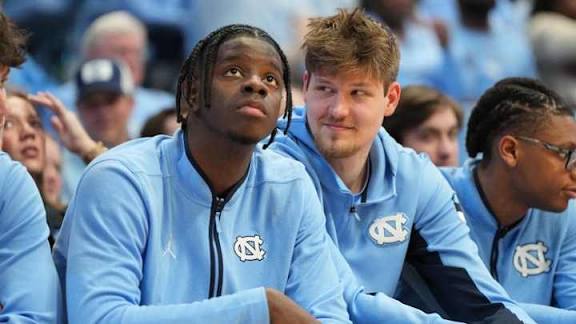
Just when the North Carolina Tar Heels men’s basketball looked ready to surge into the postseason with momentum, devastating injury news involving freshman star Caleb Wilson shook the locker room—and teammate Henri Veesaar delivered a reaction that revealed just how deeply the moment has impacted Tar Heel Nation.
The excitement around North Carolina basketball this season has been fueled by a mixture of rising talent, veteran leadership, and the belief that the Tar Heels were building toward something special as the postseason approached. Yet college basketball has a way of delivering unexpected twists, and for North Carolina, one of the most painful twists of the season arrived at the worst possible time.
Freshman sensation Caleb Wilson, who had quickly emerged as one of the most electrifying young players in the country, suffered a thumb injury during practice that required surgery and ultimately ended his season. The news immediately sent shockwaves through the program and across the fan base.
For a team preparing for the high-pressure environment of the ACC Men’s Basketball Tournament, losing a player of Wilson’s caliber is more than just a lineup adjustment—it is an emotional blow that touches every part of the locker room.
And when Henri Veesaar spoke publicly about the situation, his words carried the kind of honesty and emotion that quickly caught the attention of Tar Heel fans everywhere.
A Breakout Freshman Season Cut Short
Before the injury, Caleb Wilson had been enjoying what many analysts described as one of the most impressive freshman seasons in recent North Carolina history.
From the moment he stepped onto the court wearing Carolina blue, Wilson demonstrated a rare blend of size, athleticism, and versatility. Standing around 6-foot-10, he possessed the ability to dominate near the basket while also defending multiple positions on the floor.
His stat line told the story of a player who had become the heartbeat of the team. Wilson averaged nearly 20 points per game while also leading the Tar Heels in rebounds, steals, and blocks. Those numbers placed him among the most productive players in the entire conference.
Opposing coaches quickly realized that game planning against North Carolina meant finding a way to slow down Wilson. Even when teams tried to focus their defensive attention on him, he often found ways to impact the game—either by scoring efficiently or by creating opportunities for teammates.
His performances did not go unnoticed.
By the end of the regular season, Wilson earned All-ACC and ACC All-Rookie Team honors, recognition that confirmed what fans had already seen throughout the year: the freshman star had become one of the brightest talents in college basketball.
The Moment Everything Changed
The injury itself occurred during what was supposed to be a routine practice session as the Tar Heels prepared for postseason play.
In a season already filled with physical battles and intense competition, the team had been focused on sharpening its execution and maintaining momentum heading into the conference tournament.
But during practice, Wilson injured his thumb in a play that initially did not appear catastrophic.
After medical evaluation, however, the diagnosis revealed a broken thumb that required surgical repair. The recovery timeline meant Wilson would not be able to return before the end of the season.
In an instant, North Carolina lost not only its leading scorer but also a player whose presence energized both the locker room and the fan base.
For players who had spent months competing alongside Wilson, the news was difficult to process.
Henri Veesaar Speaks from the Heart
When Henri Veesaar addressed the situation, his reaction reflected the emotions felt throughout the team.
The 7-foot center had developed strong chemistry with Wilson on the court, particularly in the frontcourt where their size and skill often created mismatches for opposing teams.
Veesaar acknowledged that the injury was a tough moment for everyone involved. Losing a teammate—especially one who had become such an important part of the team’s identity—was never easy.
Yet his comments also highlighted something deeper: the respect that Wilson had earned from his teammates.
Despite being a freshman, Wilson had quickly become one of the most respected voices in the locker room. His work ethic, competitive spirit, and willingness to do whatever the team needed had made a lasting impression.
Veesaar made it clear that the team felt the loss both on the court and emotionally.
At the same time, he emphasized that the Tar Heels still had a season to finish—and that Wilson would remain part of the team’s motivation moving forward.
Hubert Davis and the Tar Heel Response
Head coach Hubert Davis also addressed the injury with a mixture of disappointment and determination.
Davis spoke about how much Wilson meant to the program, not just because of his talent but because of his character.
According to Davis, Wilson had fully embraced what it means to play for North Carolina. He approached every practice and game with the understanding that he was representing a program with decades of tradition and excellence.
Hearing that the freshman’s season had come to an abrupt end was heartbreaking for the coaching staff.
But Davis also delivered a message that reflected the mindset he has tried to build within the program: adversity is part of the journey.
Rather than dwelling on what was lost, the Tar Heels would focus on what remained ahead of them.
The Opportunity for Others to Step Up
With Wilson unavailable, the Tar Heels now face the challenge of redistributing his production across the roster.
That responsibility will fall on several players, including Veesaar himself.
As one of the team’s most important frontcourt players, Veesaar is expected to play an even larger role moving forward. His ability to protect the rim, rebound effectively, and contribute offensively will be critical.
Other teammates will also need to increase their contributions in scoring and defensive intensity.
While replacing Wilson entirely may be impossible, collective effort could help the team maintain its competitive edge.
This kind of challenge is not unfamiliar to North Carolina. Throughout the season, the Tar Heels have already faced injuries and lineup adjustments, yet they continued to find ways to win games.
The Weight of Tar Heel Expectations
Playing for North Carolina basketball carries unique expectations.
The program’s history includes national championships, legendary players, and countless memorable moments in March.
Every season, fans expect the Tar Heels to compete at the highest level.
Losing a player like Caleb Wilson certainly complicates that mission, but it does not eliminate it.
For the current roster, the goal remains the same: compete for championships and represent the program with pride.
Looking Toward the Postseason
As the ACC Tournament approaches, North Carolina must quickly adjust to life without its freshman star.
Preparation becomes even more important in moments like this. Coaches will analyze matchups, refine strategies, and search for ways to maximize the strengths of the remaining roster.
Players will also need to embrace new roles and responsibilities.
The postseason often reveals the true character of a team.
And for the Tar Heels, the coming games will test their resilience, unity, and determination.
Caleb Wilson’s Legacy—Even in One Season
Even though his freshman campaign ended earlier than expected, Wilson’s impact on North Carolina basketball has already been significant.
In just one season, he demonstrated the kind of talent that fans rarely forget.
His highlight plays, dominant performances, and fearless competitiveness made him one of the most exciting players to watch in college basketball this year.
Many analysts believe Wilson will soon take the next step in his basketball journey, potentially entering the professional ranks.
If that happens, his time in Chapel Hill will be remembered as a brief but brilliant chapter in Tar Heel history.
A Team Playing for Something Bigger
In moments of adversity, teams often discover a deeper sense of purpose.
For North Carolina, that purpose may now include playing for the teammate who cannot take the court.
Henri Veesaar’s reaction captured that feeling perfectly.
While the injury hurt, it also reminded the team how much they care about one another.
And sometimes, that kind of unity becomes the spark that fuels an unforgettable run.
As the postseason begins, one question remains:
Can the Tar Heels turn heartbreak into motivation and write a new chapter in their season?
Tar Heel Nation will soon find out.




