


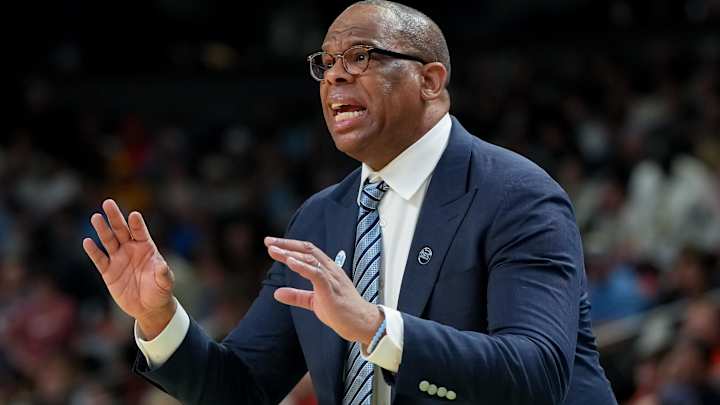
The silence hit harder than the loss. One moment, UNC looked untouchable—19 points up, cruising, in control. The next, everything unraveled in a way fans won’t forget anytime soon. Now, with questions swirling, pressure mounting, and “the standard” suddenly under the spotlight, all eyes are on what comes next in Chapel Hill… and whether Hubert Davis can truly deliver when it matters most.
A Collapse That Changed the Conversation
For a program as decorated as North Carolina Tar Heels men’s basketball, losses happen—but collapses like this do not. The Tar Heels’ stunning first-round exit in the NCAA Men’s Basketball Tournament wasn’t just another early elimination; it was a moment that may define the trajectory of the program under Hubert Davis.
Blowing a 19-point lead is shocking in any game. Doing so on college basketball’s biggest stage? That crosses into historic territory. And for UNC, it marked something even more troubling: back-to-back first-round exits, something that had not happened since the tournament expanded in 1985.
That’s not just a bad night—it’s a red flag.
“The Standard Is the Standard”… But Is It Being Met?
Back in September, inside the Dean Smith Center, Davis spoke with confidence about expectations.
“The standard is the standard.”
At UNC, that phrase carries weight. It doesn’t mean being “good.” It means being elite. It means competing for championships, making deep tournament runs, and maintaining a level of consistency that separates the Tar Heels from nearly every other program in college basketball.
This season, UNC was good. A 24–9 record. Wins over elite opponents. Resilience through injuries. On paper, it checked many boxes.
But March doesn’t care about paper.
When the moment demanded poise, execution, and composure, UNC faltered. And in Chapel Hill, that matters more than anything that happens between November and February.
The Injury Factor: Context That Can’t Be Ignored
To fairly evaluate Davis, context is critical.
The Tar Heels were not at full strength for much of the season. Freshman standout Caleb Wilson—arguably the team’s most impactful player—missed the final stretch, leaving a massive void in scoring, rebounding, and overall presence.
Earlier in the year, UNC showed flashes of dominance when fully healthy:
A strong record against ranked opponents
Signature wins over blue-blood programs
Momentum that hinted at a deep tournament run
For a time, they looked like a legitimate top-four seed.
Even after Wilson went down, the team initially responded well, winning five of its first six games without him. That resilience spoke to coaching, leadership, and depth.
But cracks began to show late.
Three straight losses to end the season—something the program hadn’t experienced in over half a century—signaled a team running out of answers at the worst possible time.
Consistency: The Real Issue
If there is one word that defines the Hubert Davis era so far, it’s this: inconsistency.
On one hand:
Five straight 20-win seasons
Competitive performances against top teams
Moments of brilliance that remind fans of UNC’s ceiling
On the other:
Multiple double-digit loss seasons
Missed opportunities in March
Inability to sustain momentum year to year—or even month to month
That duality is what makes evaluating Davis so complicated.
He’s not failing. But at UNC, “not failing” isn’t enough.
The Shadow of Greatness
Every UNC coach operates under the shadow of greatness.
Davis didn’t just take over any program—he followed Roy Williams, a Hall of Famer who delivered national championships and maintained the program’s elite status for nearly two decades.
Even Williams, however, experienced turbulence toward the end of his tenure, going 32–30 in his final two seasons. That context matters, as it suggests Davis didn’t inherit a flawless machine.
Still, the expectations didn’t change.
At UNC, history isn’t just remembered—it’s demanded.
The Duke Comparison: An Unavoidable Reality
In college basketball, no rivalry looms larger than UNC vs. Duke.
And right now, the comparison is becoming uncomfortable.
Jon Scheyer, head coach of Duke Blue Devils men’s basketball, has hit the ground running:
At least 27 wins in each of his first four seasons
Back-to-back 30+ win campaigns
Consistent positioning as a national contender
Meanwhile, UNC is still searching for stability.
Fair or not, the comparison shapes perception. And perception, in a program like UNC, quickly turns into pressure.
The Weight of Back-to-Back Early Exits
March Madness defines legacies.
Regular-season success is appreciated, but tournament performance is remembered. And right now, Davis’ résumé has a glaring issue: early exits.
Back-to-back losses in the Round of 64 aren’t just disappointing—they’re historically significant for the wrong reasons.
For a program with:
Six national championships
21 Final Four appearances
Anything short of a deep run feels like a missed opportunity.
The concern isn’t just the losses—it’s what they represent: a gap between expectation and execution.
What Needs to Change?
So, what’s next?
That’s the question echoing across Chapel Hill—and it doesn’t have a simple answer. But several areas stand out.
1. Late-Game Execution
The collapse against VCU exposed issues in closing games. Whether it’s play-calling, composure, or decision-making, UNC must improve in high-pressure moments.
2. Depth and Durability
Injuries happen, but elite programs adapt. Building a roster that can withstand key absences is critical.
3. Offensive Consistency
The Tar Heels showed they could score—but not always when it mattered most. Finding reliable offensive options late in games is essential.
4. Identity
Great teams know exactly who they are. UNC has shown flashes of different identities, but hasn’t consistently locked into one.
Is Hubert Davis on the Hot Seat?
It’s too early to call this a make-or-break moment—but the temperature is rising.
Davis has achieved things many coaches would envy:
Sustained winning seasons
Player development
Competitive relevance
But at UNC, the margin for error is razor-thin.
Another early exit next year? The conversation could shift dramatically.
For now, he remains firmly in control—but under increasing scrutiny.
Reasons for Optimism
Despite the disappointment, it’s not all doom and gloom.
There are genuine positives:
A proven ability to win big games
Strong recruiting pipelines
A culture rooted in accountability and tradition
And perhaps most importantly, Davis understands the standard. He’s not an outsider trying to figure it out—he’s part of the Carolina family.
That matters.
The Road Ahead
The offseason now becomes crucial.
Every decision—from recruiting to player development to tactical adjustments—will be viewed through the lens of this collapse.
Next season won’t just be about wins and losses. It will be about response.
Can UNC:
Regain its consistency?
Deliver in March?
Reestablish itself among the elite?
Those answers will define not just a season, but an era.
Final Thought
The loss to VCU wasn’t just a game—it was a turning point.
For Hubert Davis, it’s a test of leadership. For UNC, it’s a moment of reflection. And for fans, it’s a reminder that even the most storied programs are not immune to uncertainty.
But one thing is certain:
The standard hasn’t changed.
The question is—can they rise back up to meet it?




