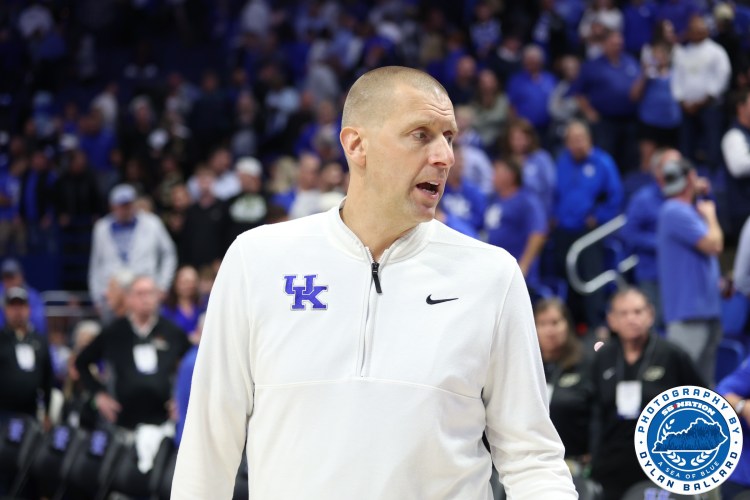
The warning signs aren’t flashing red just yet—but if you listen closely, you can already hear the rumble. It’s not coming from opposing arenas or rival fanbases. It’s rising from within Big Blue Nation itself. And for Mark Pope, that rumble may be the earliest signal that the same relentless pressure that consumed Hubert Davis at North Carolina is beginning to take shape in Lexington.
This isn’t just about wins and losses. It’s about expectations—sky-high, unforgiving, and historically rooted expectations that don’t care about context, injuries, or rebuilding timelines. At Kentucky, you’re not judged by progress. You’re judged by banners.
And right now, the conversation around Pope is starting to shift in a way that should make everyone in the program uneasy.
The Comparison That Sparked Everything
It all started with a statement—one that might have sounded reasonable in a vacuum, but landed very differently in Lexington.
During a radio appearance, Pope pointed to a statistical comparison between his early tenure and the final stretch of John Calipari’s time at Kentucky. His claim? That his team’s winning percentage over two seasons was slightly better than the Wildcats’ performance in the four years before he arrived.
On paper, it was factual.
In reality, it struck a nerve.
Because Kentucky fans don’t celebrate marginal statistical improvements. They don’t hang banners for being “barely better.” And more importantly, they don’t want to hear their current coach comparing himself to the declining phase of a predecessor they had already grown frustrated with.
That’s where the disconnect began.
Why Big Blue Nation Isn’t Buying It
To understand the reaction, you have to understand Kentucky.
This is a program that measures success differently. A solid season at most schools—a 25-win campaign, a tournament appearance, maybe even a Sweet 16—is often cause for celebration. At Kentucky, it’s just the baseline.
Fans remember what Calipari built before things started slipping: Final Fours, elite recruiting classes, and a national championship. That’s the standard that still defines the program.
So when Pope leans on a .639 winning percentage as evidence of progress, many fans don’t see growth—they see deflection.
They see a coach trying to win a numbers argument instead of winning the games that matter most.
And in a place like Lexington, that’s a dangerous perception to create.
The Silent Shift: From Patience to Pressure
Every new coach is given a window. A period where fans are willing to be patient, to believe in the vision, to accept growing pains.
But that window doesn’t stay open forever.
For Pope, it feels like that window is starting to close faster than expected.
At first, the conversation was optimistic:
“He just needs time.”
“Let him build his system.”
“Recruiting will catch up.”
Now, the tone is changing:
“Where’s the breakthrough?”
“Why are we still falling short in March?”
“Is this really better?”
And perhaps most tellingly:
“Is this going to end the same way it did at North Carolina?”
That last question is where Hubert Davis enters the picture—not as a comparison of styles or records, but as a cautionary tale.
The Hubert Davis Warning Isn’t About History—It’s About Patterns
Everyone already knows how things ended for Hubert Davis at North Carolina. That’s not the story anymore.
The real story is how quickly things shifted.
Davis wasn’t always under fire. In fact, he started with momentum, even leading the Tar Heels to a national championship game early in his tenure. For a moment, it looked like everything was on track.
Then expectations caught up.
Consistency became the issue. Tournament exits became more painful. Questions grew louder. And eventually, the same fanbase that once believed in the vision began to lose patience.
Not because Davis failed completely—but because he didn’t meet the standard.
That’s the part Kentucky fans are starting to see in their own situation.
Not the ending—but the trajectory.
The Numbers vs. The Reality
Let’s go back to the numbers, because they matter—but not in the way Pope might hope.
Yes, a .639 winning percentage is respectable.
But at Kentucky, “respectable” isn’t the goal.
What fans are looking for is visible, undeniable progress:
Deep tournament runs
Signature wins
A clear identity that holds up under pressure
So far, those moments have been limited.
There have been flashes, yes. Exciting plays, close wins, signs of potential. But when the spotlight gets brightest—when March arrives—the results haven’t matched the expectations.
And that’s where the frustration grows.
Because Kentucky fans aren’t just watching games. They’re watching for proof.
Proof that this is heading somewhere bigger.
The Dangerous Power of Perception
In college basketball, perception can become reality faster than anything else.
Once a narrative takes hold, it’s hard to shake.
Right now, a subtle narrative is forming around Pope:
That he’s leaning too much on explanations
That he’s defending rather than delivering
That he’s not fully grasping the magnitude of the job
Fair or not, those perceptions matter.
Because they shape how every future result is interpreted.
A loss isn’t just a loss—it’s confirmation.
A win isn’t just a win—it’s relief.
And when a coach reaches that point, the margin for error disappears.
Why Some Fans Are Already Losing Patience
It might seem early for calls of concern, but at Kentucky, timelines move differently.
This isn’t a rebuilding program. It’s a reload program.
So when fans see:
Early tournament exits
Struggles against top competition
Public comments that don’t fully resonate
They don’t think “give it time.”
They think “what’s missing?”
That’s why some voices—still a minority, but growing—are already questioning whether Pope is the long-term answer.
Not because he’s failed completely.
But because he hasn’t proven enough yet.
The Road Ahead: A Make-Or-Break Stretch
The good news for Pope is that none of this is irreversible.
Narratives can change quickly—especially in college basketball.
One deep tournament run can reset everything.
One dominant season can silence the doubts.
But the opposite is also true.
Another early exit.
Another season of “almost.”
And the pressure won’t just grow—it will explode.
Because by then, the conversation won’t be about patience anymore.
It will be about decisions.
What Pope Must Do Next
If there’s one thing clear, it’s this: Pope can’t win this battle with comparisons or calculations.
He has to win it on the court.
That means:
Delivering in March
Building a team that thrives under pressure
Creating moments that fans can believe in
Most importantly, it means embracing the expectations—not explaining them away.
Because at Kentucky, pressure isn’t something you avoid.
It’s something you conquer.
Final Thoughts: The Warning Is Real
The situation in Lexington isn’t identical to what happened at North Carolina.
But it doesn’t have to be.
All it takes is a familiar pattern:
High expectations
Inconsistent results
Growing frustration
That’s how pressure builds.
And right now, that pressure is no longer hypothetical.
It’s real. It’s growing. And fans are starting to notice.
For Mark Pope, the message is becoming impossible to ignore:
Stop looking backward. Stop making comparisons.
Because if the results don’t change soon, the conversation won’t be about John Calipari anymore.
It will be about whether Kentucky needs to make a change—just like North Carolina once did.
And by then, it might already be too late.