


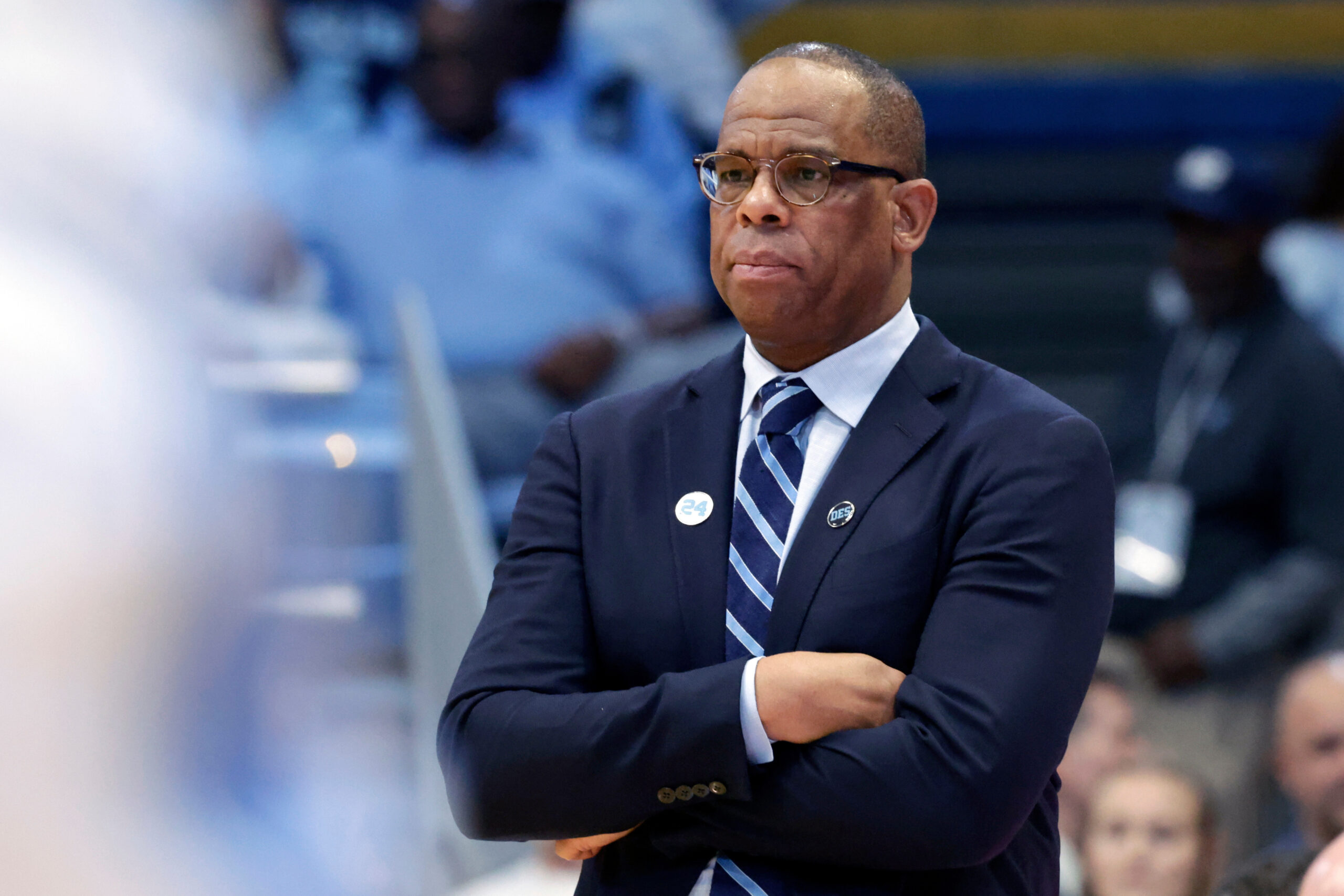
The search for the next head coach of the North Carolina Tar Heels men’s basketball has quickly transformed from a routine leadership transition into one of the most intriguing and politically layered stories in college sports today. What should have been a straightforward process—identify top candidates, negotiate terms, and make a hire—has instead evolved into a high-stakes drama shaped by institutional power shifts, administrative tensions, and a redefined chain of authority that could ultimately decide everything.
At the center of this unfolding situation is a little-known but enormously consequential change in governance—one that has effectively altered who holds the real power in determining who will lead one of college basketball’s most iconic programs.
The Catalyst: Hubert Davis’ Departure
The entire process was set into motion when Hubert Davis was dismissed after five seasons as head coach. A beloved figure within the Carolina community, Davis was not just a coach—he was a former player, a proud representative of the program’s traditions, and someone deeply embedded in the university’s culture.
Despite his strong ties and moments of promise, the results on the court ultimately fell short of expectations. In a program where excellence is not just desired but demanded, the decision was made to move in a new direction. Davis still had four years remaining on his contract, with a buyout exceeding $5 million—highlighting the financial weight of the decision.
But while his departure created a vacancy, it also revealed something far more complex: a system of decision-making that had quietly shifted behind the scenes.
The Power Shift That Changed Everything
To understand the current chaos surrounding UNC’s coaching search, one must go back to a pivotal moment in 2025. Following a controversial process that led to the hiring of football coach Bill Belichick, concerns were raised about the role of the university’s board of trustees in athletic decisions.
Enter Peter Hans, the president of the UNC System.
In response to what he viewed as overreach and potential legal risk, Hans issued a directive that would dramatically reshape the power structure at North Carolina. Through a formal memo, he temporarily suspended certain authorities of the board of trustees related to athletics—specifically limiting their involvement in contract negotiations.
Though labeled as a temporary measure, the directive remains in effect more than a year later—and it now plays a central role in the hiring of the next basketball coach.
A New Reality: Who Really Decides?
Under the current framework, the process for hiring a new head coach at UNC includes a crucial step that fundamentally changes how decisions are made:
The university’s chancellor must first approve the proposed hire
The contract must then be submitted to the UNC System president
The president must provide written approval before the deal can proceed
The board of trustees is excluded from negotiations and serves only a final approval role
This means that even if the athletic department identifies its ideal candidate and reaches an agreement, the decision is not final until it passes through the system president’s office.
In essence, the ultimate authority now lies not within the university itself, but at the system level.
The Fallout: Trustees Sidelined
One of the most striking aspects of this power shift is the diminished role of the board of trustees—a group that historically played a significant part in major athletic decisions.
The controversy stems from the involvement of John Preyer, who, during the football coaching search, communicated directly with Belichick and key figures like football general manager Michael Lombardi.
While Preyer has denied negotiating contracts, the perception of independent action raised red flags within the university system. Hans’ memo explicitly warned that such actions could blur lines of authority and create legal complications.
As a result, trustees have been effectively sidelined—unable to participate in negotiations and limited to a more passive role in the final stages of approval.
The Decision-Makers: Who’s Running the Search?
With the board’s influence reduced, the responsibility for conducting the search now falls primarily on the university’s athletic leadership.
Leading the effort are:
Bubba Cunningham, UNC’s longtime athletic director
Steve Newmark, who is set to take on a larger leadership role
They are supported by Turnkey ZRG, a firm known for handling high-profile searches across sports and business.
Together, this group is tasked with navigating a complex process that now involves multiple layers of oversight and approval—each with its own priorities and considerations.
The Advisory Influence
In addition to the core decision-makers, an advisory group consisting of former players, coaches, and key supporters has been assembled to provide input.
While this group does not have formal authority, its perspectives are expected to shape the direction of the search. Their role highlights the importance of maintaining a connection to the program’s history and values—even as the structure of decision-making evolves.
Leadership at the Top
Overseeing much of this process is Lee Roberts, who has taken on a central role in guiding the university through a period of significant change.
Roberts has emphasized the broader importance of athletics within the university, echoing the philosophy of legendary coach Dean Smith.
“Athletics is the front porch of the university,” Roberts explained, underscoring its visibility and impact.
This perspective reinforces why the coaching hire is about more than just basketball—it’s about the university’s public image, identity, and long-term direction.
Honoring the Past While Facing the Future
Even as the program looks ahead, there has been a conscious effort to honor the contributions of Hubert Davis.
Roberts spoke warmly about Davis and his family, highlighting their deep connection to the university and their lasting impact on the Carolina community.
This balance—respecting the past while embracing change—adds another layer of complexity to the decision-making process.
The Urgency Factor
Time is a critical factor in this search.
With the transfer portal active and recruiting cycles underway, delays in hiring a new coach could have significant consequences for the program’s future. Players are watching. Recruits are waiting. And every day without a clear leader adds uncertainty.
Yet, the added layer of approval required from the system president introduces a potential bottleneck—one that could slow down the process if not managed carefully.
What Lies Ahead?
As UNC moves closer to a decision, several key questions remain:
Will the athletic department’s top choice align with the system president’s vision?
Could the approval process lead to unexpected complications or delays?
Will the reduced role of trustees streamline the process—or create new tensions?
These uncertainties add to the drama and make this coaching search one of the most compelling stories in college sports.
Final Thoughts: A Defining Moment
This is more than just a coaching search.
It is a moment that reflects the evolving nature of college athletics—where governance, authority, and institutional dynamics play just as significant a role as wins and losses.
For the North Carolina Tar Heels men’s basketball, the decision will shape not only the future of the program but also how it operates within a new framework of oversight and accountability.
And as the drama continues to unfold, one thing is certain:
The biggest question isn’t just who will be the next head coach
It’s who truly has the power to decide
In a story filled with tension, intrigue, and shifting power, UNC’s coaching search has become a defining chapter in the modern era of college basketball.
And when the final decision is made, it won’t just end the speculation—it will reveal the true balance of power behind one of the sport’s most prestigious programs.




