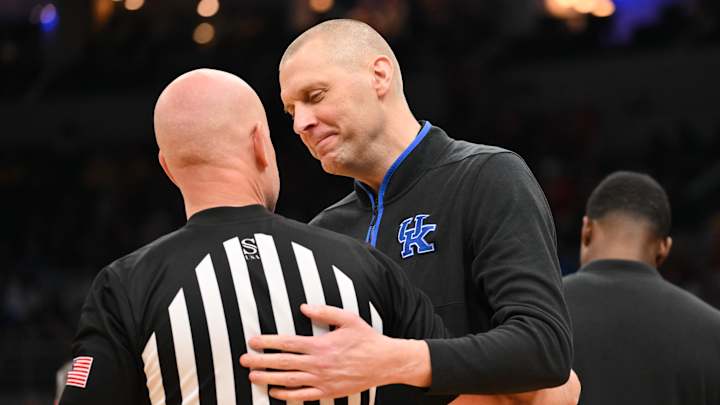
The pressure surrounding Mark Pope and the Kentucky Wildcats heading into the 2026–27 season isn’t just building—it’s reaching a boiling point. After a 2025–26 campaign that failed to meet expectations, the conversation around Kentucky basketball has shifted from optimism to urgency. And at the center of it all lies one glaring issue that could ultimately define the program’s trajectory next season:
Three-point volume.
Not just making threes. Not just shooting them efficiently. But taking enough of them to truly reflect the offensive identity Pope envisioned when he first arrived in Lexington.
Because right now, that identity feels incomplete.
The Vision That Hasn’t Materialized
When Mark Pope took over the Kentucky program, his philosophy was clear from day one. This was going to be a modern offense—fast-paced, spacing-driven, and heavily reliant on the three-point shot. Pope didn’t just want Kentucky to be good from beyond the arc; he wanted the Wildcats to be among the nation’s leaders in three-point attempts.
The target?
Between 30 and 35 three-point attempts per game. A number that would firmly place Kentucky among the most aggressive perimeter-shooting teams in college basketball.
It sounded bold. It sounded exciting. And most importantly, it sounded like the future.
But two seasons into his tenure, that vision hasn’t become reality.
Instead, it’s become a glaring question mark.
The Numbers Tell a Concerning Story
For all the talk about perimeter shooting and offensive evolution, Kentucky’s actual production tells a very different story.
During the 2025–26 season, the Wildcats averaged just 23.9 three-point attempts per game. That number placed them 153rd nationally—a far cry from the top-tier status Pope envisioned.
Let that sink in.
A team built around the idea of shooting threes… ranking in the middle of the pack in actually taking them.
That disconnect is more than just a stat—it’s a symptom of a deeper issue.
Because when a team can’t fully execute its identity, everything else starts to unravel.
Why Three-Point Volume Matters So Much
In today’s game, three-point shooting isn’t just a weapon—it’s a necessity.
Spacing the floor opens driving lanes. It forces defenses to stretch. It creates mismatches, rotations, and ultimately, easier scoring opportunities.
But here’s the key:
You can’t benefit from those advantages if you’re not taking enough shots.
Kentucky’s 23.9 attempts per game simply didn’t put enough pressure on opposing defenses. Instead of dictating the pace and style of play, the Wildcats often found themselves adjusting—playing a brand of basketball that didn’t fully align with Pope’s system.
And that’s where the real problem lies.
Injuries Played a Role — But Not the Whole Story
To be fair, the Wildcats didn’t have a smooth season from a health standpoint.
The injury to Jaland Lowe was a significant blow. As a key piece in Kentucky’s backcourt, Lowe’s absence disrupted offensive flow, playmaking, and overall rhythm. Without a consistent creator, it became harder to generate clean looks from beyond the arc.
But injuries alone don’t explain everything.
Even when healthy, Kentucky struggled to reach the volume numbers Pope was targeting. There were stretches where the offense stagnated, where possessions lacked purpose, and where the three-point shot became more of an option than a priority.
That’s not just bad luck.
That’s a structural issue.
A Roster That Didn’t Fully Fit the System
One of the biggest takeaways from the 2025–26 season is that Kentucky’s roster, as constructed, didn’t perfectly align with Pope’s philosophy.
Yes, there were shooters.
Yes, there was talent.
But there wasn’t enough consistent, high-volume perimeter threat to sustain the kind of offense Pope wants to run.
Some players were hesitant. Others were streaky. And in a system that thrives on confidence and repetition, that inconsistency proved costly.
Pope gambled on potential shooters last offseason—but in the high-stakes world of college basketball, potential isn’t always enough.
Sometimes, you need certainty.
The Transfer Portal Becomes the Battleground
That’s why this offseason is so critical.
With the transfer portal opening, Pope has a chance to reshape the roster in a way that finally brings his vision to life. And make no mistake—this isn’t just about adding talent.
It’s about adding the right talent.
Shooters who are not only capable but willing to take shots.
Players who thrive in space.
Guards who can create and distribute.
Wings who can stretch defenses to their breaking point.
The portal is filled with options, and more names will continue to emerge. The challenge for Pope isn’t finding players—it’s identifying the ones who fit.
And then convincing them that Lexington is the place to be.
The Importance of a True Playmaker
If Kentucky is going to increase its three-point volume, it starts with one position:
Point guard.
Last season exposed just how vital a true playmaker is to Pope’s system. Without consistent ball movement and shot creation, the offense struggled to generate clean perimeter looks.
A high-level point guard changes everything.
They control tempo.
They collapse defenses.
They create opportunities where none exist.
For shooters, that means more open looks, better rhythm, and ultimately, more attempts.
If Pope can secure that piece in the portal, it could unlock the entire offense.
Year Three: No More Excuses
There’s a reality that can’t be ignored—this will be year three under Mark Pope.
At this stage, expectations shift.
It’s no longer about building or experimenting.
It’s about delivering.
Kentucky isn’t a program that waits patiently for results. The standard is immediate success, and anything less invites scrutiny.
That’s why improving this one metric—three-point attempts per game—isn’t just important.
It’s essential.
Because it represents more than just a number.
It represents identity.
What Success Would Look Like
So what does a successful 2026–27 season look like for Kentucky?
It starts with hitting that 30+ three-point attempt threshold.
But beyond that, it’s about consistency.
It’s about commitment to the system.
It’s about players fully embracing their roles.
Imagine a Kentucky team that:
Pushes the pace
Spreads the floor
Shoots confidently from deep
Forces defenses into constant rotation
That’s the vision.
That’s the goal.
And that’s what Big Blue Nation is waiting to see.
The Stakes Couldn’t Be Higher
There’s no sugarcoating it—this offseason will define Mark Pope’s tenure at Kentucky.
The moves he makes.
The players he brings in.
The system he implements.
It all comes together to determine whether the Wildcats return to national prominence—or continue to search for answers.
Because in college basketball, momentum is everything.
And right now, Kentucky is at a crossroads.
Final Thoughts
For Mark Pope and the Kentucky Wildcats, the path forward is clear—but far from easy.
They must fix the one issue that has quietly held them back.
They must commit to the identity they set out to build.
They must evolve.
Because if they don’t?
The consequences could be far greater than just another disappointing season.
They could define the future of the program itself.
And that’s why this isn’t just about shooting more threes.
It’s about proving that Kentucky basketball still knows exactly who it is—and where it’s going.