


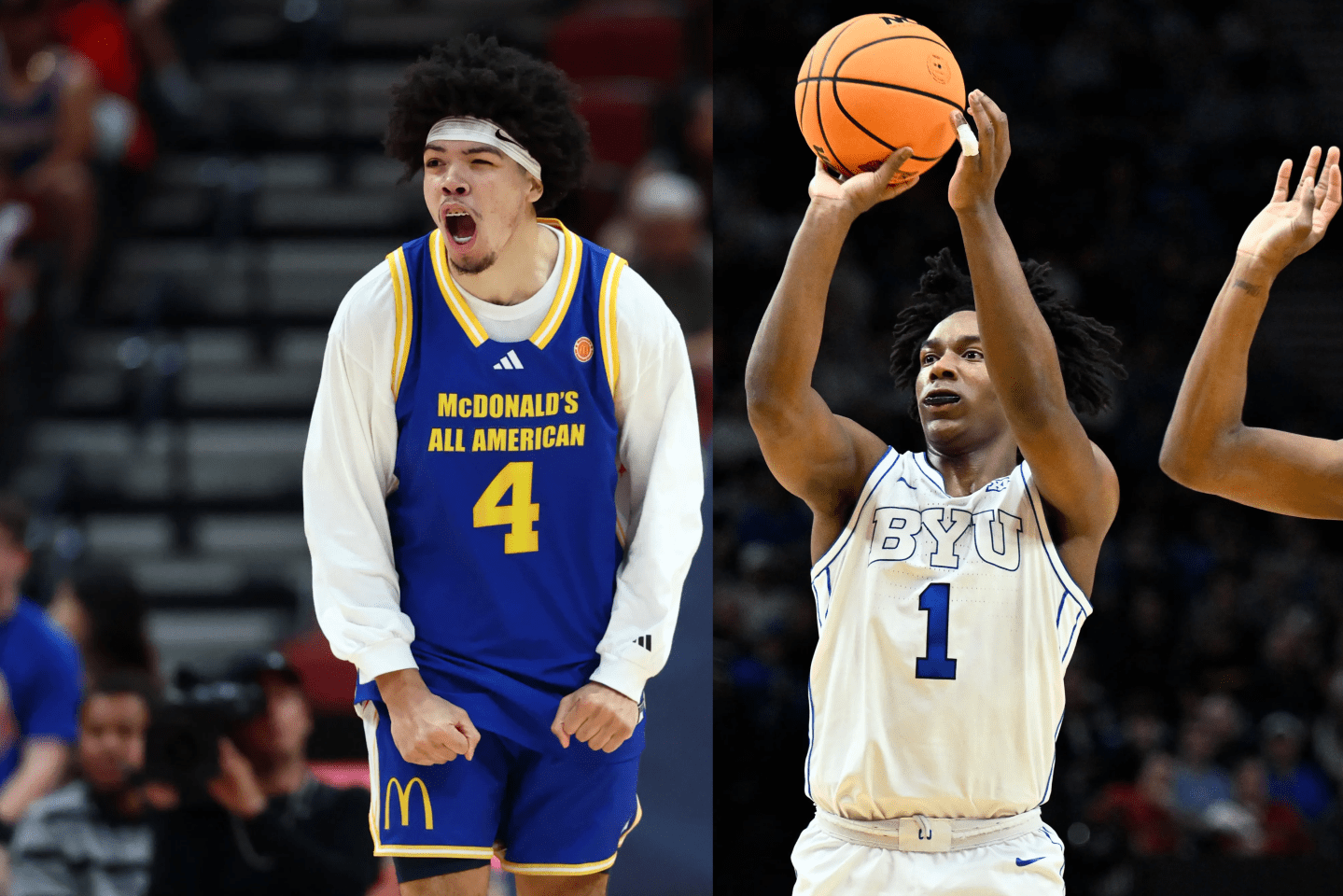
Kentucky Basketball took a bold swing over the past two days, hosting two of the most highly sought-after talents on the recruiting market—elite high school standout Tyran Stokes and BYU transfer point guard Rob Wright. The hope was clear: secure at least one major commitment to help stabilize and elevate the Wildcats’ roster heading into the new season.
However, as both visits have officially concluded, Kentucky finds itself in a far more uncertain position.
Stokes wrapped up his visit early Tuesday morning, while Wright departed later that afternoon. Despite early optimism—especially surrounding Wright—neither player left Lexington with a commitment. What initially seemed like a promising stretch for head coach Mark Pope and his staff has now turned into a tense waiting game, with momentum appearing to shift away from Kentucky.
Heading into the visits, the Wildcats were widely viewed as having a solid chance to land Wright, while Stokes was always considered more of a long shot. But as the situation has unfolded, even Kentucky’s perceived advantage with Wright has begun to fade.
Recruiting analyst Travis Branham provided insight into the evolving situation, noting that confidence in Kentucky securing Wright has significantly decreased over the past 24 to 48 hours. What once looked like a favorable position has now turned into a true toss-up, with a strong possibility that Wright could ultimately return to BYU instead of making the move to Lexington.
That shift is a tough blow for Kentucky, especially considering the program’s vision for its backcourt. There had been growing excitement around the idea of pairing Wright with Washington transfer Zoom Diallo, forming a dynamic and explosive guard duo. However, that scenario now appears to be off the table, further complicating Kentucky’s roster-building efforts.
As for Stokes, the situation remains fluid—but far from reassuring. While Kentucky is expected to stay patient and await his decision, that patience comes with significant risk. Stokes has indicated that he plans to take his time, likely waiting another week or two before making a final choice. His approach is strategic, as he wants to evaluate how rosters across his list of schools take shape before committing.
For Kentucky, this delay could prove costly.
The Wildcats are still in the early stages of constructing their roster, with only a couple of returning players who logged meaningful minutes last season and no confirmed additions from the transfer portal. As other programs continue to secure commitments, Kentucky risks falling behind if it waits too long for Stokes—especially if he ultimately chooses another destination.
There’s also an underlying concern that Kentucky may be used as leverage in these recruiting battles. Both Wright and Stokes have strong ties to other programs—BYU and Kansas, respectively—and it’s not uncommon in today’s landscape for players to use competing offers to maximize their opportunities, whether that be playing time, exposure, or financial incentives.
If that’s the case, Kentucky could find itself empty-handed after investing significant time and resources into these high-profile visits.
The bigger picture paints a challenging scenario for Mark Pope. His aggressive approach to recruiting—swinging big on elite targets—comes with inherent risks. When it works, it can quickly transform a roster into a contender. But when it doesn’t, it can leave glaring holes and limited options as the market begins to dry up.
Right now, Kentucky is walking that fine line.
Missing out on Wright would leave a major gap at point guard, while waiting on Stokes without a backup plan could further delay critical roster decisions. Meanwhile, other top transfers and recruits are steadily coming off the board, reducing the pool of available talent.
Despite the uncertainty, Kentucky still has time to recover. Recruiting is rarely linear, and momentum can shift quickly with the right move. But the margin for error is shrinking, and the pressure is mounting.
In the coming days, all eyes will be on how Pope and his staff respond. Whether it’s pivoting to new targets, re-engaging with current ones, or doubling down on their strategy, the next steps will be crucial in shaping the Wildcats’ future.
For now, what was supposed to be a defining recruiting stretch has instead become a moment of reflection—and a reminder that in the high-stakes world of college basketball recruiting, nothing is guaranteed.




