


Something is shifting in Chapel Hill — and it’s not subtle.
What started as a clear, aggressive plan to reload the roster has suddenly turned into a high-stakes chess match, one where every move matters and every miss could ripple across the entire season. At the center of it all is Michael Malone, who has made it crystal clear: he’s not here to patch holes — he’s here to rebuild, reshape, and reload the North Carolina Tar Heels men’s basketball into a force that can compete at the highest level again.
But rebuilding at this level doesn’t come quietly.
In a bold and somewhat shocking reset, Malone essentially wiped the slate clean. Five-star recruit Dylan Mingo is no longer part of the picture. Promising names like Kyan Evans and Luka Bogavac have also moved on, along with a wave of outgoing transfers. For many programs, that kind of turnover would signal instability.
For Malone?
It’s strategy.
Because with those departures comes something even more valuable in today’s college basketball landscape — flexibility. Roster spots. Financial room. The ability to go “big-game hunting” in the transfer portal, where instant impact players can change a program overnight.
And make no mistake — that was exactly the plan.
At the top of UNC’s wish list sat one name: Juke Harris.
The Wake Forest Demon Deacons men’s basketball wing wasn’t just a target — he was the target. A 6-foot-7 sophomore with elite versatility, Harris averaged over 20 points per game and proved himself to be one of the most complete offensive players in the portal. He could score, create, defend, and elevate everyone around him. In many ways, he was the perfect modern wing — exactly the type of player teams build around.
For UNC, landing Harris would have instantly validated Malone’s aggressive reset. It would have been the kind of move that sends a message across the entire country: the Tar Heels are not rebuilding… they’re reloading.
But now?
That dream is slipping.
Recent reports suggest Harris is leaning toward Tennessee Volunteers men’s basketball, with Michigan Wolverines men’s basketball also firmly in the mix. If that holds, UNC will be forced to pivot — and quickly.
And that’s where things get interesting.
Because while losing out on a top target can derail some programs, it can also reveal something deeper: how prepared you really are.
Does UNC have a Plan B?
Or better yet… does it have multiple?
The answer, quietly, is yes.
Even if Harris chooses another destination, the Tar Heels are far from out of options. In fact, they may already be assembling something that, while different, could still be dangerous.
One of the most likely additions is Terrence Brown, a transfer from Utah Utes men’s basketball. UNC is widely considered the favorite to land him, and for good reason. Brown brings size, scoring ability, and the kind of versatility that fits perfectly in Malone’s evolving system.
Pair him with Neoklis Avdalas, and suddenly UNC has the foundation of a dynamic duo — a 1-2 punch that can create offense, stretch defenses, and control tempo.
But Malone knows that’s not enough.
In today’s game, especially in a conference as demanding as the ACC, depth on the wing is not a luxury — it’s a necessity. And if Harris is no longer an option, UNC must find players who can collectively replicate his impact.
That brings us to the backup plan.
First up: Paul McNeil.
At 6-foot-5, McNeil offers one thing at an elite level — shooting. And not just good shooting. Game-changing shooting.
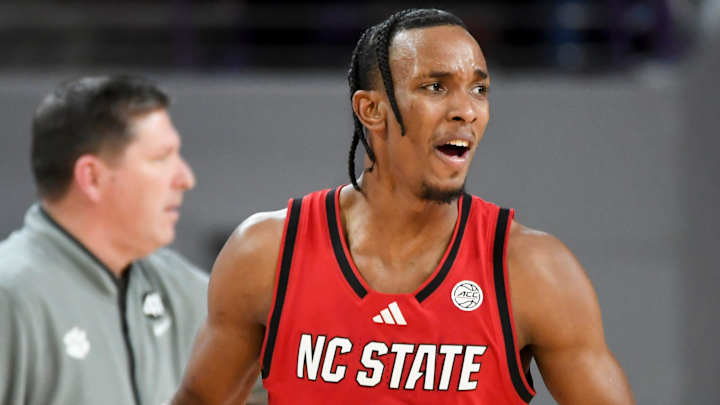
During his time with the NC State Wolfpack men’s basketball, McNeil built a reputation as one of the most dangerous perimeter threats in the country. Nearly 80 percent of his shot attempts came from beyond the arc, and yet he still managed to hit an incredible 42 percent of them.
That’s not volume shooting — that’s efficiency at its highest level.
What makes McNeil even more intriguing is his quick, almost unguardable release. Defenders can close out perfectly and still be too late. He can extend his range well beyond the NBA three-point line without sacrificing form, making him a constant threat the moment he crosses half court.
In a lineup featuring creators like Brown and Avdalas, McNeil’s role becomes crystal clear: space the floor, punish defenses, and force opponents to make impossible choices.
Do you help on the drive?
Or do you stay glued to a shooter who can end the game with one hot streak?
Malone has already made contact, and if Harris commits elsewhere, this pursuit could escalate quickly.
But McNeil isn’t the only option.
Enter Matt Able — a different kind of weapon.
While McNeil is a specialist, Able is a Swiss Army knife.
At 6-foot-6 with a stronger frame, Able brings versatility that McNeil simply doesn’t. He can defend multiple positions, rebound effectively, and contribute as a secondary playmaker. Offensively, he’s more comfortable attacking the rim, finishing through contact, and creating his own shot when needed.
He may not match McNeil’s elite shooting numbers, but what he lacks in pure shooting, he makes up for in balance.
And in many ways, he’s a closer approximation to what Juke Harris provides.
He’s not just a scorer.
He’s a connector.
A player who can do a little bit of everything, filling gaps and keeping the offense flowing.
For Malone, the choice between McNeil and Able isn’t necessarily about who is better — it’s about what the team needs most.
Shooting?
Or versatility?
But here’s where things get even more intriguing…
Why choose?
There is a real possibility that UNC could pursue both players.
On the surface, it might seem redundant. Two wings with overlapping skill sets. But in reality, it could be a strategic masterstroke. In modern basketball, you can never have too much shooting — especially when it comes packaged with size and defensive capability.
Imagine a lineup where McNeil stretches defenses to their breaking point while Able attacks the gaps that creates.
That’s not redundancy.
That’s pressure.
Constant, relentless pressure.
And then there’s the wildcard: Curtis Givens III.
Unlike the others, Givens is more of a traditional guard. At 6-foot-3, he doesn’t offer the same positional size Malone seems to be targeting, but he brings something else — off-the-dribble ability.
A former Memphis Tigers men’s basketball guard, Givens is comfortable operating in ball-screen situations, attacking closeouts, and getting to the rim. He’s not just a catch-and-shoot player — he can create his own offense.
That said, his game isn’t without flaws.
A high turnover rate raises questions about decision-making, especially if he’s asked to handle the ball extensively. And in a system that may already feature multiple primary creators, his role could become unclear.
Still, as a complementary piece, he has value.
He can space the floor, keep defenses honest, and provide another layer of offensive versatility.
But the real story here isn’t just about individual players.
It’s about strategy.
It’s about how Malone responds when Plan A doesn’t go as expected.
Because that’s what separates good programs from great ones.
Anyone can chase a top target.
But what happens when that target slips away?
Do you panic?
Or do you pivot?
Right now, all signs point to Malone choosing the latter.
And that could be the most important development of all.
Because if UNC successfully executes this backup plan — if they land Brown, add a combination of McNeil, Able, or Givens, and build around Avdalas — they may not just recover from missing out on Harris…
They might come out stronger.
More balanced.
More unpredictable.
More dangerous.
And that’s the twist no one is talking about.
Sometimes, Plan B isn’t a fallback.
Sometimes, it’s the plan that wins you everything.
So while the headlines may focus on what UNC might lose…
The real story could be what they’re about to build.




