


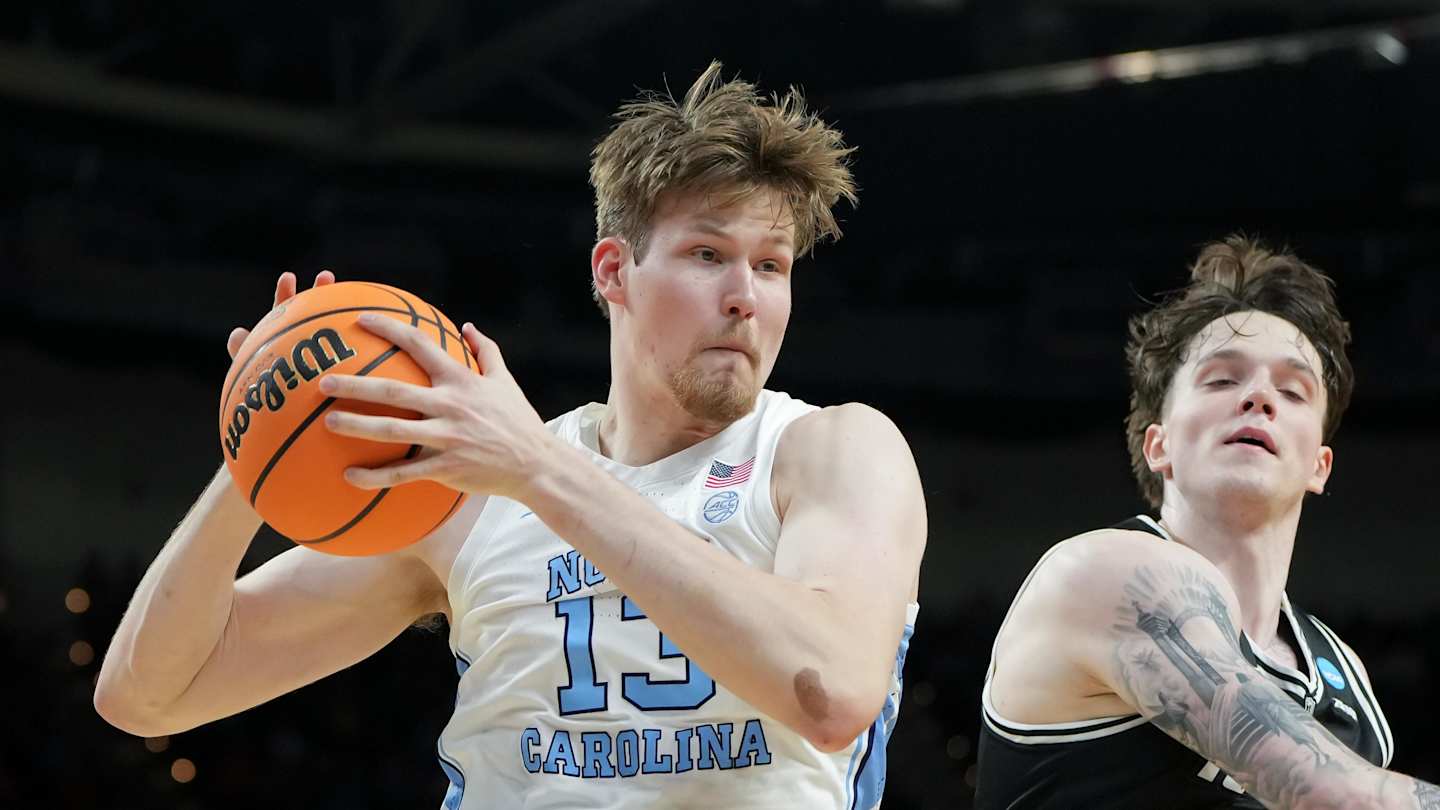
The waiting game continues in Chapel Hill as all eyes remain fixed on UNC standout Henri Veesaar and the decision that could shape the next chapter of his basketball career. With the offseason in full swing, Veesaar stands at a pivotal crossroads: return to North Carolina for another season or declare for the NBA Draft and begin his professional journey.
While the transfer portal always lingers as a wildcard in modern college basketball, it appears unlikely to factor into Veesaar’s plans. The real debate centers on two clear options—stay and elevate his draft stock or take the leap now and test his value at the next level.
A recent NBA Mock Draft from Yahoo Sports analyst Kevin O’Connor has added an intriguing twist to the conversation. In his latest projections, Veesaar is slated to be selected with the No. 36 overall pick by the Los Angeles Clippers. While still a respectable position, landing in the second round brings a very different outlook compared to the guarantees and security that come with being a first-round pick.
O’Connor praised Veesaar’s versatile skill set, describing him as an agile big man with a smooth shooting touch, strong connective playmaking, and the ability to impact the game without dominating the ball. His strengths extend to setting solid screens, finishing plays above the rim, and providing dependable help defense. Veesaar’s rim protection and awareness on that end of the floor make him a valuable modern big, capable of fitting into a variety of systems.
However, despite those strengths, his current projection suggests that NBA teams may want to see further development before committing a first-round investment. For Veesaar, that distinction matters. First-round picks benefit from guaranteed contracts and longer leashes, while second-rounders often have to fight for roster spots and consistent minutes.
If Veesaar were to land with the Clippers, as projected, there would still be a compelling developmental pathway. Learning behind a veteran like Brook Lopez—one of the league’s most respected stretch bigs and rim protectors—could be invaluable. Lopez’s ability to space the floor while anchoring a defense mirrors the type of role Veesaar could grow into at the next level.
But even with that opportunity, the alternative path may be even more appealing.
Returning to UNC for another season offers Veesaar the chance to refine his game, take on a larger leadership role, and significantly boost his draft stock. With another year of development, he could position himself as a first-round lock, dramatically improving both his financial outlook and long-term NBA stability.
There’s also the modern reality of college basketball to consider. Name, Image, and Likeness (NIL) opportunities have changed the equation for players like Veesaar. Staying in Chapel Hill wouldn’t mean sacrificing income—in fact, he could earn substantial compensation while continuing to develop in a system that already maximizes his strengths.
Additionally, the coaching factor cannot be overlooked. With Michael Malone now leading the program, UNC is clearly building toward something bigger. Malone’s presence brings NBA-level insight and player development experience, which could be instrumental in helping Veesaar round out his game. For a player on the fringe of the first round, that kind of mentorship could make all the difference.
From a team perspective, retaining Veesaar would be a massive win for North Carolina. His return would not only solidify the frontcourt but also send a strong message to other recruits and transfer portal targets. UNC has already added Virginia Tech transfer Neoklis Avdalas, and decisions from players like Juke Harris and Terrence Brown are still pending. Keeping Veesaar in the fold could be the cornerstone move that elevates the Tar Heels into serious contention next season.
Beyond roster construction, there’s also legacy to consider. Another standout season in Chapel Hill could cement Veesaar’s status as one of the program’s key contributors in recent years, while also giving him unfinished business to chase at the collegiate level.
Ultimately, the decision will come down to priorities. If Veesaar values entering the NBA as soon as possible and is comfortable navigating the uncertainty of a second-round path, declaring for the draft is a defensible choice. But if maximizing his long-term potential, financial security, and draft positioning is the goal, returning to UNC appears to be the smarter, more strategic move.
For now, fans, coaches, and analysts alike can only wait. One thing is certain, though—whatever decision Henri Veesaar makes will have ripple effects, not just for his future, but for the trajectory of North Carolina basketball heading into a highly anticVEESAAR’S NBA STOCK SLIPS—WHY RETURNING TO UNC COULD BE HIS SMARTEST POWER MOVE
The waiting game continues in Chapel Hill as all eyes remain fixed on UNC standout Henri Veesaar and the decision that could shape the next chapter of his basketball career. With the offseason in full swing, Veesaar stands at a pivotal crossroads: return to North Carolina for another season or declare for the NBA Draft and begin his professional journey.
While the transfer portal always lingers as a wildcard in modern college basketball, it appears unlikely to factor into Veesaar’s plans. The real debate centers on two clear options—stay and elevate his draft stock or take the leap now and test his value at the next level.
A recent NBA Mock Draft from Yahoo Sports analyst Kevin O’Connor has added an intriguing twist to the conversation. In his latest projections, Veesaar is slated to be selected with the No. 36 overall pick by the Los Angeles Clippers. While still a respectable position, landing in the second round brings a very different outlook compared to the guarantees and security that come with being a first-round pick.
O’Connor praised Veesaar’s versatile skill set, describing him as an agile big man with a smooth shooting touch, strong connective playmaking, and the ability to impact the game without dominating the ball. His strengths extend to setting solid screens, finishing plays above the rim, and providing dependable help defense. Veesaar’s rim protection and awareness on that end of the floor make him a valuable modern big, capable of fitting into a variety of systems.
However, despite those strengths, his current projection suggests that NBA teams may want to see further development before committing a first-round investment. For Veesaar, that distinction matters. First-round picks benefit from guaranteed contracts and longer leashes, while second-rounders often have to fight for roster spots and consistent minutes.
If Veesaar were to land with the Clippers, as projected, there would still be a compelling developmental pathway. Learning behind a veteran like Brook Lopez—one of the league’s most respected stretch bigs and rim protectors—could be invaluable. Lopez’s ability to space the floor while anchoring a defense mirrors the type of role Veesaar could grow into at the next level.
But even with that opportunity, the alternative path may be even more appealing.
Returning to UNC for another season offers Veesaar the chance to refine his game, take on a larger leadership role, and significantly boost his draft stock. With another year of development, he could position himself as a first-round lock, dramatically improving both his financial outlook and long-term NBA stability.
There’s also the modern reality of college basketball to consider. Name, Image, and Likeness (NIL) opportunities have changed the equation for players like Veesaar. Staying in Chapel Hill wouldn’t mean sacrificing income—in fact, he could earn substantial compensation while continuing to develop in a system that already maximizes his strengths.
Additionally, the coaching factor cannot be overlooked. With Michael Malone now leading the program, UNC is clearly building toward something bigger. Malone’s presence brings NBA-level insight and player development experience, which could be instrumental in helping Veesaar round out his game. For a player on the fringe of the first round, that kind of mentorship could make all the difference.
From a team perspective, retaining Veesaar would be a massive win for North Carolina. His return would not only solidify the frontcourt but also send a strong message to other recruits and transfer portal targets. UNC has already added Virginia Tech transfer Neoklis Avdalas, and decisions from players like Juke Harris and Terrence Brown are still pending. Keeping Veesaar in the fold could be the cornerstone move that elevates the Tar Heels into serious contention next season.
Beyond roster construction, there’s also legacy to consider. Another standout season in Chapel Hill could cement Veesaar’s status as one of the program’s key contributors in recent years, while also giving him unfinished business to chase at the collegiate level.
Ultimately, the decision will come down to priorities. If Veesaar values entering the NBA as soon as possible and is comfortable navigating the uncertainty of a second-round path, declaring for the draft is a defensible choice. But if maximizing his long-term potential, financial security, and draft positioning is the goal, returning to UNC appears to be the smarter, more strategic move.
For now, fans, coaches, and analysts alike can only wait. One thing is certain, though—whatever decision Henri Veesaar makes will have ripple effects, not just for his future, but for the trajectory of North Carolina basketball heading into a highly anticipated season.ipated season.




