


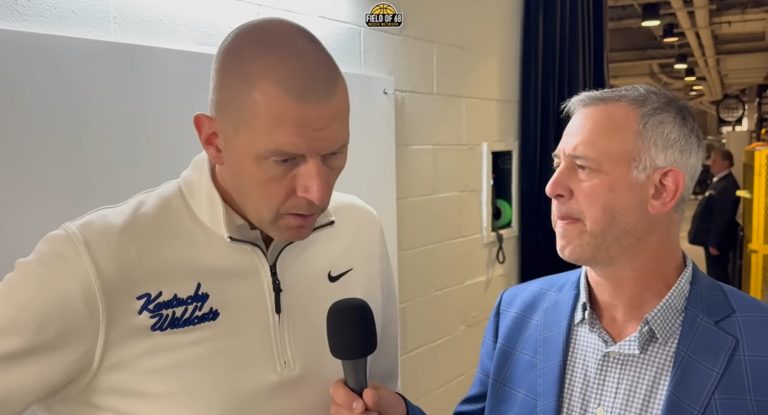
During a recent appearance on KSR, Derek Anderson offered a candid look into the ongoing conversations among members of Kentucky Wildcats men’s basketball’s 1996 national championship team. According to Anderson, the group chat featuring Mark Pope remains active—but not without restraint.
Anderson revealed that while discussions are frequent, teammates often type out messages only to delete them, concerned that their critiques of Pope’s coaching performance might come across as too “brutal.”
As someone who works closely with NBA players and top-100 high school recruits, Anderson did not shy away from addressing what he sees as structural issues contributing to Kentucky’s struggles in Pope’s third season.
Concerns Over Coaching Temperament
While Anderson expressed respect for Pope’s character and ability to connect with players, he questioned whether the head coach’s temperament aligns with the expectations and culture of Kentucky basketball.
“He can relate to the guys because he’s a great guy,” Anderson explained. “When you’re at BYU, you get to kind of run and play, and it’s a different style when you’re in the SEC and Kentucky thing. We were coming for your throat, and that’s a different mentality. Is he teaching that mentality? Because he’s never been that rah-rah guy anyway.”
Anderson contrasted their playing styles during their time as teammates:
“You saw when we played, I’m dancing when I dunk on you. He’s just like this, ‘Good play, DA. Go sit down.’ Like, that’s a great guy, but that’s not Kentucky. Like, I was taught to dominate players whenever I played, and that was a mentality.”
His comments suggest that Kentucky may be lacking the aggressive edge that once defined the program—an issue he believes originates from the tone set in practice.
Practice Philosophy Under Scrutiny
Anderson also pointed to differences in practice structure, particularly highlighting Pope’s approach to free-throw shooting drills. According to Anderson, Pope requires complete silence during these sessions—a method he strongly disagrees with.
“We wanted everybody loud,” Anderson said. “If I’m at the free throw line, I need to hear noise so I know it at the end of the game, when there’s crazy going on, I gotta concentrate… If you don’t teach that, and when it happens in a game, how am I prepared? I’m not.”
This critique underscores a broader concern: whether Kentucky’s training environment adequately prepares players for high-pressure game situations.
Questions Around Player Development and Basketball IQ
Perhaps Anderson’s most pointed criticism centered on what he perceives as a lack of fundamental teaching within the program. He expressed surprise at the team’s struggles with basic basketball concepts.
“We didn’t know how to play basketball. It was literally, we couldn’t throw a bounce pass,” Anderson said, referencing recent performances.
He further highlighted issues such as poor execution against zone defenses and a lack of accountability during practice sessions.
“It was not teaching,” Anderson stated firmly. “And I was always telling him, you’ve got to teach the IQ part and understanding of the game if you want players to be better. You can’t just let them go and say, well, they’ll figure it out.”
Anderson’s remarks reflect a broader concern about modern player development, where emphasis on advanced techniques may come at the expense of foundational skills.
Coaching Staff Under the Microscope
The criticism also extends beyond Pope to his supporting staff. While Kentucky has added Mo Williams this offseason, questions remain about whether the current coaching structure is equipped to address these issues.
With Mark Fox on an expiring contract and at least one vacancy still open, the program faces a pivotal opportunity to reshape its coaching dynamics.
If Pope is to maintain his player-friendly approach, Anderson’s comments suggest that surrounding himself with assistants who emphasize discipline, fundamentals, and accountability could be essential.
A Defining Moment for Kentucky Basketball
Anderson’s perspective highlights what could be a critical juncture for Kentucky. While there is widespread belief in Pope’s character and leadership, the concerns raised point to deeper structural questions about identity, preparation, and development within the program.
As expectations remain high in Lexington, how Pope responds to these critiques—both in philosophy and staffing—may ultimately determine his long-term future with the Wildcats.




