


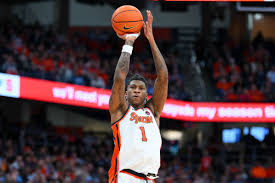
The recruitment of Donnie Freeman has taken a decisive turn, with the talented forward committing to St. John’s Red Storm over the Kentucky Wildcats—a move that sends ripples through the college basketball transfer market and leaves Kentucky searching for answers in its frontcourt.
Freeman, widely regarded as one of the top remaining options in the transfer portal, had drawn serious interest from multiple programs. Kentucky appeared to be in a strong position after hosting him for a visit in Lexington, a trip that reportedly led Freeman to cancel several other scheduled visits. For a moment, it looked like head coach Mark Pope and his staff had done enough to secure a commitment.
But in the end, Freeman chose a different path—one that leads to Rick Pitino and a resurging St. John’s program.
At the heart of Freeman’s decision was trust in development. According to reports from Jeff Goodman and The Field of 68, the offers on the table from both schools were comparable in terms of opportunity, exposure, and potential role. What separated St. John’s was Freeman’s belief in Pitino’s ability to elevate his game and prepare him for the next level.
That belief is not unfounded. Pitino’s résumé speaks for itself, with decades of experience developing elite talent and guiding players to professional success. For a player like Freeman—who is already productive but still refining his overall game—the appeal of playing under a Hall of Fame-caliber coach proved decisive.
During his time with the Syracuse Orange, Freeman showcased why he was such a coveted transfer. The 6-foot-9 forward started 21 games last season, averaging 16.5 points and 7.2 rebounds per contest. He demonstrated versatility on the offensive end, with the ability to score inside while also stretching the floor, knocking down 30.2% of his shots from beyond the arc.
That blend of size, skill, and perimeter shooting made him an ideal modern forward—exactly the type of player Kentucky was hoping to plug into its system. His departure from the Wildcats’ target list is, without question, a significant setback.
For Kentucky, the miss highlights a broader challenge facing the program as it transitions under Pope. While the Wildcats still boast a strong core, the need for a dynamic forward has become more urgent. Freeman could have filled that role seamlessly, offering both scoring and rebounding while fitting into the team’s evolving identity.
Now, the focus shifts elsewhere.
One name that immediately rises to the top of Kentucky’s wishlist is Tyran Stokes, the highly touted Class of 2026 prospect. At 6-foot-7, Stokes is considered a potential generational talent, capable of impacting the game in multiple ways from the small forward position. His combination of athleticism, scoring ability, and defensive upside makes him a natural target for a program looking to reestablish itself among the elite.
However, landing a player of Stokes’ caliber is far from guaranteed. Kentucky will face stiff competition from other powerhouse programs, and the recruitment process is still in its early stages. Even if the Wildcats do secure his commitment, relying on a high school prospect to immediately fill a major role comes with inherent risks.
In the meantime, Kentucky will lean on its current roster. Players like Malachi Moreno, Kam Williams, Zoom Diallo, and Alex Wilkins are expected to form the backbone of the team moving forward. The backcourt combination of Diallo and Wilkins, in particular, should provide solid ball-handling and scoring punch.
Still, the absence of a proven, go-to forward remains a glaring gap.
Freeman had the profile to be that player—a versatile scorer who could create mismatches and anchor the frontcourt. His decision to join St. John’s not only strengthens Pitino’s roster but also underscores the growing competitiveness of the transfer portal era, where coaching relationships and development pathways can outweigh traditional power dynamics.
For St. John’s, this is more than just a recruiting win—it’s a statement. Landing a player like Freeman signals that the program is serious about returning to national prominence under Pitino’s leadership. It also reinforces the idea that top-tier talent is increasingly willing to look beyond traditional blue-blood programs in search of the right fit.
As for Kentucky, the road forward is clear but challenging. The Wildcats must regroup, reassess their options, and continue building a roster capable of competing at the highest level. Missing out on Freeman hurts, but it also sharpens the focus on what comes next.
In today’s college basketball landscape, momentum can shift quickly. For now, that momentum belongs to St. John’s—and to Donnie Freeman, whose decision could prove to be a defining moment in the trajectory of both programs.




