


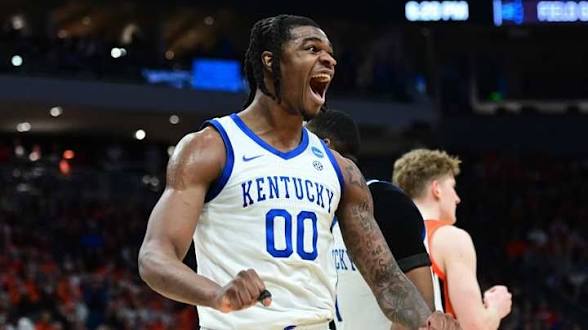
The college basketball world is no stranger to chaos, but what is currently unfolding behind the scenes could redefine the sport in ways few imagined just months ago. At the center of it all is a proposed eligibility shift by the NCAA that has the potential to shake rosters, alter championship races, and revive careers that many believed had already reached their conclusion. And for the Kentucky Wildcats, this looming decision could mean something even bigger — the possible return of their most impactful player in recent years, Otega Oweh.
According to multiple reports circulating within college basketball circles, the NCAA is preparing to push forward with a vote on what is being called the “five-in-five” eligibility rule. The concept is simple on the surface but monumental in impact: every college athlete would be granted five full years of eligibility within a five-year window starting from either their high school graduation or their 19th birthday. While that may sound like a technical adjustment, the ripple effects would be massive.
For decades, eligibility rules have shaped the structure of college athletics. Athletes traditionally had four years of competition within a five-year clock, with redshirts and special waivers offering occasional flexibility. However, recent disruptions — from the COVID-19 pandemic to transfer portal changes — have already loosened those boundaries. Now, the NCAA appears ready to take an even bigger leap, potentially granting a new wave of opportunities to athletes who had already exhausted their eligibility under previous rules.
That is where Otega Oweh enters the picture.
Oweh, who has been nothing short of sensational for Kentucky over the past two seasons, just completed what was widely believed to be his final year in college basketball. A dynamic scorer, relentless defender, and proven leader, he emerged as the heartbeat of the Wildcats during a period of transition and rebuilding. His presence on the court was not just felt — it was often the difference between victory and defeat.
Last season, Oweh delivered a statistical campaign that firmly placed him among the elite players in the nation. Averaging 18.6 points per game, he consistently served as Kentucky’s primary offensive weapon. But his contributions extended far beyond scoring. He added 4.6 rebounds, 2.7 assists, and 1.8 steals per contest, showcasing his versatility and all-around impact. Whether it was creating his own shot, facilitating for teammates, or locking down opposing guards, Oweh did it all.
And then there was the moment that defined his season — and perhaps his legacy.
In the opening round of the NCAA Tournament, with Kentucky on the brink of elimination against Santa Clara, Oweh delivered one of the most unforgettable plays in recent memory. With time expiring and the Wildcats desperate for a miracle, he launched a shot from near half court. As the buzzer sounded, the ball found the net, sending Kentucky forward and igniting a wave of emotion that swept across the college basketball landscape. It was the kind of moment that turns great players into legends.
At the time, it felt like a fitting climax to his college career. But now, that story may not be finished.
If the NCAA’s proposed rule passes — and crucially, if it applies retroactively to players who just exhausted their eligibility — Oweh could be granted one more season in Lexington. The implications of that possibility are enormous.
For Kentucky head coach Mark Pope, the return of Oweh would represent a game-changing development. Building a roster in today’s college basketball environment is an increasingly complex task, with coaches balancing recruiting, transfers, NIL considerations, and now potential eligibility shifts. Having a proven star like Oweh already in the system would provide stability, leadership, and a clear focal point around which the team could be constructed.
It would also instantly elevate Kentucky’s status on the national stage. With Oweh back in the lineup, the Wildcats would not just be competitive — they could be legitimate championship contenders. His ability to take over games, particularly in high-pressure situations, is something that cannot be easily replaced. In a sport where experience often proves decisive in March, adding a seasoned veteran with deep tournament experience could be the difference between an early exit and a Final Four run.
Beyond the X’s and O’s, Oweh’s potential return would have a profound impact on the locker room. Leadership in college basketball is invaluable, and few players embody it more than Oweh. Teammates look to him not just for production, but for composure, work ethic, and belief. In moments of adversity, he has consistently been the player who steadies the ship.
However, as exciting as this scenario may be for Kentucky fans, there are still significant hurdles to clear.
First and foremost, the rule itself must be approved. While there is growing momentum behind the proposal, NCAA legislation is rarely straightforward. Stakeholders across the college athletics landscape — from administrators to coaches to compliance officials — will weigh in on the potential consequences. Expanding eligibility could create complications in areas such as scholarship limits, roster management, and competitive balance.
Then there is the question of retroactivity. It is one thing to implement a new rule moving forward; it is another to apply it to athletes who have already completed their eligibility. Doing so would open the door for a wide range of players across multiple sports to return, potentially creating a ripple effect that reshapes entire rosters nationwide.
Even if both of those hurdles are cleared, one final factor remains: Oweh himself.
Would he want to return?
After four years of college basketball and a standout final season, Oweh could very well have professional aspirations. Whether that means pursuing opportunities in the NBA or exploring options overseas, the next step in his career is an important decision. Returning to Kentucky for another season would offer the chance to further cement his legacy, improve his draft stock, and chase a national championship. But it would also delay his entry into the professional ranks.
It is a deeply personal choice, one that would involve careful consideration of both immediate and long-term goals.
Meanwhile, coaches across the country are already preparing for the possibility that the rule could pass. Reports suggest that programs are strategically managing their resources, including NIL budgets, in anticipation of needing to retain or re-recruit players who might suddenly become eligible again. It is a level of uncertainty that adds yet another layer of complexity to an already unpredictable offseason.
For Kentucky, that preparation could pay off in a major way. The Wildcats have remained active and flexible, positioning themselves to adapt to whatever changes come their way. If the opportunity to bring Oweh back becomes a reality, they appear ready to seize it.
Zooming out, the broader implications of the five-in-five rule cannot be overstated. It represents a fundamental shift in how college athletics operates, one that prioritizes flexibility and opportunity for student-athletes. In many ways, it is a response to the evolving landscape of college sports, where player movement and empowerment have become central themes.
Critics, however, will argue that such changes risk further blurring the line between college and professional athletics. Extending eligibility could lead to older, more experienced teams dominating the competition, potentially altering the traditional balance of power. It could also complicate the development pipeline, affecting everything from high school recruiting to professional scouting.
Supporters counter that the rule simply provides athletes with more control over their careers. Injuries, transfers, and unforeseen circumstances can disrupt even the most carefully planned journeys. Offering an additional year of eligibility could serve as a safety net, ensuring that players have a full and fair opportunity to compete.
As the debate continues, one thing is certain: all eyes will be on the NCAA in the coming weeks.
For Kentucky fans, the anticipation is particularly intense. The possibility of seeing Otega Oweh don the Wildcats uniform once more is both thrilling and surreal. It is the kind of storyline that captures the imagination — a star player, thought to be gone, potentially returning for one final act.
If it happens, it would not just be a boost for Kentucky. It would be a defining moment for college basketball as a whole.
Because in a sport built on passion, tradition, and unforgettable moments, the idea of giving players one more chance — one more season, one more run, one more shot at greatness — is something that resonates deeply.
And if that chance belongs to Otega Oweh, the rest of the college basketball world may not be ready for what comes next.




