


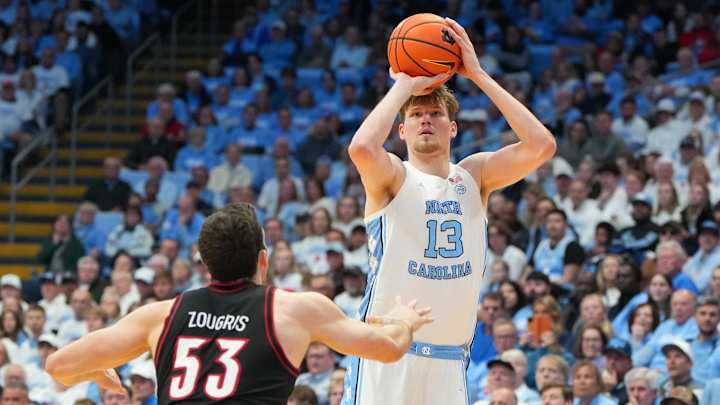
A DEPARTURE THAT CHANGES EVERYTHING: As Henri Veesaar Makes a Bold, Final Call on His Future, the North Carolina Tar Heels men’s basketball Are Suddenly Thrown Into Uncertainty—And What Comes Next Could Reshape the Entire Offseason in Chapel Hill
CHAPEL HILL, NC — April 24, 2026
What had long felt like a looming possibility has now become reality—and its impact is already sending shockwaves through Chapel Hill.
After weeks of speculation, deliberation, and rising anticipation ahead of the NBA Draft declaration deadline, Henri Veesaar has officially made his decision: he is leaving college basketball behind and fully committing to the 2026 NBA Draft, closing the door on a potential return to the North Carolina Tar Heels men’s basketball.
For a program in transition under new leadership, the timing could not be more significant—or more complicated.
A Breakout Star Walks Away at His Peak
Veesaar’s departure isn’t just another offseason move—it’s the loss of a centerpiece.
Coming off a breakout junior campaign, the versatile big man evolved into one of the most dynamic frontcourt players in college basketball. Averaging 17.0 points and 8.7 rebounds per game while shooting an impressive 42% from three-point range, Veesaar redefined what it meant to be a modern stretch big.
He wasn’t just productive—he was essential.
During stretches when the Tar Heels battled injuries and inconsistency, Veesaar became the stabilizing force. His ability to stretch the floor, protect the rim, and create mismatches made him the focal point of both the offense and the team’s identity.
Now, that identity must be rebuilt.
Why Now? The Decision Behind the Move
From a basketball perspective, the decision makes sense—even if it stings for fans.
Draft projections have consistently placed Veesaar in the conversation as a potential first-round pick. With his stock rising and his skillset translating seamlessly to the modern NBA game, returning for another college season carried as much risk as reward.
By declaring now, Veesaar capitalizes on momentum.
There’s also the financial and developmental angle. While NIL opportunities at North Carolina could have provided a lucrative return, the long-term upside of entering the NBA—combined with professional development resources—ultimately tipped the scale.
In short, the window was open—and Veesaar chose to step through it.
A Crushing Blow for a Program in Transition
For head coach Michael Malone, the loss creates an immediate and pressing challenge.
Already navigating a turbulent offseason filled with transfer portal movement, recruiting battles, and unexpected coaching staff changes, Malone now faces the reality of replacing his most reliable and productive frontcourt player.
And replacing Veesaar won’t be simple.
There are very few players in college basketball who can replicate his unique combination of size, shooting, and versatility. His departure leaves not just a statistical gap, but a structural one—impacting spacing, rotations, and overall team strategy.
The Ripple Effect: What This Means for UNC’s Offseason
The consequences of this decision extend far beyond one roster spot.
1. Urgency in the Transfer Portal
Expect North Carolina to aggressively pursue frontcourt talent. The Tar Heels were already active—but now, the need becomes immediate. Every available big man with size, shooting ability, or defensive presence will be evaluated.
2. Recruiting Priorities Shift
With Veesaar gone, recruiting strategy may pivot toward securing multiple contributors rather than a single replacement. Depth becomes just as important as star power.
3. Increased Pressure on Returning Players
If any frontcourt pieces remain, their roles are about to expand dramatically. Development timelines may need to accelerate.
4. System Adjustments
Malone may need to rethink elements of his offensive and defensive schemes. Without a stretch big like Veesaar, spacing and play design could look very different next season.
A Defining Moment for the Malone Era
Every program faces turning points. For North Carolina Tar Heels men’s basketball, this is one of them.
The loss of Veesaar isn’t just about production—it’s about direction.
How quickly and effectively Malone responds will shape not only the upcoming season but also the perception of his tenure moving forward. Can he pivot? Can he rebuild on the fly? Can he turn adversity into opportunity?
Those questions now take center stage.
What Comes Next?
While Veesaar begins preparing for the next chapter of his career, the focus in Chapel Hill shifts to reconstruction.
The offseason is far from over—but it has undeniably changed.
What once looked like a team building around a rising star is now a program searching for answers, recalibrating its plans, and racing against time to fill a massive void.
And as the dust settles, one thing is clear:
This wasn’t just a departure.
It was a turning point.




