


Something that should have been a dream moment for a young star quickly turned into something far darker—and now, what’s being revealed is leaving fans across college basketball stunned.
When a five-star recruit announces his college decision, it’s usually a moment of celebration. Cameras flash, social media erupts, and fanbases either rejoice or regroup. But for Caleb Wilson, one of the most highly coveted prospects in the country, what followed his commitment to North Carolina took a disturbing turn—one that has reignited conversations about fan behavior, boundaries, and the growing intensity of recruiting culture in college sports.
Wilson, a standout from Holy Innocents Episcopal School, had drawn heavy interest from multiple powerhouse programs. Among them was Kentucky, a school with one of the most passionate and demanding fanbases in all of college basketball. For weeks, speculation swirled about where he would land. Would he choose the tradition-rich dominance of Kentucky? Or would he align himself with another blue blood program?
In the end, Wilson made his choice clear: North Carolina.
For Tar Heels fans, it was a massive win—another elite recruit choosing Chapel Hill, reinforcing the program’s reputation as a recruiting powerhouse under head coach Hubert Davis. For Kentucky fans, however, the decision hit differently.
And for some, it went too far.
A Commitment That Sparked More Than Celebration
At its core, Wilson’s decision wasn’t controversial. Top recruits choose between elite programs every year. Someone wins, someone loses—it’s part of the game. But in today’s hyper-connected world, the reaction doesn’t stop at message boards or sports talk shows.
It goes directly to the player.
Shortly after Wilson announced his commitment, troubling messages began to surface—messages that were not just critical, but deeply inappropriate and, in some cases, outright threatening. While criticism from disappointed fans is nothing new, the tone and content of these messages crossed a line.
And that’s when Wilson’s mother stepped in.
A Mother Speaks Out
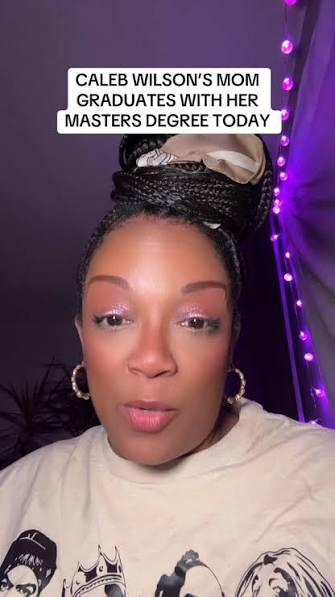
In a move that quickly gained attention, Wilson’s mom publicly addressed the situation, calling out the behavior and exposing the kind of messages her son had been receiving.
Her message wasn’t just about defending her child—it was about drawing a boundary.
Because behind the rankings, the highlights, and the recruiting hype is a teenager. A young athlete making one of the biggest decisions of his life, navigating pressure that most people never experience at that age.
The response from the broader basketball community was immediate.
Many fans, analysts, and even rival supporters rallied behind Wilson, condemning the behavior and emphasizing a simple but often ignored principle: recruits are not professionals. They are not public property. And they should not be treated as targets.
The Passion—and the Problem
To understand how situations like this happen, you have to understand the culture surrounding programs like Kentucky.
Big Blue Nation, as it’s often called, is widely regarded as one of the most passionate fanbases in sports. Their commitment to the program is unmatched. They live and breathe Kentucky basketball, celebrating every win and analyzing every move.
That passion is part of what makes college basketball special.
But passion, when unchecked, can turn into something else.
In recruiting battles, emotions run high. Fans invest time, energy, and hope into landing top prospects. When those prospects choose another school, the disappointment can feel personal—even though it isn’t.
That’s where the line begins to blur.
For most fans, that disappointment stays within reasonable bounds—discussion, debate, maybe a few heated takes online. But for a small minority, it escalates into something harmful.
And unfortunately, those are often the voices that get the most attention.
Why This Moment Matters
What happened to Wilson isn’t just an isolated incident—it’s part of a larger pattern that has become more visible in recent years.
Social media has fundamentally changed the relationship between fans and athletes. There is no longer a buffer. No separation. A frustrated fan can send a message directly to a player within seconds.
That accessibility comes with responsibility.
And when that responsibility is ignored, situations like this emerge.
The exposure of these messages serves as a wake-up call—not just for one fanbase, but for the entire college basketball community.
Because this isn’t about Kentucky versus North Carolina.
It’s about how recruits are treated.
Wilson’s Decision: More Than Just Basketball
Lost in the controversy is the reason Wilson chose North Carolina in the first place.
By all accounts, his decision was thoughtful and grounded. He cited the program’s culture, its history, and his connection with head coach Hubert Davis as key factors.
“I picked North Carolina because of their culture and the history of the program,” Wilson said. “They were my first blue blood offer.”
That matters.
For recruits, the decision isn’t just about winning games. It’s about fit. Development. Trust.
Wilson also emphasized his relationship with Davis, highlighting the coach’s honesty, energy, and commitment to player growth.
“He is a truth-teller,” Wilson noted. “That’s what I want.”
Those are not the words of someone making a casual choice. That’s a young athlete making a calculated decision about his future.
And that decision deserves respect—even from those who hoped for a different outcome.
The Role of Coaches and Programs
Moments like this also put a spotlight on the role of coaches and programs in shaping the environment around their teams.
While they can’t control every fan, they can set expectations.
They can reinforce the message that recruits should be supported, not targeted. That competition should remain respectful. That the focus should be on building, not tearing down.
Programs like Kentucky and North Carolina carry immense influence. Their voices matter.
And in situations like this, that influence can help shift the conversation in a more positive direction.
A Lesson for the Future
If there’s one takeaway from this situation, it’s this: boundaries matter.
Fans are an essential part of college sports. Their energy, loyalty, and passion drive the atmosphere that makes the game so special.
But that passion must be balanced with perspective.
Recruits are not opponents. They are not enemies. They are young individuals making personal decisions.
And those decisions should not come with harassment.
The phrase “don’t tweet at recruits” has been repeated countless times—and for good reason. Even positive messages can feel intrusive. Negative ones can be damaging.
Respecting that boundary is one of the simplest ways fans can contribute to a healthier sports culture.
Moving Forward
For Caleb Wilson, the focus now shifts back to basketball.
Despite the noise, his future remains bright. He joins a North Carolina program that believes in his talent and his potential. A program that sees him as part of its next chapter.
And for all the negativity that surfaced, there has also been overwhelming support.
Fans from across the country have rallied behind him, reminding him—and others—that the loudest voices are not always the majority.
In many ways, this moment could strengthen his resolve.
Adversity, even in unexpected forms, often shapes athletes in powerful ways. It builds resilience. Focus. Determination.
And if Wilson channels this experience the right way, it could become part of what drives him forward.
Final Thoughts
What started as a celebration turned into controversy—but it also sparked an important conversation.
About respect.
About boundaries.
About what it means to be a fan.
Caleb Wilson made a decision that was right for him. That should have been the end of the story.
Instead, it became something bigger.
But maybe that’s not entirely a bad thing.
Because moments like this force reflection.
They challenge assumptions.
They push the conversation forward.
And if that leads to even a small shift in how recruits are treated, then something positive can emerge from something negative.
At the end of the day, college basketball is about more than wins and losses.
It’s about people.
And how we treat them matters.




