


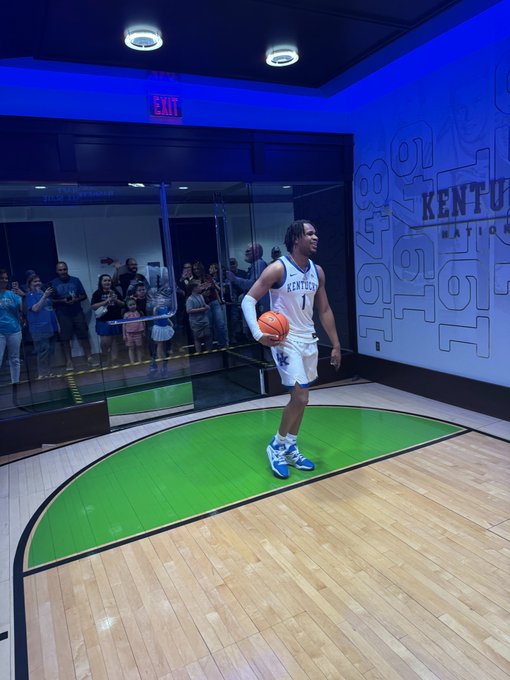
There’s a growing sense of intrigue surrounding Kentucky basketball right now — and for once, it’s not just about who the Wildcats didn’t land.
It’s about what they already have.
With the addition of Washington State transfer Jerone Morton, Mark Pope has effectively finalized what appears to be Kentucky’s primary backcourt rotation heading into the upcoming season. Alongside Morton are Washington transfer Zoom Diallo and Furman standout Alex Wilkins — three experienced, productive guards who bring playmaking, scoring instincts, and a level of maturity that Kentucky desperately needed.
On the surface, it looks like a win.
Actually, more than a win — it looks like stability.
But beneath that optimism lies a subtle, potentially game-defining concern that could shape the entire trajectory of Kentucky’s season.
Because when you dig into the numbers… something doesn’t quite add up.
A Backcourt Built on Experience — and Expectations
Let’s start with what’s undeniable.
Kentucky needed guards. Not just bodies, but players who could handle the ball, create offense, and steady the team in high-pressure situations. In today’s college basketball landscape, experienced backcourt play isn’t just helpful — it’s essential.
And in Morton, Diallo, and Wilkins, Mark Pope has assembled a trio that checks many of those boxes.
Jerone Morton arrives with familiarity and motivation, returning to his home state with something to prove.
Zoom Diallo brings explosiveness, confidence, and the ability to create his own shot.
Alex Wilkins offers scoring versatility and a proven track record at the collegiate level.
Individually, each player has shown the ability to produce.
Collectively, they could form one of the more intriguing guard units in the SEC.
But here’s where things get complicated.
Because while they all can score… how they score may be the real issue.
The Hidden Pattern That Raises Eyebrows
At first glance, their scoring profiles seem fine. Points are points, right?
Not exactly.
Modern basketball — especially at the highest levels — isn’t just about scoring. It’s about efficiency. It’s about maximizing possessions. It’s about taking the right shots, not just making tough ones.
And when analysts began breaking down the shot profiles of Kentucky’s new backcourt trio, a clear — and concerning — trend emerged.
Together, Morton, Diallo, and Wilkins have logged:
196 catch-and-shoot jumpers
335 dribble jumpers
That’s not just a slight imbalance.
That’s a massive tilt toward one of the least efficient shot types in basketball: the pull-up midrange jumper.
Why the Midrange Shot Is So Controversial
To understand why this matters, you have to understand how the game has evolved.
Analytics have reshaped basketball strategy over the past decade. The numbers are clear:
Shots at the rim are highly efficient
Three-pointers offer greater value per attempt
Midrange jumpers, especially off the dribble, are the least efficient option
It’s not that midrange shots are bad.
It’s that they’re hard.
They’re often contested. They require precision. And they don’t offer the scoring upside of a three-pointer or the high-percentage nature of a layup.
That’s why most modern offenses are built around a simple philosophy:
Attack the rim or shoot from deep. Avoid the in-between.
And that’s exactly the philosophy Mark Pope has preached throughout his coaching career.
The Mark Pope Paradox
Here’s where things get fascinating.
Mark Pope isn’t just aware of analytics — he embraces them.
During his time at BYU, Pope made it clear that he wanted his teams to prioritize three-point shooting. In fact, he openly pushed for his offense to attempt 30+ threes per game, emphasizing spacing, ball movement, and efficient shot selection.
His system is built on:
Driving to collapse the defense
Kicking out to open shooters
Generating high-value looks
So when you look at Kentucky’s new backcourt and see a heavy reliance on dribble pull-ups?
It creates a paradox.
Because the players he now has… don’t naturally play that way.
Can Great Shot-Makers Break the Rules?
Of course, there’s always an exception.
Basketball history is filled with elite players who thrived in the midrange — players who could consistently hit tough shots and make inefficient looks feel automatic.
The question is:
Are Morton, Diallo, and Wilkins that good?
Because if they are — if they can turn those dribble jumpers into high-percentage weapons — then this “problem” might actually become a strength.
Imagine a scenario where SEC defenses, trained to protect the rim and run shooters off the line, start conceding midrange space… only to get punished for it.
That’s the upside.
That’s the gamble.
The Risk: When Style Becomes a Limitation
But the downside is just as real.
If those midrange shots don’t fall at an elite rate, Kentucky’s offense could become:
Predictable
Inefficient
Easier to defend
SEC defenses are smart. They scout tendencies. They exploit weaknesses.
If they recognize that Kentucky’s guards prefer pulling up over attacking the rim or kicking out for threes, they’ll adjust accordingly — sagging into gaps, contesting late, and daring the Wildcats to beat them with lower-value shots.
And over the course of a long season?
That math usually wins.
Rewiring Habits: Easier Said Than Done
So what’s the solution?
In theory, it’s simple:
Q11 Change the shot selection.
Encourage more catch-and-shoot threes.
Promote ball movement.
Create more rim pressure.
But in practice?
It’s incredibly difficult.
Shot selection isn’t just a strategy — it’s a habit. It’s muscle memory. It’s instinct.
Players who have built their games around pull-up jumpers don’t just flip a switch overnight.
It takes time. Repetition. Buy-in.
And most importantly…
It takes trust in the system.
A Lesson from Last Season
If there’s one thing Kentucky fans learned last year, it’s that buy-in matters.
Talent alone isn’t enough.
You need cohesion. Discipline. A shared understanding of how the team wants to play.
If this new backcourt fully embraces Mark Pope’s vision — if they commit to evolving their shot profiles and playing within the system — the results could be impressive.
But if they revert to old habits under pressure?
That’s where things could unravel.
The High-Stakes Balancing Act
This is what makes Kentucky’s upcoming season so compelling.
It’s not just about wins and losses.
It’s about identity.
Will this be a team that sticks to analytics-driven principles?
Or one that leans on individual shot-making, even if it goes against the numbers?
Can Mark Pope adapt his system to fit his players?
Or will he demand that his players adapt to fit his system?
The answer likely lies somewhere in between.
Why This Could Still Work Brilliantly
For all the concern, it’s important to remember:
This isn’t a doomed roster.
Far from it.
There’s real talent here. Real experience. Real upside.
If everything clicks — if the guards find the right balance between aggression and efficiency, if the system evolves, if the chemistry develops — Kentucky could surprise a lot of people.
In fact, this very “problem” could become what makes them unique.
While other teams zig, Kentucky might zag.
And sometimes, that’s enough to win.
But the Margin for Error Is Thin
Still, there’s no escaping the reality:
The margin for error is small.
In a loaded SEC, where every possession matters and every weakness gets exposed, Kentucky can’t afford prolonged inefficiency.
They don’t need to be perfect.
But they need to be intentional.
Final Thoughts: A Season Defined by Decisions
As the offseason progresses and the season draws closer, one thing is clear:
Kentucky’s fate won’t just be determined by talent.
It will be determined by choices.
The shots they take
The system they trust
The adjustments they make
Because in modern basketball, how you play matters just as much as who you have.
And for Mark Pope and his newly formed backcourt trio…
That reality could change everything.




