


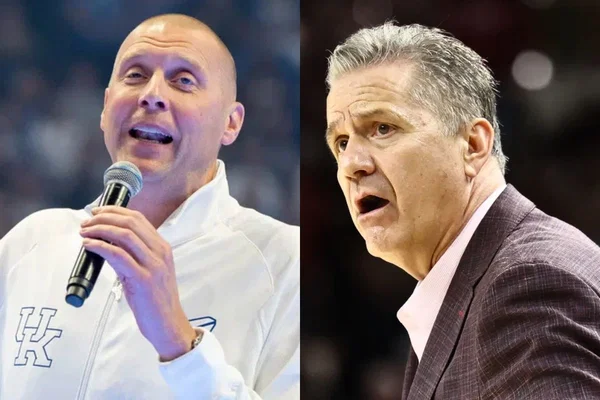
The college basketball world moves fast—sometimes brutally fast. What feels like a brilliant decision one season can look questionable the next, and nowhere is that reality more evident right now than in Lexington, Kentucky. Just a year ago, the narrative surrounding Kentucky basketball was filled with optimism, renewal, and belief that a fresh start under Mark Pope would usher in a new golden era. Meanwhile, John Calipari’s departure to Arkansas was viewed by many as the closing chapter of a once-dominant reign.
But today? The conversation has shifted—and not just slightly. The contrast between Kentucky’s current uncertainty and Arkansas’s rising momentum has become one of the most fascinating—and debated—storylines in college basketball.
This isn’t about declaring winners and losers too early. It’s about examining how quickly perception can change, how expectations shape narratives, and how two programs that were once intertwined are now heading in very different directions.
A Move That Changed Everything
When John Calipari stepped away from Kentucky, it marked the end of an era defined by elite recruiting classes, deep NCAA Tournament runs, and a standard of excellence that few programs in the country could match. Despite recent frustrations from fans—particularly surrounding postseason shortcomings—Calipari’s tenure in Lexington was undeniably successful.
Enter Mark Pope.
A former Kentucky player with deep ties to the program, Pope represented something different. He wasn’t just a coaching hire; he was a cultural reset. His return to Lexington carried emotional weight, symbolic meaning, and a promise of reconnecting Kentucky basketball with its roots.
At the time, the move felt right.
Pope brought energy. He brought enthusiasm. He brought a style that fans believed could modernize the program while still honoring its tradition. And early on, the results suggested Kentucky might have pulled off something special.
Early Returns: A Promising Start
The 2025 season gave Kentucky fans reasons to believe. The Wildcats earned a No. 3 seed in the NCAA Tournament—a strong showing that suggested stability and competitiveness under new leadership. Compared to Arkansas, which entered as a No. 10 seed, the optics seemed to favor Kentucky.
For a moment, it looked like the Wildcats had made the better move.
There was a sense that Pope had steadied the ship. That he had taken a program dealing with internal pressure and external criticism and given it direction again. That Kentucky, despite the coaching change, remained a national force.
But college basketball doesn’t operate in snapshots. It’s a continuous story, and what happens next often matters more than what came before.
The Tournament Reality Check
While Kentucky entered the NCAA Tournament with optimism, the postseason didn’t unfold the way fans had hoped. A second-round exit—particularly one marked by a lopsided loss—shifted the tone quickly.
In Lexington, expectations aren’t just about making the tournament. They’re about advancing. Competing. Contending.
Anything less raises questions.
At the same time, Arkansas, under Calipari, began to build something of its own. What initially seemed like a rebuilding phase started to show signs of cohesion and momentum. A deeper tournament run, followed by a strong offseason, began to reshape how people viewed the coaching switch.
Suddenly, the comparison wasn’t hypothetical anymore. It was real.
Offseason Decisions Under the Microscope
If the NCAA Tournament planted seeds of doubt, the offseason has only amplified the conversation around Kentucky’s direction.
Recruiting—always the lifeblood of elite college programs—has become a central focus. Kentucky fans are used to competing for the nation’s top prospects, and any perceived misstep in that arena is magnified.
One particular storyline that gained traction involved elite recruit Tyran Stokes. Kentucky was heavily involved in his recruitment, and for a time, there was genuine belief that the Wildcats had a strong chance of landing him.
But as events unfolded, questions began to surface.
Social media activity, timing of announcements, and the broader handling of the recruitment created a wave of discussion among fans and analysts alike. While none of these moments define a program on their own, collectively they contributed to a sense of unease.
It wasn’t just about missing on a recruit—it was about how the process played out.
The Pressure of the Kentucky Standard
To understand why these moments matter so much, you have to understand Kentucky.
This is not just another college basketball program. It’s a blueblood. A powerhouse. A place where banners, not just wins, define success.
Coaches at Kentucky don’t get the luxury of gradual rebuilds. They are expected to compete immediately. To recruit at the highest level. To win—consistently and convincingly.
Mark Pope knew this when he accepted the job.
And while it’s still early in his tenure, the pressure is already building—not necessarily because of catastrophic failure, but because of the gap between expectation and reality.
Meanwhile, in Arkansas…
While Kentucky navigates its growing list of questions, Arkansas is quietly constructing a compelling narrative of its own.
John Calipari, a coach who many believed might be nearing the twilight of his dominance, appears reinvigorated. Freed from the intense spotlight of Lexington, he’s operating with a renewed sense of purpose.
His recruiting efforts have been particularly noteworthy. Bringing in top-tier talent and assembling a roster that analysts are beginning to view as highly competitive, Calipari is reminding the college basketball world of what he does best.
Developing talent. Building rosters. Competing at the highest level.
There’s a certain irony in it all.
The coach Kentucky moved on from is now creating buzz elsewhere, while the program that sought a fresh start is still searching for consistency.
Perception vs. Reality
It’s important to pause here and separate perception from reality.
Mark Pope is not a failed coach. Not even close.
He’s still early in his tenure, still implementing his system, still building relationships with recruits, and still navigating the complexities of leading one of the most scrutinized programs in the country.
At the same time, John Calipari’s success at Arkansas doesn’t erase the challenges he faced at Kentucky.
Both things can be true.
But in the world of sports, perception often drives the conversation. And right now, the perception is that Arkansas is trending upward while Kentucky is searching for answers.
The Role of Patience
One of the most overlooked elements in coaching transitions is time.
Programs don’t always transform overnight. Systems take time to implement. Culture takes time to establish. Recruiting pipelines take time to develop.
The question for Kentucky isn’t just whether Mark Pope can succeed—it’s whether the program and its fanbase are willing to give him the time required to do so.
History suggests that patience is not always abundant in Lexington.
But if Pope is to succeed long-term, it will require trust. Stability. And a belief that short-term challenges can lead to long-term success.
What Comes Next?
Looking ahead, the next season will be crucial.
Not necessarily in terms of championships or Final Four appearances—but in terms of direction.
Can Kentucky show growth? Can it compete at a higher level? Can it reestablish itself as a recruiting powerhouse?
These are the questions that will define the narrative moving forward.
For Arkansas, the challenge is different. It’s about sustaining momentum. About turning promise into results. About proving that this resurgence is not temporary.
A Story Still Being Written
Perhaps the most important takeaway from all of this is that the story isn’t finished.
Far from it.
College basketball is unpredictable. Teams rise. Programs fall. Narratives shift—sometimes dramatically—from one season to the next.
What feels like a turning point today could look entirely different a year from now.
Mark Pope still has the opportunity to shape his legacy at Kentucky. To build something meaningful. To meet—and maybe even exceed—the expectations that come with the job.
John Calipari, meanwhile, has a chance to write a new chapter at Arkansas. One that reinforces his place among the game’s elite coaches.
Final Thoughts
So, did Kentucky get it wrong?
It’s too early to say.
But what’s undeniable is that the conversation has changed. What once felt like a clear and confident decision now carries layers of complexity, uncertainty, and intrigue.
And that’s what makes this story so compelling.
Two programs. Two coaches. Two very different paths—intertwined by one pivotal decision.
As the next season approaches, all eyes will be on Lexington and Fayetteville, watching closely to see which direction truly defines the future.
Because in college basketball, the only thing more powerful than history… is what happens next.




