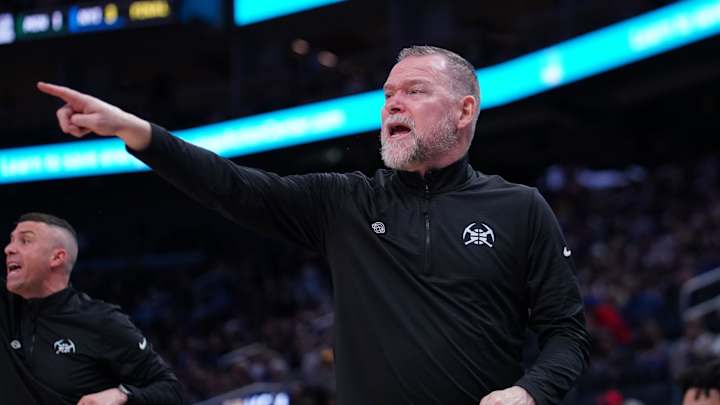
Michael Malone’s first offseason leading the North Carolina Tar Heels men’s basketball program has generated plenty of excitement, but early national projections are already serving as a reminder that the rebuild in Chapel Hill remains a work in progress.
While fans have been energized by the coaching change, international recruiting push, and roster reshaping, the first major bracketology projections suggest that outsiders still view UNC as a team with more questions than answers heading into the 2026-27 season.
In his first-ever projected 76-team NCAA Tournament field following the tournament’s official expansion, Andy Katz placed UNC as a No. 9 seed and the 33rd overall team in the country. Although the Tar Heels avoided the expanded play-in section of the bracket, the projection still landed with disappointment among fans who hoped the arrival of Malone would immediately elevate the program back into true national contender territory.
The ranking reflects a broader national perception that UNC’s offseason has been solid rather than spectacular. Malone inherited a roster that lacked identity and consistency under former head coach Hubert Davis, and to his credit, he has moved quickly to reshape the team in his image. Size, versatility, and playmaking have clearly become priorities, especially across the one-through-four positions.
However, roster construction alone does not guarantee elite results. The biggest concern surrounding the Tar Heels entering the season is the frontcourt, particularly after the departure of Henri Veesaar to the NBA. Veesaar provided experience, size, and interior stability, and replacing that production will not be easy. UNC added international center Sayon Keita from FC Barcelona, but expecting him to immediately anchor the paint at the college level may be unrealistic.
There are also lingering concerns about physicality and depth in the post. Jarin Stevenson is expected to spend significant time at the power forward position, yet questions remain about whether the Tar Heels possess enough toughness and rebounding strength against elite ACC competition. Keita reportedly weighs around 215 pounds, which could become an issue against more experienced and physically mature frontcourts.
UNC’s perimeter additions also come with uncertainty. Malone has targeted versatile players who can handle the ball, defend multiple positions, and fit a modern pace-and-space system. Still, there is skepticism about whether enough shooting exists on the roster. Terrence Brown’s offensive consistency remains under scrutiny, while international standout Neoklis Avdalas arrives with talent but without proven college experience.
Meanwhile, NC State transfer Matt Able could become an important piece, but expectations may need to be tempered early. Able projects as a valuable floor spacer and complementary scorer, though it remains unclear whether he can evolve into a complete offensive threat capable of creating his own shot consistently against top-level defenses.
One of the more fascinating elements of this offseason has been Malone’s aggressive international recruiting strategy. Rather than relying exclusively on the transfer portal, the new UNC staff has spent significant energy building overseas relationships and scouting long-term talent pipelines. That approach could pay major dividends in the future, especially as college basketball becomes increasingly global.
Still, those long-term gains may not immediately translate into wins this season. The transfer portal has largely dried up, leaving UNC with limited opportunities to make another major addition before the season begins. Unless an unexpected international prospect emerges late in the cycle, the Tar Heels’ core roster is likely close to finalized.
That reality is partly why Katz’s projection feels sobering. UNC fans understandably hoped that hiring Malone, an NBA championship-winning coach, would instantly return the program to the upper tier of college basketball. Instead, national analysts appear to view the Tar Heels as a talented but incomplete group that still needs time to develop chemistry, identity, and consistency under a first-time college head coach.
To Malone’s credit, he has already accomplished several important things during his brief tenure. He stabilized recruiting, retained elite prospect Maximo Adams, and established a clearer stylistic direction than the program had in recent years. There also appears to be stronger organizational structure around player evaluation and roster balance.
Even so, the comparison to previous seasons remains unavoidable. Under Hubert Davis, UNC often entered seasons with lofty expectations built around top-end talent and recognizable names. Malone’s current roster may possess better overall fit, but critics question whether it has enough star power to truly compete with the nation’s elite teams in March.
The ACC itself may also present significant challenges. Programs like Duke Blue Devils men’s basketball, Louisville Cardinals men’s basketball, and Virginia Cavaliers men’s basketball are expected to remain highly competitive, while several middle-tier conference programs improved significantly through the portal. UNC may not have the luxury of easing into Malone’s system without pressure.
At the same time, preseason projections are far from definitive. Every offseason brings teams that outperform expectations and others that collapse under hype. Malone’s NBA experience, defensive philosophy, and player-development background could ultimately elevate the Tar Heels far beyond their current projection once the season begins.
For now, though, Katz’s early bracketology reflects the uncertainty surrounding the program. UNC has undeniably made progress this offseason, but whether that progress meaningfully moves the Tar Heels closer to national championship contention remains unclear.
The foundation may be stronger, the vision may be clearer, and the future may be brighter, but until the wins start piling up on the court, skepticism will continue to follow Michael Malone’s first chapter in Chapel Hill.