


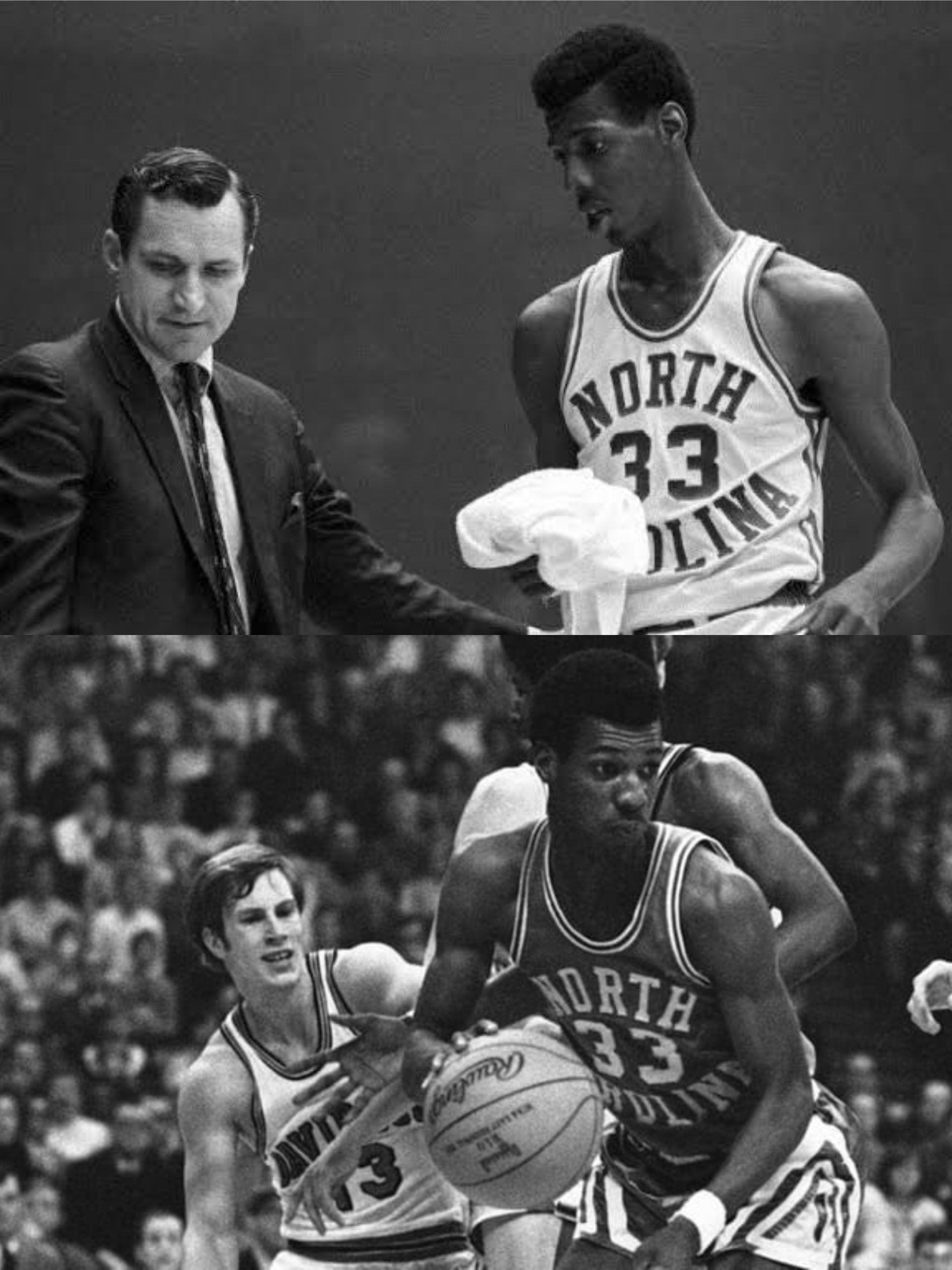
There are certain names in college basketball history that instantly trigger memories of championships, buzzer-beaters, and iconic moments.
At University of North Carolina, names like Michael Jordan, Vince Carter, Tyler Hansbrough, and James Worthy are celebrated as larger-than-life legends who helped shape the identity of one of college basketball’s most iconic programs.
But long before the championships became tradition and before UNC evolved into a global basketball powerhouse, there was one man who carried a responsibility far heavier than winning games.
He was asked to carry the weight of change itself.
And decades later, many still believe his story remains one of the most powerful — and underappreciated — chapters in the entire history of college sports.
Charlie Scott did not simply play basketball at North Carolina.
He walked directly into a social warzone.
When Scott arrived in Chapel Hill in the late 1960s, the American South was still deeply divided by segregation, racial hostility, and political unrest. The Civil Rights Movement had changed laws, but it had not erased hatred. In many parts of the South, Black athletes were still treated as outsiders, no matter how talented they were.
And in the ACC, there had never been anything quite like Charlie Scott.
He became the first Black scholarship basketball player in UNC history — a groundbreaking moment that instantly placed him at the center of one of the most emotionally charged periods in American sports.
Today, it’s easy to read that sentence quickly and move on.
But at that time, it changed everything.
Scott wasn’t simply joining a basketball team.
He was stepping into a world where every road trip could become hostile, every arena could turn ugly, and every mistake would be magnified beyond basketball itself.
The pressure surrounding him was relentless.
Opposing crowds screamed racial slurs from the stands. Fans mocked him with cruel taunts designed to break his concentration. Opposing players often targeted him physically, elbowing him harder, fouling him more aggressively, and testing his composure in ways few athletes today could fully imagine.
Some players refused to shake his hand.
Some fans refused to acknowledge his brilliance even when he dominated games.
And still, he kept showing up.
That’s what made Charlie Scott extraordinary.
He never had the luxury of simply being “a player.”
Every game carried historical significance whether he wanted it to or not.
Every time he stepped onto the floor wearing Carolina blue, he represented something bigger than basketball — and both supporters and critics knew it.
But what makes his story even more remarkable is that amid all the hatred and pressure, Scott became one of the best players in America.
Not good.
Not respected.
Truly elite.
Under legendary head coach Dean Smith, Scott evolved into a superstar whose skill level became impossible to deny. His explosiveness, scoring ability, confidence, and athletic brilliance transformed him into one of the most electrifying guards in college basketball.
The same crowds that hated his presence often left arenas talking about his talent.
And slowly, whether people wanted to admit it or not, change began happening across Southern basketball.
Because once Charlie Scott succeeded at North Carolina, the barriers that had existed for generations started cracking open.
Other schools could no longer pretend Black athletes did not belong.
Other programs could no longer ignore the talent they were excluding.
Scott’s success forced the ACC and Southern college basketball into a new era.
And the emotional burden of carrying that transition fell heavily on his shoulders.
What’s often forgotten is how isolating that experience could be.
Modern athletes operate in an era of massive media support, social media followings, and widespread institutional backing. Scott played during a period where loneliness often accompanied progress. He represented hope for many people, but hope can become exhausting when one person is asked to carry so much of it alone.
Yet he kept performing.
He kept winning.
And eventually, he became more than a basketball player.
He became a symbol of courage throughout college athletics.
Then came another moment that elevated his story to an even greater historical level.
In 1968, Scott was selected to represent the United States at the Olympic Games in Mexico City — one of the most politically charged Olympics in modern history.
The world was watching America closely during that period. Civil rights protests, racial tensions, and social unrest dominated headlines globally. The Olympics became far more than a sporting event; they became a reflection of a changing world.
Scott helped lead Team USA to Olympic gold.
Think about the magnitude of that journey.
A young Black athlete who endured hatred while integrating Southern college basketball was now standing on the world stage representing the same nation still struggling to fully embrace equality at home.
It was both triumphant and painfully complicated.
And perhaps that’s why the silence surrounding his accomplishments afterward felt so powerful.
Scott returned as an Olympic champion, yet the broader recognition many expected never fully matched the historical significance of what he had accomplished. While he earned respect inside basketball circles, the emotional depth of his impact often went under-discussed compared to other sports icons of his generation.
But over time, historians and fans began looking back differently.
They started realizing that Charlie Scott’s story wasn’t simply about points scored or games won.
It was about barriers shattered.
It was about surviving unimaginable pressure with dignity.
It was about forcing change in places where change was deeply resisted.
Without Charlie Scott, the modern version of ACC basketball may never have evolved the same way.
Without Charlie Scott, countless Black athletes across Southern universities may have faced even greater delays entering major programs.
Without Charlie Scott, UNC’s basketball legacy itself might look completely different.
That’s why many now consider him one of the true architects of modern Carolina basketball — even if his contributions were not always celebrated loudly enough during his playing days.
And perhaps that silence says more than words ever could.
Because Charlie Scott’s greatness was never only about basketball.
It was about courage under impossible circumstances.
It was about walking into hostile arenas, hearing hatred from every direction, and still finding a way to perform with brilliance.
It was about changing history without asking for sympathy.
He integrated Southern college basketball not through speeches, protests, or headlines alone.
He did it possession by possession.
Shot by shot.
Win by win.
And decades later, his story still stands as one of the heaviest, bravest, and most important chapters in the entire history of North Carolina basketball.




