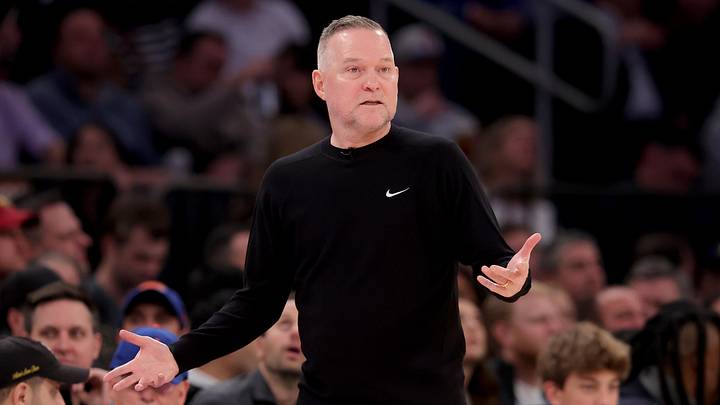
UNC Thought It Had Found the Perfect International Star for Michael Malone’s New Era — Then the NCAA Dropped a Surprise Rule That Could Change Everything. A Mysterious Eligibility Crackdown Is Suddenly Hovering Over One of Carolina’s Biggest Targets… And Tar Heel Fans Are Starting to Fear This Recruitment May Not Be as Close to the Finish Line as Everyone Believed
By Staff Writer
CHAPEL HILL, N.C. — For the past several weeks, optimism around North Carolina basketball has been building quietly behind the scenes.
A new era under Michael Malone has already brought energy, urgency, and a sense that the Tar Heels are preparing to attack the modern college basketball landscape aggressively. Transfer portal targets are being evaluated daily. International prospects are being monitored heavily. And one name, more than almost any other, had started to generate serious buzz inside recruiting circles:
Alexandros Samodurov.
The talented Greek big man had emerged as one of UNC’s most intriguing frontcourt targets — a modern stretch forward-center with size, skill, mobility, and professional experience overseas. For a program searching desperately for frontcourt depth and long-term upside, Samodurov looked almost too perfect.
Then the NCAA stepped in.
And suddenly, what once looked like a straightforward pursuit may have become one of the most complicated recruiting situations of the offseason.
A Recruitment That Seemed to Be Trending Toward Chapel Hill
Before the latest NCAA guidance surfaced, many around college basketball believed North Carolina had positioned itself strongly in the race for Samodurov.
The 6-foot-11 Greek standout checks nearly every box Malone appears to value as he reshapes the Tar Heels roster. He is versatile offensively, comfortable handling the ball in transition, capable of spacing the floor, and advanced defensively for his age because of his professional-level experience overseas.
More importantly, UNC’s coaching staff viewed him as a potential foundational piece — not just another portal addition.
Sources close to the situation indicated that Carolina’s pitch centered around development, exposure, and immediate opportunity. With the Tar Heels still trying to solidify their frontcourt rotation, Samodurov represented the kind of international talent who could arrive in Chapel Hill and immediately carve out meaningful minutes.
And unlike many overseas prospects who remain projects, Samodurov already carries the polish of someone who has played against grown professionals.
That experience, however, may now be the very thing putting his college future in jeopardy.
The NCAA’s New Guidance Changes the Conversation
Late this week, reports surfaced that the NCAA is tightening its interpretation of eligibility standards for international athletes entering American college basketball.
According to the new guidance, players who competed in professional systems or received compensation beyond “actual and necessary expenses” could face serious challenges obtaining NCAA eligibility clearance.
At first glance, the wording sounded technical.
But within recruiting circles, alarm bells immediately started ringing.
Why?
Because many elite European prospects — especially those coming through major club systems and EuroLeague pipelines — routinely participate in environments where compensation structures become difficult to separate from professional status.
And that means players like Samodurov could suddenly find themselves trapped in NCAA limbo.
The issue is not necessarily whether the player signed a massive professional contract. Instead, the concern centers around whether participation in certain leagues, developmental systems, or club agreements violates the NCAA’s increasingly strict amateurism interpretations.
For North Carolina, the timing could not be worse.
Michael Malone’s International Vision Hits Its First Obstacle
Ever since taking over in Chapel Hill, Malone has made it clear that he wants UNC to think bigger.
Not just geographically.
Philosophically.
The former NBA championship coach has repeatedly emphasized versatility, physicality, defensive toughness, and positionless basketball. International prospects naturally fit that model because many are trained differently than American players — emphasizing passing, spacing, and skill development at every position.
Samodurov appeared to embody that vision perfectly.
That is why the new NCAA development has created so much anxiety around the program.
“This isn’t just about one player,” one college basketball insider said. “This is about whether schools can confidently recruit top international talent without worrying about hidden eligibility landmines.”
And right now, nobody seems entirely sure where those landmines are.
Why Tar Heel Fans Are Suddenly Nervous
What makes the situation especially frustrating for North Carolina supporters is that momentum had been building steadily.
Many fans believed Samodurov could become one of the defining additions of Malone’s first major roster build. His combination of length, shooting touch, and international experience made him feel like a perfect modern college big.
Now, uncertainty has replaced excitement.
On social media, fans have already begun speculating about worst-case scenarios:
- Could the NCAA deny eligibility entirely?
- Could the process drag on for months?
- Could UNC move on before receiving answers?
- Could NIL collectives hesitate because of uncertainty?
- Could rival schools back away as well?
At this point, nobody knows.
And that uncertainty is exactly what makes the situation so dangerous for roster construction.
In the portal era, timing matters almost as much as talent. Coaches cannot afford to wait forever on unresolved cases while other targets disappear elsewhere.
Another Major UNC Recruit Could Also Be Affected
What makes this story even more concerning is that Samodurov may not be the only player impacted.
Reports suggest that Sayon Keita — another highly regarded international prospect tied to North Carolina — could also face questions under the new NCAA interpretation.
That possibility has amplified fears that the NCAA’s latest guidance could reshape how programs recruit globally moving forward.
For years, college basketball has aggressively expanded its international footprint. Coaches have scouted Europe, Africa, and international academies searching for players with pro-ready skill sets.
But now?
Programs may have to navigate a legal and compliance maze every time they pursue an overseas prospect.
And for first-year staffs trying to rebuild quickly, that uncertainty becomes a nightmare.
Malone’s Biggest Challenge May No Longer Be Recruiting Talent
Ironically, this development arrives at a time when North Carolina’s recruiting momentum actually appears strong.
Malone has generated significant buzz in a short period of time. High-level transfer targets continue to listen to UNC’s pitch. Recruits appear intrigued by his NBA pedigree. And there is growing belief that Carolina could become far more aggressive and modern in roster construction under his leadership.
But talent acquisition in 2026 is no longer just about evaluation.
It is about navigation.
The modern college basketball landscape now requires coaches to manage NIL negotiations, transfer portal timelines, roster chemistry, and increasingly complicated eligibility questions all at once.
And that means Malone’s first offseason may be far more difficult than many originally expected.
The Bigger Question Hanging Over College Basketball
The Samodurov situation also raises a larger issue that many programs are quietly discussing behind closed doors:
How exactly does the NCAA plan to define amateurism in a global basketball system where many elite international teenagers already operate inside professional club structures?
In Europe especially, the line between development and professionalism has always been blurry.
Young prospects often train with professional clubs, compete in professional leagues, receive housing assistance, and participate in systems connected directly to major organizations.
That model is normal internationally.
But under NCAA rules, those same pathways can suddenly become eligibility risks.
And unless clearer standards emerge quickly, schools may become hesitant to pursue international prospects altogether.
What Happens Next?
For now, North Carolina is expected to continue monitoring the situation closely while staying engaged with Samodurov and his representatives.
Nothing has officially collapsed.
Nothing has officially been denied.
But the easy optimism surrounding this recruitment has undeniably changed.
Instead of focusing purely on basketball fit, the conversation has shifted toward compliance, interpretation, and uncertainty.
And until definitive answers arrive, Tar Heel fans may have to live with an uncomfortable reality:
One of UNC’s most exciting recruiting pursuits may now depend less on recruiting — and more on NCAA bureaucracy.
For a program hoping to launch a bold new era under Michael Malone, that is not the kind of drama anyone in Chapel Hill wanted to see this early.