


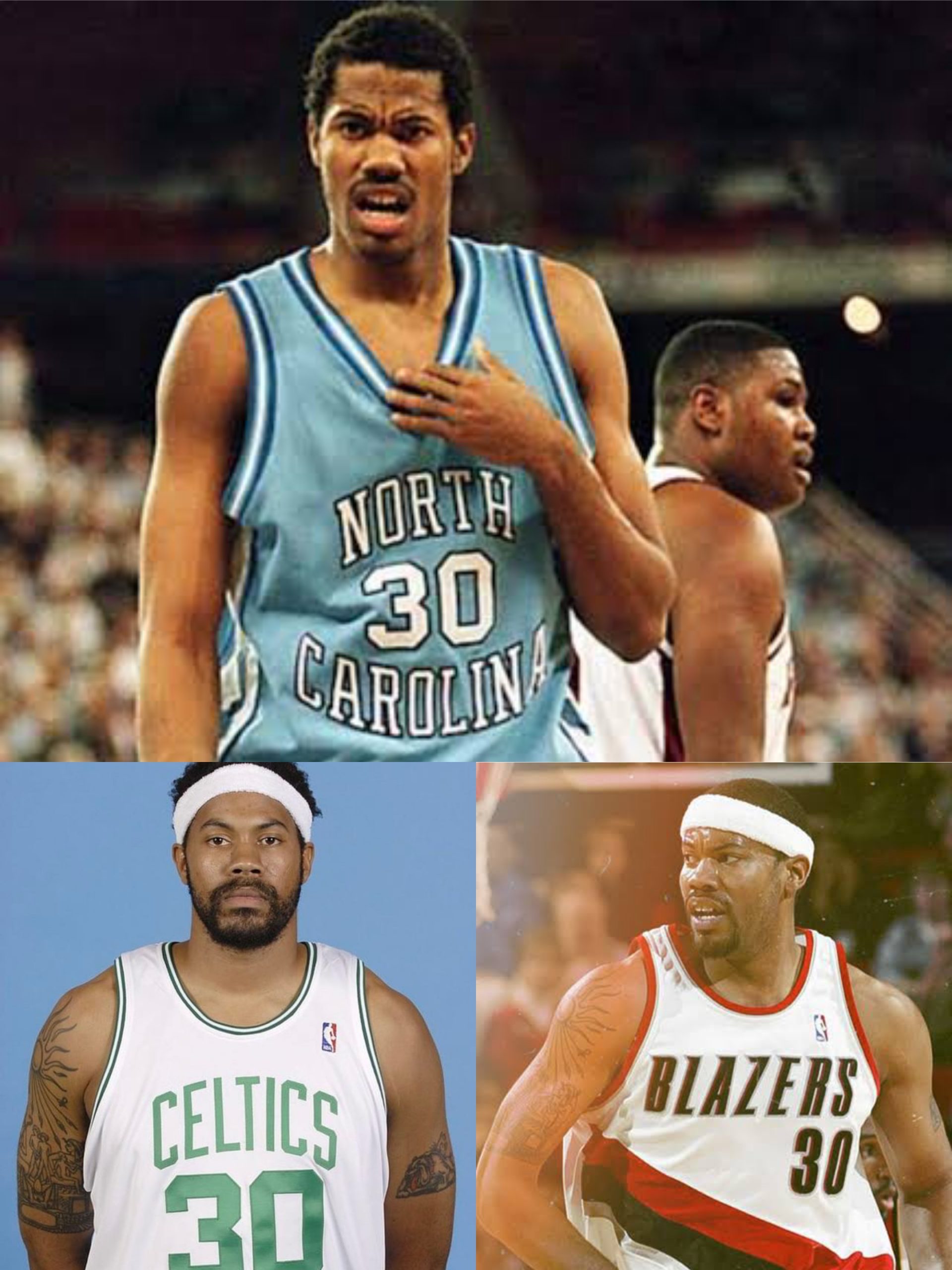
Before the technical fouls, before the legendary trash talk, before he became one of the NBA’s most intimidating enforcers, Rasheed Wallace was already terrifying opponents in Chapel Hill.
Long before “Ball Don’t Lie” became part of basketball culture, Wallace was altering games in ways that statistics could barely explain.
He blocked shots that looked impossible to reach. He forced guards to abandon layups midair. He turned the paint into restricted territory before “rim protector” became a modern basketball obsession. And despite playing in one of the most brutal eras in ACC history — an era dominated by names like Tim Duncan, Joe Smith, Grant Hill, Jerry Stackhouse, and Antawn Jamison — Wallace somehow managed to leave an imprint so powerful that, three decades later, former teammates still describe him with the same word:
Scary.
Not because he screamed the loudest.
Not because he chased headlines.
But because when Rasheed Wallace locked in defensively, entire offenses changed the way they played basketball.
The Forgotten Monster of Chapel Hill
When fans discuss the greatest players in North Carolina history, the conversation usually begins with Michael Jordan, Tyler Hansbrough, James Worthy, Vince Carter, or Phil Ford.
Rasheed Wallace’s name often comes later.
That has always been strange to the people who actually played against him.
Because in the mid-1990s, there may not have been a more physically overwhelming player in the country.
Standing 6-foot-11 with elite footwork, explosive leaping ability, and absurd instincts defensively, Wallace possessed a combination of size and mobility that felt years ahead of its time. He could protect the rim like a center while moving laterally like a wing. He could defend post scorers, hedge ball screens, recover to shooters, and still erase shots at the basket.
And he did all of it while playing with an edge that made opponents visibly uncomfortable.
Former ACC players have repeatedly described the experience the same way: you always knew where Rasheed Wallace was on the floor.
Because if you forgot for even a second, your shot was probably ending up in the third row.
Sophomore Season: The Year He Became a Problem
Wallace’s sophomore season at UNC in 1994-95 was the year everything changed.
Dean Smith already knew he had a future professional star on his hands. What he may not have fully realized at first was just how dominant Wallace could become defensively.
By season’s end, Wallace ranked third in the ACC in blocked shots per game at 2.7.
The only two players ahead of him?
Wake Forest superstar Tim Duncan — who would eventually become one of the greatest defensive players in NBA history — and Maryland phenom Joe Smith, the future No. 1 overall pick in the NBA Draft.
That company alone should tell the story.
But statistics still fail to capture Wallace’s true impact.
Opposing coaches spent entire game plans trying to pull him away from the rim because once he settled into the paint, attacking UNC became almost impossible. Guards stopped driving. Big men rushed hook shots. Fast breaks suddenly turned cautious.
Even teammates admitted practices became brutal because Wallace competed like every possession was personal.
And when emotions rose, his intensity somehow increased.
The Duke Game That Changed His Reputation Forever
If there was one college game that perfectly captured the chaos and brilliance of Rasheed Wallace, it came against Duke in 1995.
UNC and Duke already hated each other. But Wallace brought a different level of energy into the rivalry.
That night in Chapel Hill became basketball warfare.
The game went into overtime. Bodies crashed everywhere. Tempers flared constantly. And Wallace dominated the emotional center of the storm.
He finished with 25 points, highlight dunks, massive defensive plays, and the kind of swagger that electrified Carolina fans while infuriating Duke supporters.
Every dunk felt violent.
Every block felt personal.
And every possession carried the sense that Wallace was one emotional spark away from taking over the entire game.
UNC eventually escaped with a dramatic 102-100 overtime win, but the performance cemented Wallace as one of the rivalry’s most unforgettable figures.
To this day, many Tar Heel fans still point to that night as the moment Wallace fully became Carolina basketball royalty.
Dean Smith’s Defensive Weapon
Dean Smith coached countless stars during his legendary career, but Wallace represented something unique.
He wasn’t merely talented.
He was disruptive.
Smith understood that Wallace’s defensive presence changed the geometry of games. Opponents couldn’t comfortably attack the basket, which allowed UNC to pressure more aggressively on the perimeter.
And unlike many dominant shot blockers, Wallace wasn’t reckless.
His timing was elite.
He rarely chased blocks out of position. Instead, he waited. Studied angles. Anticipated movement. Then exploded at exactly the right moment.
That discipline made him even more dangerous.
Smith often preached team defense over individual statistics, which partly explains why Wallace never accumulated the awards many believe he deserved. He never won ACC Defensive Player of the Year. He never became First-Team All-ACC.
But ask the people who played against him whether those honors mattered.
Most laugh at the question.
Because awards didn’t change what they experienced firsthand.
The Final Four Run and the Painful Ending
The 1994-95 Tar Heels looked capable of winning everything.
With Wallace anchoring the defense and providing explosive scoring inside, UNC stormed into the NCAA Tournament carrying enormous momentum.
The Tar Heels reached the Final Four, where they faced Nolan Richardson’s relentless Arkansas Razorbacks — the defending national champions.
The matchup became a war of styles.
Arkansas pressed relentlessly. UNC tried to counter with size and control. Wallace battled through double teams, physical defense, and nonstop pressure.
But eventually, Arkansas wore Carolina down.
The Razorbacks defeated UNC 75-68, ending Wallace’s college career one step short of a national title.
For many players, that loss might have defined the final memory.
For Wallace, it became fuel.
From Chapel Hill Enforcer to NBA Champion
After leaving UNC, Wallace quickly became one of the NBA’s most feared players.
His talent was undeniable from the beginning. But it was his toughness — mental and physical — that separated him.
With the Portland Trail Blazers, Wallace evolved into an All-Star and one of the league’s most versatile forwards. He could score inside, stretch defenses, protect the rim, and defend multiple positions years before modern NBA schemes demanded versatility.
Then came Detroit.
When Wallace joined the Pistons in 2004, everything changed.
Detroit already had a tough, defensive-minded identity. Wallace transformed it into a championship machine.
His rim protection, leadership, and fearlessness became central to one of the greatest defensive teams of the modern era. The Pistons famously defeated Kobe Bryant, Shaquille O’Neal, and the heavily favored Lakers in the 2004 NBA Finals — a victory many still consider one of basketball’s greatest upsets.
And fittingly, Wallace’s fingerprints were all over it.
Why Teammates Still Call Him the Scariest
Thirty years later, the stories still sound almost mythical.
Former teammates talk about practices where Wallace blocked everything in sight. Opponents remember hearing footsteps near the rim and panicking. Coaches recall how quickly games changed once his energy intensified.
The statistics remain impressive.
But the fear he created?
That’s what people remember most.
Rasheed Wallace didn’t need trophies to validate what he was.
He didn’t need Defensive Player of the Year awards.
He didn’t need unanimous All-American recognition.
Because the players who shared the court with him already knew the truth:
At his peak, Rasheed Wallace wasn’t just dominant.
He was terrifying.




