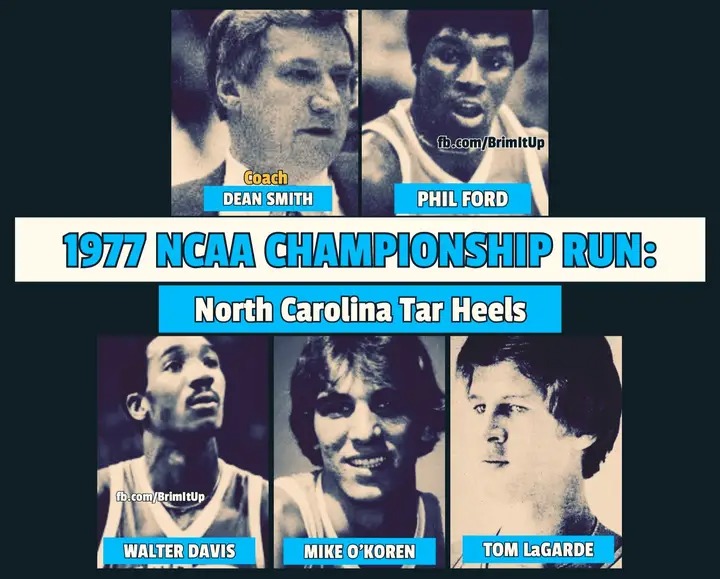
The Team That Refused to Fold: How Dean Smith’s 1976–77 Tar Heels Came Within One Game of Immortality—and Built a Legacy That Still Echoes Through Chapel Hill
Long before national championship banners multiplied in the Dean Smith Center and decades before names like Michael Jordan, James Worthy, Tyler Hansbrough, and Justin Jackson became synonymous with North Carolina basketball greatness, there was another Tar Heel team that helped shape the foundation of Carolina’s modern identity.
The 1976–77 North Carolina squad did not finish the season holding the national championship trophy.
They did something that, in many ways, can be just as memorable.
They captured the imagination of an entire fan base, fought their way through one of the toughest seasons in program history, reached the NCAA Championship Game, and established a standard of excellence that would influence generations of Tar Heels to come.
Nearly five decades later, the story of Dean Smith’s 1976–77 team remains one of the most fascinating chapters in North Carolina basketball history.
A Program on the Rise
By the mid-1970s, Dean Smith had already established himself as one of college basketball’s brightest coaching minds.
Yet despite consistent success, conference titles, and national respect, critics continued to focus on one thing.
National championships.
Smith had guided North Carolina to multiple Final Fours, but the elusive NCAA title remained just out of reach. Every season seemed to bring another opportunity—and another heartbreaking ending.
The pressure surrounding the program was immense.
Still, Smith never abandoned the principles that defined his coaching philosophy: discipline, teamwork, unselfishness, defensive intensity, and player development.
The 1976–77 season would become one of the finest examples of those values in action.
Phil Ford: The Heartbeat of Carolina Basketball
Every great team needs a leader.
For North Carolina, that leader was Phil Ford.
Widely regarded as one of the greatest point guards in college basketball history, Ford was much more than a scorer. He was the engine that powered everything the Tar Heels did.
At a time when flashy guards often dominated headlines, Ford stood out because of his intelligence, composure, and ability to control the tempo of a game.
During the 1976–77 campaign, he averaged 15.1 points and 4.3 assists per game while serving as the unquestioned floor general.
Opposing coaches knew exactly where every possession began.
Stopping him was another matter entirely.
Ford possessed a rare ability to make teammates better. He could score when necessary, create opportunities for others, and dictate the rhythm of a game with remarkable precision.
Many longtime Carolina fans still view him as one of the most influential players ever to wear the Carolina blue uniform.
A Supporting Cast Built for Winning
While Ford was the centerpiece, North Carolina’s success depended on a deep and talented roster.
Walter Davis brought elite athleticism and scoring ability. His smooth offensive game made him one of the most feared players in the nation.
John Kuester provided leadership and versatility.
Tom LaGarde added toughness and rebounding inside.
Dudley Bradley delivered relentless defense that frustrated opposing stars.
Mike O’Koren emerged as a young contributor whose future would become extremely bright.
Together, they formed a roster that perfectly embodied Dean Smith’s team-first approach.
No one player carried the burden alone.
Everyone had a role.
Everyone contributed.
And everyone bought into Smith’s vision.
The Journey Through the Season
The Tar Heels finished the regular season with an outstanding 28–5 record.
They consistently ranked among the nation’s elite teams and demonstrated an ability to win in multiple ways.
Some nights it was Ford orchestrating the offense.
Other nights it was Davis taking over as a scorer.
Sometimes it was defense.
Sometimes it was rebounding.
Sometimes it was sheer determination.
That versatility made North Carolina incredibly difficult to prepare for.
As March arrived, confidence within the program continued to grow.
The Tar Heels believed they had the talent, experience, and chemistry necessary to make a championship run.
Surviving the Madness
The NCAA Tournament has always been unforgiving.
One bad night can erase an entire season.
North Carolina understood that reality better than most.
Game after game, the Tar Heels navigated pressure-packed situations against elite competition.
Their poise became one of their greatest strengths.
Dean Smith’s teams were famous for preparation, and that preparation paid dividends throughout the tournament.
Every possession mattered.
Every defensive stop mattered.
Every rebound mattered.
The deeper North Carolina advanced, the more it became clear that this team possessed something special.
The dream of a national championship was no longer hypothetical.
It was within reach.
One Win Away From History
The Tar Heels ultimately advanced to the NCAA Championship Game, placing themselves just 40 minutes from college basketball immortality.
For players, coaches, and fans, it represented the culmination of years of hard work and sacrifice.
The championship stage is where legends are made.
It is also where heartbreak can become permanent.
North Carolina entered the title game determined to finish the journey.
The team had overcome obstacles all season.
Now only one final challenge remained.
The Pain of Falling Short
Championship games often become defined by tiny moments.
A missed shot.
A defensive lapse.
A rebound that bounces the wrong way.
For North Carolina, the final chapter ended in disappointment.
The Tar Heels fell just short of securing the national championship, finishing as NCAA runners-up.
The loss was devastating.
Players who had poured everything into the season were forced to watch another team celebrate.
For Dean Smith, it was another painful near miss in his pursuit of the championship that many believed he deserved.
Yet something remarkable happened in the aftermath.
The team’s legacy did not disappear.
In fact, it grew stronger.
Why This Team Still Matters
Many runner-up teams fade into history.
The 1976–77 Tar Heels never did.
Part of the reason is the extraordinary talent on the roster.
Part of it is the respect Dean Smith commanded.
But perhaps the biggest reason is what the team represented.
This was a group that embodied everything Carolina basketball aspired to be:
- Selfless
- Disciplined
- Tough
- Intelligent
- Competitive
- Resilient
Their success helped strengthen North Carolina’s national reputation and laid important groundwork for future championship teams.
Without the lessons learned during seasons like 1976–77, the championships that followed might never have happened.
The Legacy of Dean Smith’s Runners-Up
History often remembers champions first.
But college basketball’s greatest stories are not always defined solely by trophies.
Sometimes they are defined by influence.
The 1976–77 North Carolina Tar Heels may not have cut down the final nets, but they helped build something even larger: a culture that would become one of the most respected in sports.
Phil Ford became a Carolina icon.
Walter Davis became a legend.
Dean Smith continued building a dynasty that would eventually reach the mountaintop.
And the players from that unforgettable season secured their place in Tar Heel history.
Nearly 50 years later, their story remains a reminder that greatness is not measured only by championships.
Sometimes greatness is measured by the standard you leave behind.
And few teams in college basketball history left a higher standard than Dean Smith’s 1976–77 North Carolina Tar Heels.