


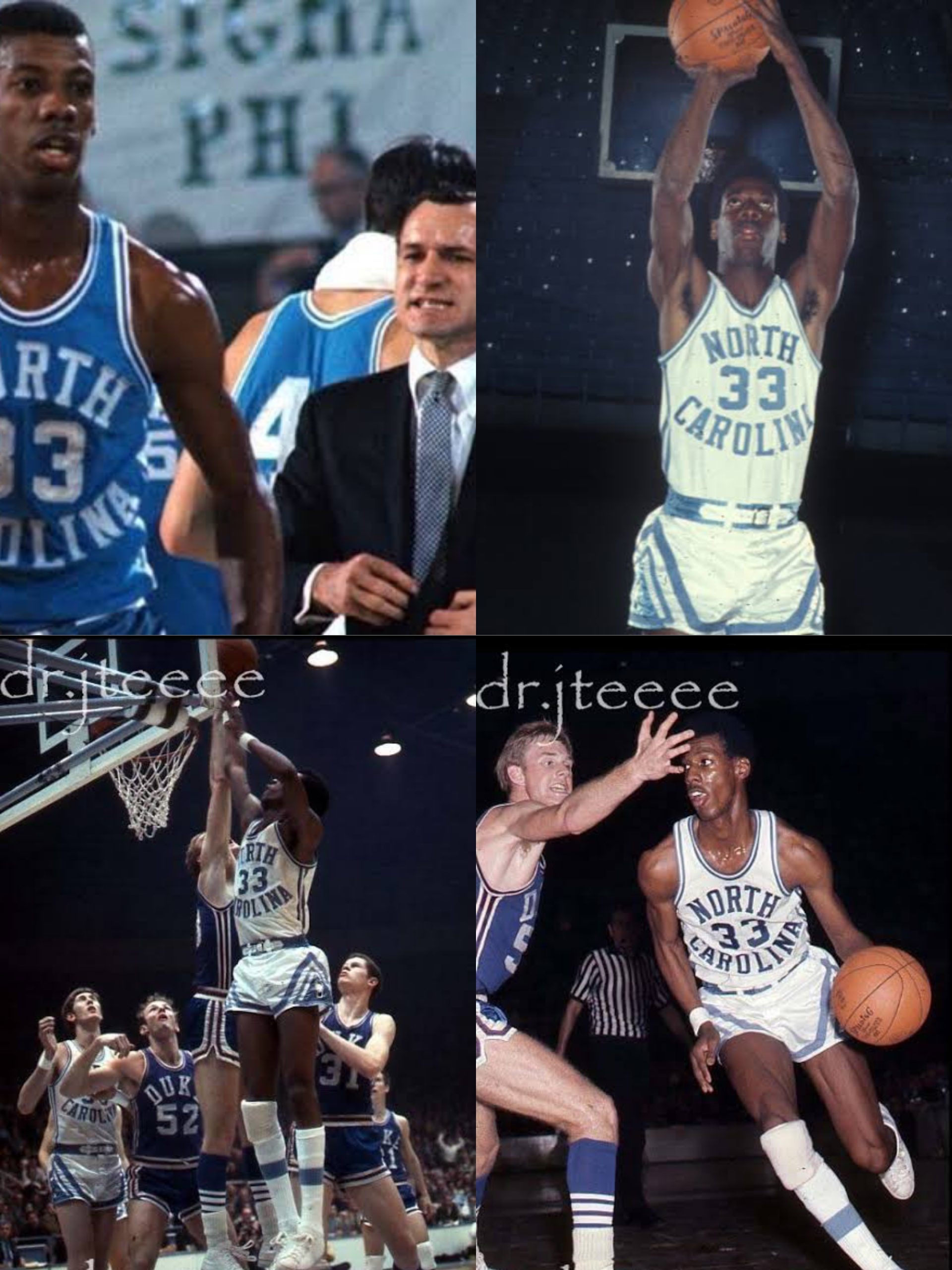
He Integrated an Entire Conference Before Most Americans Had Even Heard of Martin Luther King Jr.’s Final March. They Spat on Him. They Chanted Things That Would Get You Banned From Social Media Today. He Didn’t Flinch. Instead, He Led His Team to Three Final Fours, Won Gold for His Country, and Then – Just When Everyone Thought His Story Was Complete – He Did Something No Other Black Tar Heel Had Ever Done Before. It Took Nearly a Decade. It Required Surviving Things Most Players Couldn’t Imagine. And When He Finally Lifted That Trophy, He Wasn’t Just a Champion – He Was a Reckoning.
CHARLOTTE, N.C. —
Before he became a champion, before the NBA spotlight, before the gold medals and Hall of Fame honor, Charlie Scott was something else entirely in Chapel Hill:
A target.
A pioneer.
And, unknowingly, a turning point in the history of Southern college basketball.
When Scott arrived at the University of North Carolina in 1967, he did not just enter a basketball program—he entered a cultural battlefield. He became the first Black scholarship athlete in UNC history and one of the first Black players in the Atlantic Coast Conference, stepping into arenas where his presence alone provoked hostility.
What he endured would have broken most players.
Instead, it built a legend.
A SOUTH THAT WASN’T READY
Scott’s arrival in Chapel Hill came during one of the most volatile periods in American history. The Civil Rights Movement was still being violently resisted across the South, and integration in college athletics was still new—and often unwelcome.
On the road, Scott was met with hatred that went far beyond basketball. Crowds shouted racial slurs so frequently that they became background noise. Opposing fans mocked, threatened, and tried to intimidate him. Some arenas felt less like sporting venues and more like hostile territory.
But Scott never reacted publicly.
He responded on the scoreboard.
And in doing so, he changed everything.
THE PLAYER WHO REFUSED TO BREAK
On the court, Scott quickly became undeniable.
He wasn’t just good—he was overwhelming.
Explosive scoring, elite athleticism, and a calm presence under pressure made him one of the most dangerous players in the country. Over three varsity seasons, he averaged more than 20 points per game and became the centerpiece of a UNC team that reached three straight Final Fours.
One performance in particular still lives in ACC history:
A 40-point explosion against Duke in the ACC Tournament final, where Scott dragged UNC back from an 11-point deficit almost single-handedly. It remains one of the most dominant performances ever seen on that stage.
He didn’t just win games.
He altered momentum.
He silenced environments.
He shifted expectations.
THE MOMENT THE WORLD BEGAN TO NOTICE
Even before his college legacy was complete, Scott was already representing something larger.
In 1968, he earned a place on the U.S. Olympic basketball team and helped bring home a gold medal in Mexico City. At a time when the United States was confronting its own internal divisions, Scott stood on the podium as a symbol of excellence emerging from struggle.
It was a global stage.
But his toughest battles were still happening at home.
THE MISSING PIECE
For all his brilliance, one thing still followed Scott: the absence of a championship at the college level.
UNC came close but fell short of the ultimate prize during his era. And while Scott’s individual greatness was never in question, critics still measured success by banners—not brilliance.
That narrative would follow him into the professional ranks.
THE LONG ROAD TO VALIDATION
Scott’s professional journey took him through the ABA, where he was named Rookie of the Year, and later into the NBA, where he became a three-time All-Star.
But the championship still eluded him.
Season after season, he came close—but not close enough.
Until 1976.
THE FINAL PIECE OF THE STORY
When Scott joined the Boston Celtics, he entered one of the most storied dynasties in sports history. Surrounded by legends, he no longer had to carry a team—but he still had to prove himself.
And in the 1976 NBA Finals, the test arrived.
The early games were difficult. Scott struggled with consistency and foul trouble, and doubts began to surface at the worst possible moment.
But champions are often defined not by how they start—but how they respond.
In Game 6, with everything on the line, Scott delivered one of the most important performances of his career. He attacked, defended, and stabilized a Celtics team that would go on to close out the Phoenix Suns and capture the championship.
When the final buzzer sounded, the narrative finally changed.
Charlie Scott was no longer just a pioneer.
He was a champion.
A LEGACY THAT REACHES FAR BEYOND BASKETBALL
Scott’s story is not just about points, wins, or trophies. It is about what happens when talent meets resistance—and refuses to retreat.
His role in integrating ACC basketball helped open doors that countless Black athletes would later walk through. His success under pressure helped redefine what was possible for future generations at UNC and beyond.
In 2018, his contributions were formally recognized with induction into the Naismith Memorial Basketball Hall of Fame, cementing his place among the game’s greats.
But long before the honors, before the ceremonies, before the recognition—
He was already changing the game.
One possession at a time.
One hostile arena at a time.
One unshaken response at a time.
EPILOGUE
History often remembers champions.
But it sometimes forgets what it took to make them.
Charlie Scott was both.
A pioneer who entered when he wasn’t welcomed.
A star who performed when he wasn’t protected.
And a champion who finally, after everything, completed a journey that began long before the trophies ever arrived.
When he lifted that NBA title in 1976, it wasn’t just victory.
It was validation.
And it was, above all else—
A reckoning.




