For most NBA prospects, draft night is the payoff.
It is the night the cameras flash, the commissioner walks to the podium, the family explodes in celebration, and years of work finally turn into one life-changing sentence: “With the 10th pick in the NBA Draft…”
It is emotional for almost everyone. It’s supposed to be. Players cry. Parents cry. Siblings cry. Coaches cry. The whole night is built around joy, relief, gratitude, and the release of pressure after years of sacrifice.
But every once in a while, one draft-night moment lands differently.
Not just because it is emotional, but because you can see, in real time, that the player on the screen isn’t simply reacting to a basketball accomplishment. He’s reacting to an entire life — to every hard mile, every setback, every impossible stretch of uncertainty, every prayer whispered in the dark, every time he had to believe in a future he couldn’t yet see.
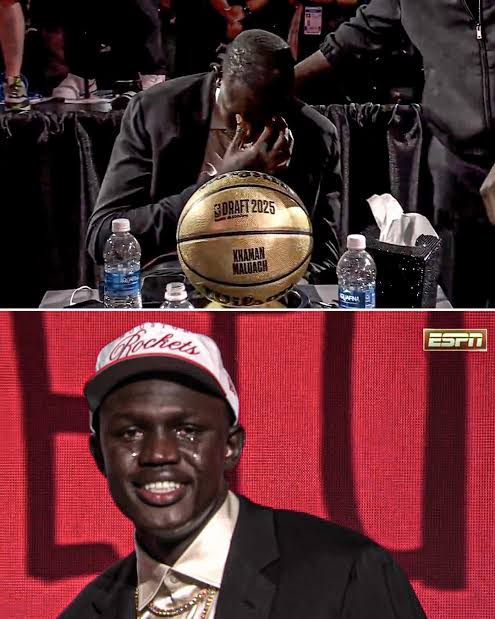
That’s why the resurfaced clip of Khaman Maluach breaking down on NBA Draft night is hitting people so hard all over again.
Because those tears were never just about hearing his name called.
They were about everything that had to happen for him to even be in that room.
And when you understand the full story behind that moment — when you understand where he came from, how late he found the game, what he carried with him to that stage, and how quickly his life changed — it becomes almost impossible to watch the clip without feeling something.
This wasn’t just a draft reaction — it was the weight of an entire journey crashing down at once
When Khaman Maluach was selected 10th overall in the 2025 NBA Draft, the moment looked, at first glance, like the kind of emotional reaction fans have seen many times before. He was overwhelmed, visibly crying, trying to compose himself as the cameras zoomed in and the world watched him process the biggest night of his basketball life. He was drafted by Houston, then routed to Phoenix as part of the Kevin Durant trade package, but the team logistics almost felt secondary in the moment. The scene that stuck with everyone was much simpler: Khaman Maluach could not hold back the tears.
And the reason that moment hit so hard is because his story is not a typical one.
Maluach was born in South Sudan and spent much of his childhood in Uganda after his family fled conflict. Public reports have described him growing up around Kawempe, a disadvantaged area outside Kampala, with the uncertainty and instability that so many displaced families know far too well. The path from there to Barclays Center in Brooklyn was never supposed to be straightforward. In fact, it was barely imaginable.
That’s what makes the tears make sense.
Because when Maluach sat in that chair on draft night, he wasn’t just thinking about workouts, scouts, Duke, or the next step in his basketball career. He was thinking about the life that existed before basketball ever became real. He was thinking about the odds. He was thinking about the people who got him there. He was thinking about the continent he has said he feels responsible to represent every time he steps on the floor.
And for a kid who didn’t even start playing basketball until his early teens, that kind of moment was never going to be processed like a normal draft selection.
The most unbelievable part of the story? Basketball wasn’t even the plan
One of the reasons Maluach’s story feels so powerful is because his rise didn’t begin with a childhood built around gyms, trainers, rankings, and recruiting hype.
It began with chance.
By multiple public accounts, Maluach did not grow up dreaming of becoming a basketball star in the way many American prospects do. Basketball was not the center of his world early on. In fact, one of the remarkable details repeated in coverage of his rise is that he only took the sport seriously after someone noticed how unusually tall he was and encouraged him to give it a shot. BBC, CBS Sports, and other reports have all described the turning point similarly: a local driver or rider in Uganda suggested he try basketball because of his height, and that suggestion ended up changing the course of his life.
Think about that for a second.
Most lottery picks spend a decade or more preparing for the NBA. They grow up in the game. They’re groomed, tracked, trained, and projected years in advance. Maluach, by contrast, was still figuring out what basketball even was as a serious path.
And then everything accelerated.
He went from a teenager with almost no basketball background to NBA Academy Africa, from there to the global stage with South Sudan, then to Duke, and then, almost unbelievably fast, to the top ten of the NBA Draft. NBA.com noted that he became the highest-drafted former NBA Academy Africa and BAL player ever when he went 10th overall.
That’s not just an impressive development curve.
That’s the kind of leap that almost doesn’t feel real until you watch the draft-night tears and remember that the person crying isn’t just emotional because he made it — he’s emotional because the speed of the transformation itself is almost too much to process.
Why his tears felt different from everyone else’s
There were other emotional moments on draft night. There always are. But Maluach’s reaction felt different because it carried the unmistakable look of someone revisiting his entire life in a matter of seconds.
After the draft, he explained it himself.
“I didn’t think I was going to cry,” Maluach said, according to multiple reports. “But everything was just going through my head; my whole journey, my people and the continent I represent.”
That quote says everything.
This wasn’t simply a young player overwhelmed by success. This was a teenager carrying memory, responsibility, gratitude, and identity into one of the biggest moments of his life. It was about his family. It was about South Sudan. It was about Uganda. It was about Africa. It was about every young player who might one day look at him and realize that the impossible isn’t always impossible.
There is something uniquely moving about watching a player cry not because the spotlight found him, but because he knows the spotlight now reaches far beyond him.
Maluach has talked openly about representing the continent and giving hope to younger players. He has framed his success not just as a personal victory, but as something bigger — something communal. That’s part of why the clip keeps resonating. People can feel that his reaction wasn’t self-centered. It was almost the opposite. It was the release of someone who understood how many people, places, and dreams were packed into that one announcement.
Duke was the final launching pad — but the emotional story was already written before he got there
By the time Maluach arrived at Duke, he was already one of the most fascinating long-term prospects in basketball.
He had size that NBA scouts dream about, defensive instincts that made him a natural rim-protection prospect, and a backstory that already felt extraordinary. At Duke, he averaged 8.6 points, 6.6 rebounds, and 1.3 blocks during his freshman season while helping power the Blue Devils to the Final Four. He wasn’t a finished product offensively, but his impact was obvious, and the combination of his frame, mobility, defensive ceiling, and rapidly developing feel made him a legitimate lottery talent.
But what made Maluach so easy to root for at Duke wasn’t just the basketball upside.
It was the way people around the program talked about him.
CBS Sports’ deep dive on his journey included glowing comments from people at Duke who described him as joyful, selfless, coachable, and one of the best human beings around the program. That kind of praise matters, especially in a one-and-done environment where players are often judged primarily by projection and production. Maluach’s appeal has always been larger than his stat line. He’s the kind of player teammates and coaches seem to genuinely love being around.
So by the time he got to the draft, the emotional release almost felt inevitable.
Not because he was expected to cry, but because every stage of his rise had been emotionally loaded. Duke was not the beginning of the story. It was the chapter that made the rest of the basketball world finally catch up to it.
There was another layer to the emotion that made the moment even harder to watch
One of the more painful details in the reporting around draft night was that visa issues affected whether family members could be there in the way they had hoped.
BBC reported that Maluach’s family had planned to be with him, but travel restrictions tied to South Sudan complicated those plans, and not everyone was able to attend. Only his sister, who was based in Australia, was reportedly able to be present in New York.
That matters because it adds another emotional layer to a night that was already overwhelming.
Imagine reaching the biggest moment of your career so far, hearing your name called in front of the entire basketball world, and still feeling the ache of the people who couldn’t be beside you because of circumstances beyond anyone’s control. Imagine carrying gratitude, relief, pride, pressure, memory, and absence all at once.
That is a lot for anyone.
For an 18-year-old whose life has already asked him to process more than most people do in decades, it’s almost unimaginable.
And that’s why the resurfaced clip is landing with such force now.
People aren’t just seeing a player cry.
They’re seeing what it looks like when joy and pain, triumph and memory, gratitude and grief all arrive at the same time.
Why the moment still matters now
The easiest thing to do with a clip like this is to call it “heartwarming” and move on.
But that undersells what it actually represents.
Khaman Maluach’s draft-night tears matter because they remind people that sports stories are never just about rankings, scouting reports, and transactions. They’re about people. They’re about families. They’re about migration, survival, belief, sacrifice, identity, and timing. They’re about the tiny moments that redirect a life — like one person telling a tall teenager he should try basketball — and the massive moments that make all of it feel real.
They matter because they show young players from Africa, from refugee communities, from overlooked backgrounds, that the pipeline to the biggest stage in the world is no longer imaginary.
And they matter because Maluach’s journey is still only beginning.
The draft was not the ending of his story. It was the opening of a new chapter. He still has to develop, still has to adjust to the NBA, still has to prove himself night after night against grown professionals. The work is far from over.
But the reason that draft-night moment keeps pulling people back is simple:
For a few seconds, the basketball world saw what it looks like when a dream is bigger than basketball.
It saw a teenager who had once lived with uncertainty, who discovered the game late, who rose through Africa’s basketball pipeline, who carried his country and continent in his heart, and who reached a stage so enormous that even he couldn’t fully contain what it meant.
That’s why the clip keeps resurfacing.
That’s why people keep sharing it.
That’s why the tears still hit.
Because Khaman Maluach wasn’t crying just because he got drafted.
He was crying because a life that once looked fragile had suddenly become undeniable.
And even now, long after the commissioner called his name, that truth still has the power to break hearts all over again.