


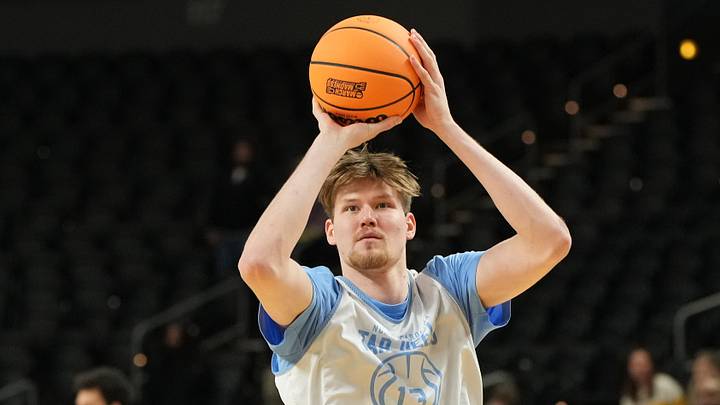
Everyone Said Henri Veesaar Made a Costly Mistake by Leaving UNC Early—Until One Stunning Contract Changed the Entire Conversation Overnight
ATLANTA — For nearly a week after the 2026 NBA Draft, the narrative surrounding former North Carolina center Henri Veesaar seemed all but settled.
He had left Chapel Hill with one year of college eligibility remaining. He turned down the opportunity to return to a Tar Heels program that would have welcomed him back with a significant role and potentially lucrative NIL opportunities. He entered the draft believing he had positioned himself to hear his name called somewhere in the late first or early second round.
Instead, he endured one of the most unexpected slides of the draft.
When the Atlanta Hawks finally selected Veesaar with the No. 52 overall pick, questions immediately followed.
Had he declared too soon?
Should he have returned to North Carolina?
Did he gamble away millions by betting on himself?
For days, those questions dominated the conversation.
Now, however, that discussion has taken a dramatic turn.
A DRAFT NIGHT THAT LEFT MANY STUNNED
Leading up to the draft, Veesaar was widely projected as a player who could comfortably hear his name called much earlier.
Several mock drafts placed him inside the top 40, while others believed he had a realistic chance to sneak into the first round.
That never happened.
Pick after pick came and went.
Teams filled needs.
Other prospects climbed unexpectedly.
Meanwhile, Veesaar remained in the green room of speculation, waiting for an opportunity that seemed increasingly uncertain.
By the time Atlanta selected him near the end of the second round, many analysts described him as one of the draft’s biggest fallers.
For critics, it appeared to validate every concern surrounding his decision to leave college early.
THE CRITICISM CAME QUICKLY
Almost immediately, social media filled with opinions.
Some believed Veesaar should have returned to UNC for another season under Michael Malone.
Others argued another year of development could have improved his draft stock considerably.
Many pointed toward the growing influence of NIL, suggesting he might have earned substantial money while improving his professional outlook.
On paper, the criticism seemed understandable.
Lower draft position often translates into less guaranteed financial security and greater uncertainty.
Or so many assumed.
THE CONTRACT THAT CHANGED EVERYTHING
Then came the announcement that few expected.
Atlanta and Veesaar agreed to his rookie contract, providing the former Tar Heel with an opportunity that dramatically changed how many observers viewed his decision.
While second-round selections often face uncertainty regarding guaranteed money, roster security, and long-term commitments, Veesaar reportedly secured a deal that gives him considerably more stability than many players selected in his range typically receive.
Suddenly, the focus shifted.
Instead of asking why he left North Carolina, people began asking whether he had quietly accomplished exactly what he wanted all along.
MORE THAN JUST MONEY
Financial security certainly matters.
But Veesaar’s decision was never solely about immediate earnings.
Throughout the pre-draft process, he consistently emphasized one goal above everything else:
Reaching the NBA.
For international players especially, hearing their name called on draft night often represents the fulfillment of years of sacrifice.
Veesaar chose to pursue that dream despite understanding the risks involved.
He believed he belonged at basketball’s highest level.
Atlanta evidently agreed.
A STRONG FIT IN THE HAWKS’ SYSTEM
Beyond the contract itself, the basketball situation may be equally encouraging.
The Hawks continue to build a roster featuring youth, athleticism, and positional versatility.
Veesaar’s combination of size, mobility, rim protection, and floor-spacing potential gives him developmental tools that NBA organizations increasingly value.
While he may not be expected to contribute immediately, Atlanta appears willing to invest time in helping him refine his game.
That patience could prove invaluable.
Many successful NBA careers have begun with second-round selections who entered the league without enormous expectations.
WHAT UNC FANS WILL REMEMBER
Although his college career in Chapel Hill lasted only one season, Veesaar quickly became a respected figure inside the program.
His willingness to embrace physical play, defend the paint, and do the smaller things necessary to win earned him appreciation from teammates, coaches, and fans alike.
Many hoped he would return for another season.
When he chose the NBA instead, disappointment naturally followed.
Now those same supporters have reason to celebrate his next chapter.
BETTING ON YOURSELF IS NEVER EASY
Professional sports are filled with stories of players who stayed too long.
They are equally filled with players who left too early.
The challenge is knowing when the timing is right.
For Veesaar, that decision came with uncertainty.
His draft position suggested one outcome.
His contract appears to suggest another.
Sometimes success is measured not by where you’re selected but by the opportunity that follows.
THE NARRATIVE HAS SHIFTED
Just days ago, Veesaar’s story centered on disappointment.
Today, it centers on possibility.
Instead of becoming a cautionary tale about leaving school too early, he has positioned himself as an example that draft position alone does not determine career success.
The NBA has repeatedly shown that organizations care far more about development than where a player hears his name called.
If Veesaar earns meaningful minutes, develops steadily, and becomes a reliable contributor, few people will remember he was the 52nd overall selection.
They’ll remember the career he built afterward.
THE REAL VERDICT IS STILL TO COME
Ultimately, no contract guarantees success.
The NBA remains one of the most competitive leagues in the world, and every rookie—regardless of draft position—must prove he belongs.
Veesaar understands that challenge better than anyone.
His work is only beginning.
But after days of hearing that he had made one of the biggest mistakes of the draft cycle, the conversation has changed.
His rookie deal has provided stability.
His new team has shown confidence in his potential.
And perhaps most importantly, the decision that once drew widespread criticism suddenly looks far more calculated than many first believed.
For Henri Veesaar, the journey from Chapel Hill to Atlanta has already included unexpected twists.
Now comes the chapter that matters most: proving that believing in himself was the right decision all along.




