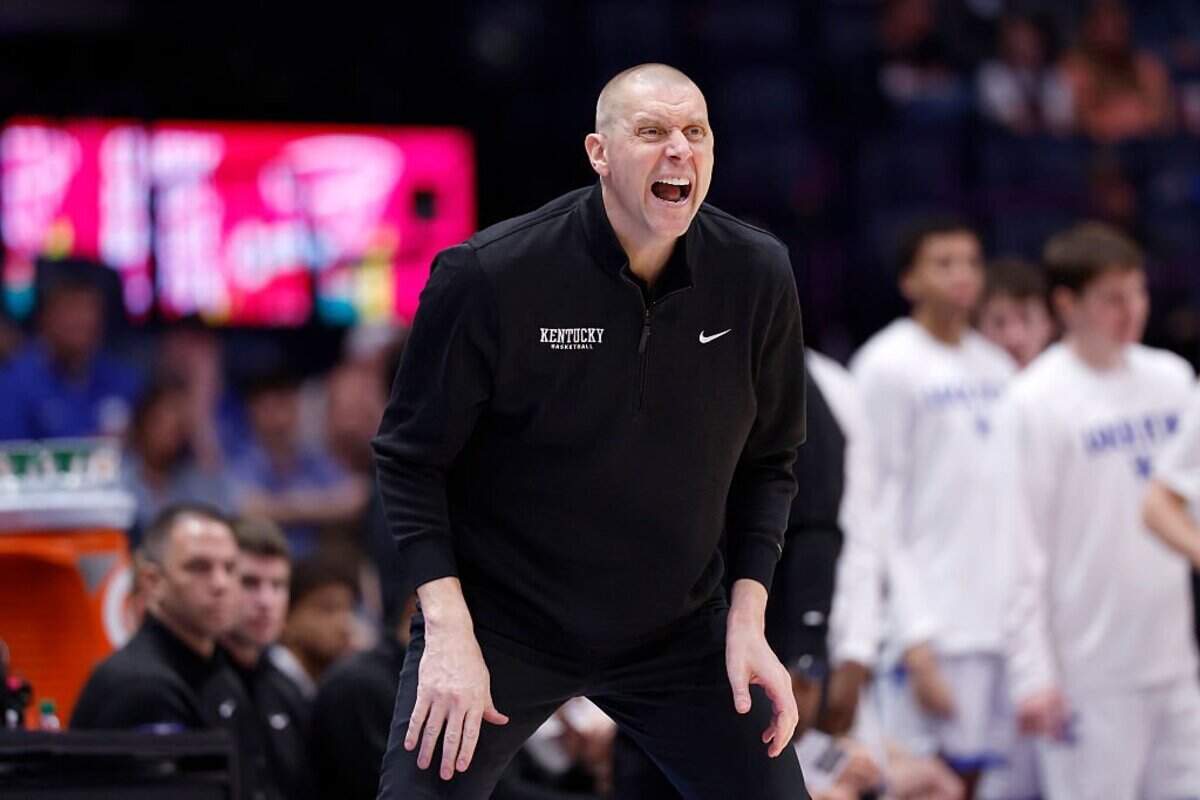
Mark Pope has delivered plenty of encouraging moments during his first two seasons as Kentucky’s head coach. The Wildcats have proven they can compete with some of the nation’s elite programs, avoided embarrassing losses to overmatched opponents, and restored excitement around the program. Yet one recurring issue has prevented Kentucky from taking the next step toward championship contention.
As Pope enters what could be the most important season of his Kentucky tenure, fixing the Wildcats’ inconsistency against middle-tier opponents has become the program’s biggest priority.
Through two seasons, Kentucky has developed a unique pattern. Against the nation’s best teams, the Wildcats have been competitive. Against lower-level opponents, they have been nearly flawless. However, games against solid—but not elite—competition have repeatedly derailed promising seasons.
Kentucky’s record against ranked opponents has been respectable, though not spectacular. Under Pope, the Wildcats are 13-16 against AP Top 25 teams. While that mark falls short of Kentucky’s championship expectations, it still represents improvement over the closing stretch of the previous coaching era, when the Wildcats went 11-18 in their final 29 games against ranked opponents.
The 2024-25 season showcased Kentucky’s ability to rise to the occasion. Pope guided the Wildcats to an impressive 8-6 record against Top 25 teams, highlighted by signature victories over eventual national champion Florida and Final Four participant Duke. Those wins demonstrated that Kentucky could compete with anyone on the biggest stage.
The following season told a different story. Kentucky stumbled to a 5-10 record against ranked opponents after losing five of its first six games against Top 25 competition. Still, the Wildcats found their rhythm midway through the year, winning four of six ranked matchups, including impressive road victories over longtime rival Tennessee in Knoxville and John Calipari’s Arkansas squad in Fayetteville.
Unfortunately, Kentucky couldn’t sustain that momentum, dropping its final three games against ranked opponents, including a loss to SEC regular-season champion Florida in the conference tournament quarterfinals.
Against several of the program’s traditional rivals, Pope has also held his own. Kentucky has gone 9-7 combined against Arkansas, Duke, Florida, Indiana, Louisville, North Carolina, and Tennessee during his first two seasons. While those numbers aren’t dominant by Kentucky standards, they suggest the Wildcats are capable of competing with high-level opponents.
Where Pope deserves significant credit is in handling games Kentucky is expected to win comfortably.
The Wildcats are a perfect 17-0 in buy games played at Rupp Arena and NCAA Tournament matchups against lower-seeded opponents, including victories over Troy and Santa Clara. That consistency is notable considering Kentucky suffered several shocking upsets during the final years of the previous coaching regime, including home losses to Evansville, Richmond, and UNC Wilmington, as well as NCAA Tournament defeats to Saint Peter’s and Oakland.
Avoiding those kinds of embarrassing losses has restored stability to the program.
However, stability alone isn’t enough for a school with Kentucky’s championship expectations.
The Wildcats’ biggest obstacle has been their inability to consistently defeat teams that fall between college basketball’s elite and its weaker programs.
The numbers tell the story clearly.
During the 2024-25 campaign, Kentucky posted a strong 7-5 record against teams that finished among the top 21 in the final NET rankings. But against teams ranked between No. 22 and No. 50, the Wildcats went just 5-7.
Those missed opportunities proved costly.
One stretch late in the season perfectly illustrated the problem. After battling No. 5 Florida in a hard-fought contest that showcased Kentucky’s potential, the Wildcats returned home only to lose to Georgia before suffering a heartbreaking one-point defeat at Auburn.
Neither opponent was considered a national powerhouse. Georgia finished No. 33 in the final NET rankings before suffering an early NCAA Tournament exit, while Auburn ended the regular season ranked No. 37 before settling for an NIT appearance.
A later road loss to Texas A&M, another team outside the nation’s elite at No. 43 in the NET rankings, further damaged Kentucky’s season.
Those defeats erased much of the momentum Kentucky had built after winning eight of its first 11 SEC games and ultimately prevented the Wildcats from reaching a higher level.
Injuries certainly played a significant role.
Kentucky players missed 50 combined games because of injuries during Pope’s first season. That number increased dramatically to 77 missed games in 2025-26, forcing the Wildcats to constantly adjust lineups and rotations.
If Kentucky finally enjoys better health in 2026-27, the Wildcats should have a better chance of maintaining consistency throughout the demanding SEC schedule.
Still, injuries cannot become the only explanation.
Championship-caliber teams consistently defeat opponents they are expected to beat, regardless of circumstances. Kentucky has already shown it can challenge the nation’s best teams and avoid disastrous upsets against overmatched opponents. The final piece of the puzzle is learning how to consistently handle quality teams that sit just below the national elite.
That will require improved execution, greater focus, stronger depth, and the ability to maintain intensity every night—not just when facing nationally ranked opponents.
Year 3 presents a tremendous opportunity for Mark Pope.
If he can solve Kentucky’s struggles against middle-tier competition while continuing to compete with the nation’s best, the Wildcats could transform from a dangerous team capable of occasional big wins into a legitimate SEC title contender and a serious threat to make a deep NCAA Tournament run.
For Kentucky, the path to becoming one of college basketball’s elite no longer depends on beating the giants. It depends on consistently taking care of the teams in the middle.