


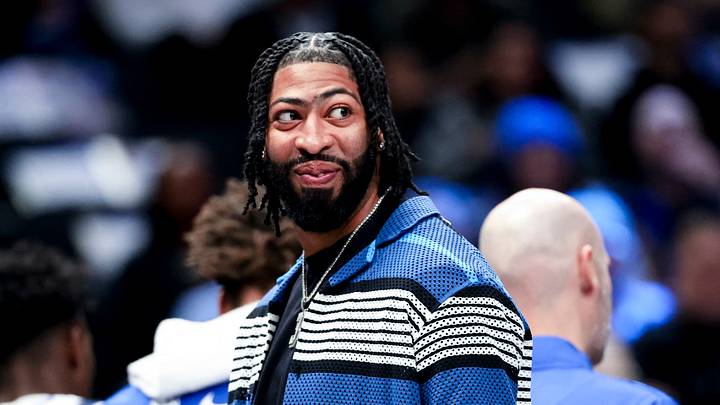
The Anthony Davis Trade Looked Like a Gamble at First—Now a Stunning Chain of Events Has Fans Wondering Whether One Team Quietly Pulled Off the Biggest Heist of the NBA Offseason
WASHINGTON, D.C. — When the Washington Wizards made the bold decision to acquire Anthony Davis, the reaction across the NBA was immediate.
Some praised the franchise for taking a swing at landing one of the league’s most accomplished two-way stars.
Others questioned whether the price was simply too steep.
Giving up multiple players and valuable draft capital for a veteran with an extensive injury history seemed like an enormous gamble for a rebuilding team. Critics wondered whether Washington had sacrificed too much of its future for a player whose best years might already be behind him.
Months later, however, the conversation surrounding the blockbuster trade has taken a dramatic turn.
Thanks to a series of offseason moves involving both the Wizards and the Dallas Mavericks, many around the league are beginning to view the deal through an entirely different lens.
What once looked like a risky investment is increasingly being discussed as one of the smartest pieces of roster management of the NBA offseason.
A TRADE THAT SHOCKED THE LEAGUE
Few expected Washington to emerge as a serious player in the Anthony Davis sweepstakes.
The Wizards entered the offseason focused on accelerating their rebuild while adding experienced talent capable of helping reshape the culture of the organization.
Landing Davis immediately changed that perception.
The package Washington surrendered included veteran Khris Middleton, promising young guard AJ Johnson, Malaki Branham, Marvin Bagley III, two first-round draft picks, and three second-round selections.
At the time, analysts debated whether the Wizards had overpaid.
After all, Davis remained one of the NBA’s premier defenders and interior forces when healthy, but his durability had consistently been one of the biggest questions surrounding his career.
Washington clearly believed the potential reward outweighed the risk.
THE STORY DIDN’T END ON TRADE DAY
As often happens in the NBA, the initial trade represented only the beginning.
General manager decisions rarely exist in isolation.
Players acquired in one transaction frequently become assets used in future moves, and Washington wasted little time maximizing every opportunity.
The Wizards continued reshaping their roster by using several acquired pieces in additional trades that strengthened multiple positions across the lineup.
Instead of simply stopping after acquiring Davis, the front office treated the trade as the foundation for a broader organizational strategy.
That long-term thinking is beginning to pay dividends.
DALLAS’ RETURN HAS CHANGED DRAMATICALLY
While Washington continued building around its new cornerstone, Dallas gradually watched its own return evolve in a very different direction.
Several players acquired in the original deal were no longer with the organization within months.
Malaki Branham was moved on quickly.
Marvin Bagley III eventually departed.
Khris Middleton’s stay proved relatively brief before later finding his way back to Washington.
AJ Johnson became part of another transaction that helped Dallas acquire Santi Aldama.
Even one of the draft selections involved in the deal ultimately changed hands again as the Mavericks continued reshaping their own roster.
Piece by piece, the original package became increasingly difficult to recognize.
THE WIZARDS KEPT BUILDING
Meanwhile, Washington continued turning acquired assets into additional improvements.
D’Angelo Russell eventually became part of another move that helped the Wizards strengthen their roster.
Jaden Hardy’s contract was later used in a transaction that brought Deandre Ayton into the frontcourt, adding another proven interior presence alongside Davis.
Instead of simply landing one All-Star, Washington positioned itself with two experienced big men capable of dramatically changing the team’s identity.
Suddenly, what initially looked like one blockbuster trade had quietly evolved into something considerably larger.
A DIFFERENT CONVERSATION
Looking strictly at today’s rosters, the comparison has become far more interesting than it appeared on trade day.
Washington now finds itself with Anthony Davis anchoring its defense while also adding Deandre Ayton to strengthen its frontcourt rotation.
Dallas, meanwhile, has continued retooling through younger players, draft assets, and additional transactions that reflect a different long-term vision.
Neither organization approached the aftermath in the same way.
Both believed they were positioning themselves for future success.
But recent developments have fueled growing debate over which front office extracted greater value from the original blockbuster.
WHY THE WIZARDS ARE EARNING PRAISE
Washington’s front office deserves credit not only for making a bold trade but for refusing to stop there.
Every subsequent decision appeared connected to a larger strategy.
Rather than allowing acquired players to remain temporary placeholders, the organization consistently searched for opportunities to improve the roster through additional transactions.
That willingness to remain aggressive has significantly altered public perception.
Instead of focusing solely on what Washington gave up, many analysts are now examining everything the organization ultimately gained.
THE PRESSURE NOW SHIFTS TO THE COURT
Of course, roster construction is only one part of the equation.
Ultimately, championships—and reputations—are determined by results.
Anthony Davis must stay healthy.
Deandre Ayton must fit within Washington’s long-term plans.
The team’s younger core must continue developing around its veteran stars.
If those pieces come together, the Wizards could emerge as one of the Eastern Conference’s most intriguing teams.
If they do not, criticism could quickly return.
DALLAS STILL HAS ITS OWN PATH
It’s also important to recognize that Dallas remains committed to its own direction.
The Mavericks have continued accumulating young talent while reshaping the roster around a different timeline.
Their evaluation of the trade extends far beyond one season.
Only time will determine whether their long-term vision ultimately proves successful.
THE FINAL VERDICT REMAINS UNWRITTEN
NBA trades are rarely judged accurately in their first few weeks—or even their first year.
Sometimes it takes multiple seasons before the full impact becomes clear.
Yet one thing has become increasingly obvious.
The Anthony Davis blockbuster is no longer being viewed as a simple exchange of players and draft picks.
Instead, it has become the starting point for two organizations pursuing very different futures.
For Washington, every move since acquiring Davis has strengthened the belief that the front office wasn’t simply making one trade—it was executing a much broader plan.
And if the roster continues to develop as expected, what once appeared to be a risky gamble may ultimately be remembered as one of the most impactful and strategic moves of the NBA offseason.




