


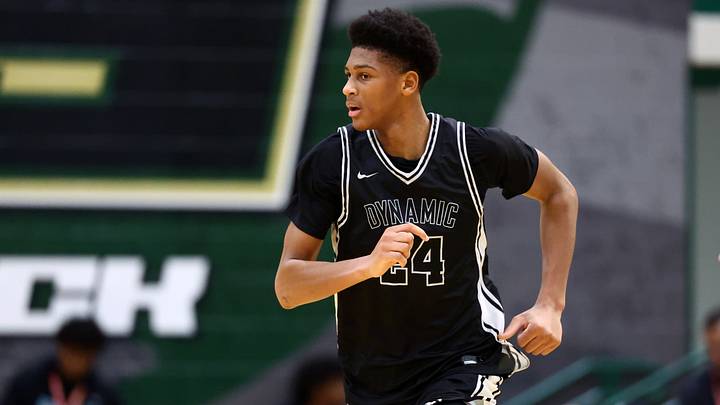
A Stunning Recruiting Twist Has Completely Changed UNC’s Pursuit of One of the Nation’s Biggest Rising Stars—and the Fallout Could Be Bigger Than Anyone Expected
CHAPEL HILL, N.C. — Recruiting in college basketball rarely follows a predictable script.
Coaches spend months—sometimes years—building relationships with elite prospects, only to see one unexpected decision reshape an entire recruiting cycle in a matter of hours.
That reality became crystal clear for North Carolina this week after one of the nation’s most coveted young talents made a surprising announcement that immediately altered the landscape of the Tar Heels’ future recruiting plans.
Five-star forward Marcus Spears Jr., long regarded as one of the premier prospects in the country, not only announced his college commitment but also revealed that he would reclassify and begin his collegiate career a full year earlier than expected.
For UNC, the news represents more than simply missing out on an elite recruit.
It changes recruiting priorities, scholarship planning, and potentially the direction of an entire recruiting class.
A RECRUIT WHO QUICKLY BECAME A PRIORITY
When North Carolina extended an offer to Spears Jr. earlier this year, it was easy to understand why.
The 6-foot-9 forward has established himself as one of the most complete players in high school basketball, possessing the size, athleticism, and versatility that have made him a consensus five-star prospect.
Recruiting services consistently rank him among the nation’s elite, with projections placing him anywhere from the top four to the top ten players in his class.
Those rankings only reinforced what college coaches already believed.
Spears Jr. projects as the type of player capable of making an immediate impact at the collegiate level while possessing long-term NBA potential.
Naturally, programs across the country entered the race.
North Carolina was one of them.
THE ANNOUNCEMENT THAT CHANGED EVERYTHING
Although Spears Jr.’s commitment attracted plenty of attention, it was the second part of his announcement that truly caught the recruiting world by surprise.
Rather than remaining in the 2027 recruiting class, Spears Jr. chose to reclassify into the 2026 class, accelerating his path to college basketball by an entire year.
That decision immediately transformed the recruiting landscape.
Programs that had been preparing for a lengthy recruitment suddenly found themselves working within an entirely different timeline.
For North Carolina, that unexpected change significantly complicated any remaining hopes of bringing Spears Jr. to Chapel Hill.
WHY THE DECISION HURTS UNC
Losing a five-star recruit is never ideal.
But the impact extends beyond simply watching another school add elite talent.
Roster construction has become increasingly delicate in modern college basketball.
With scholarship limits, transfer portal activity, NIL considerations, and returning players all influencing decisions, every unexpected development creates ripple effects.
Spears Jr.’s accelerated timeline meant schools needed immediate flexibility.
For UNC, whose projected roster already appeared close to capacity, adjusting on short notice became considerably more difficult.
Even if scholarship space could have been created, the compressed timeline left far less room for maneuvering.
HOME-STATE APPEAL PROVED DIFFICULT TO OVERCOME
While the reclassification complicated matters, geography may have played an equally important role.
Spears Jr. ultimately chose to remain in his home state by committing to Texas, giving him an opportunity to stay close to family while joining a program with growing national ambitions.
For many recruits, proximity to home remains an important factor.
Support systems matter.
Family matters.
Familiarity matters.
Texas offered all three.
North Carolina, despite its national reputation, faced an uphill challenge convincing Spears Jr. to leave his home state.
MICHAEL MALONE’S RECRUITING APPROACH REMAINS ACTIVE
Although this recruitment did not end in UNC’s favor, there is little indication that Michael Malone and his staff intend to slow their efforts.
Since arriving in Chapel Hill, Malone has emphasized building relationships early while identifying players capable of fitting both the culture and playing style he hopes to establish.
Recruiting success is rarely defined by one player.
Elite programs understand that setbacks are part of the process.
The focus quickly shifts toward the next opportunity.
THERE IS STILL PLENTY OF TALENT AVAILABLE
Fortunately for North Carolina, the recruiting cycle remains far from complete.
Several highly regarded prospects continue considering the Tar Heels, giving the coaching staff multiple opportunities to strengthen future classes.
Recruiting boards constantly evolve.
Unexpected commitments create new openings.
Other prospects emerge.
Some players reclassify in the opposite direction.
The landscape changes almost daily.
UNC’s staff understands that adaptability often separates successful recruiting classes from disappointing ones.
TEXAS MAKES A MAJOR STATEMENT
While the news stings in Chapel Hill, it represents a significant victory for Texas.
Adding a player widely viewed as one of the nation’s premier young talents immediately strengthens the Longhorns’ future outlook.
The combination of Spears Jr.’s commitment and reclassification gives Texas another impact player capable of contributing much sooner than originally anticipated.
If he develops as expected, he could become one of the centerpiece players for a roster expected to compete at a high level over the next two seasons.
RECRUITING NEVER STOPS
Perhaps the biggest lesson from this development is how quickly recruiting can change.
One announcement can alter scholarship availability.
One reclassification can force coaches to completely reevaluate priorities.
One commitment can reshape expectations for multiple programs simultaneously.
North Carolina experienced that reality firsthand this week.
THE BIGGER PICTURE
Although missing out on Marcus Spears Jr. is undoubtedly disappointing for the Tar Heels, the long-term impact will ultimately depend on how UNC responds.
Elite programs rarely allow one recruiting loss to define an entire class.
Instead, they adjust.
They regroup.
They identify new opportunities.
For Michael Malone and North Carolina, that process is already underway.
The Tar Heels may have lost the opportunity to land one of the nation’s brightest young stars, but the recruiting cycle is far from over.
And while Spears Jr.’s decision closes one chapter for UNC, it also opens the door for the program to redirect its attention toward the next generation of elite talent.
In college basketball recruiting, every setback creates another opportunity—and North Carolina’s next move may prove just as important as the one that got away.




