


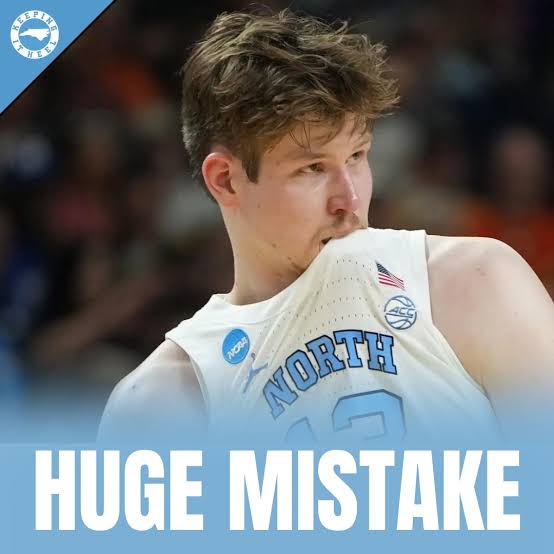
When Henri Veesaar announced that he was keeping his name in the 2026 NBA Draft, many North Carolina fans understood the appeal. After all, every player dreams of hearing his name called on draft night and beginning a professional career. But now, only weeks after officially signing his first NBA contract, one question refuses to disappear around Chapel Hill:
Did Henri Veesaar leave too soon?
It’s a debate that has only intensified after details of his rookie contract became public. While the deal represents an incredible achievement for the former Tar Heel center, it has also reignited conversations about the massive NIL opportunities he reportedly turned down by choosing the NBA over one more season in college basketball.
For many UNC supporters, the numbers tell a fascinating story—and one that suggests Veesaar may have left millions on the table while also passing up an opportunity to dramatically improve his draft stock.
A Dream Realized—But at What Cost?
There is no denying that hearing your name called in the NBA Draft is a life-changing moment.
After beginning his college career at Arizona before transferring to North Carolina, Veesaar steadily developed into one of the nation’s most versatile big men. Standing 6-foot-11 with the ability to score inside, stretch the floor with his three-point shooting, rebound, and protect the rim, he entered the draft process as an intriguing prospect.
However, the 2026 NBA Draft featured one of the deepest pools of talent in recent memory.
With elite prospects filling the top of the board, many talented players unexpectedly slipped further than analysts originally projected. Veesaar became one of those casualties, eventually hearing his name called with the 52nd overall pickafter the Atlanta Hawks acquired the selection from the Los Angeles Clippers.
Simply getting drafted is an accomplishment many players never achieve.
Still, the position where Veesaar was selected immediately sparked discussions about whether returning to Chapel Hill for another season would have been the smarter long-term decision.
The Millions He Walked Away From
Perhaps the biggest talking point surrounding Veesaar’s decision wasn’t basketball at all.
It was money.
Before officially declaring for the draft, multiple reports indicated that Veesaar had received NIL opportunities worth more than $5.5 million if he chose to return to college basketball.
North Carolina reportedly stood ready to make a significant financial commitment to keep its star center in Chapel Hill.
Even more intriguing, several other programs were believed to be interested, potentially creating a competitive bidding environment that could have increased his value even further.
In today’s college basketball landscape, experienced centers with Veesaar’s unique skill set are among the most sought-after players in the country.
Instead of accepting those offers, however, Veesaar stayed committed to pursuing his NBA dream.
It was a decision built on confidence.
A belief that he belonged at the next level.
A willingness to bet on himself.
The Rookie Contract That Changed the Conversation
On Thursday, that bet officially became reality.
Veesaar signed a four-year contract worth approximately $9.3 million with the Atlanta Hawks.
At first glance, that appears to be a tremendous outcome for someone selected near the end of the second round.
In fact, many analysts noted that the structure of his contract resembles deals typically reserved for players selected much earlier in the draft.
That speaks volumes about how highly Atlanta values his long-term potential.
The Hawks clearly believe Veesaar can develop into a dependable rotational player capable of contributing in the years ahead.
From Atlanta’s perspective, this represents an excellent investment.
But from the perspective of many college basketball observers, the contract also highlights the financial gamble Veesaar accepted.
Why Some Believe UNC Made More Sense
The debate isn’t about whether Veesaar belongs in the NBA.
Few question his talent.
Instead, it’s about timing.
Had he returned to North Carolina for one more season, several factors appeared to be working in his favor.
First, the NIL compensation reportedly available would have provided guaranteed financial security before ever stepping onto an NBA floor.
Second, another productive season could have dramatically improved his draft positioning.
Instead of entering one of the deepest draft classes in recent memory, Veesaar could have entered the 2027 draft with another year of experience, additional physical development, and an even stronger résumé.
That combination might have elevated him into first-round consideration.
The financial difference between a late second-round pick and a first-round selection can be enormous over the course of an NBA career.
For many analysts, that possibility made returning to college extremely appealing.
A Dominant Final College Season
Part of the reason expectations were so high stemmed from Veesaar’s outstanding production during his final collegiate campaign.
He averaged:
17.0 points per game
8.7 rebounds
2.1 assists
1.2 blocks
60.8% shooting from the field
42.6% from three-point range
Those numbers showcased one of the most complete offensive skill sets among college centers.
Modern NBA teams value big men who can stretch defenses while still protecting the rim and finishing around the basket.
Veesaar demonstrated all of those abilities.
Had he produced similar numbers for another season against ACC competition, many scouts believe his draft stock could have risen significantly.
Why Atlanta Was Willing to Invest
Despite falling to No. 52 overall, Atlanta clearly saw something special.
Players drafted late in the second round rarely receive contracts with this level of organizational commitment.
The Hawks appear convinced that Veesaar possesses tremendous developmental upside.
His combination of size, mobility, shooting touch, and basketball IQ fits perfectly within today’s NBA.
Rather than viewing him as simply another late draft pick, Atlanta seems to believe it uncovered tremendous value.
If Veesaar develops into a reliable rotation player—or perhaps even a starter years from now—the Hawks could ultimately be viewed as one of the biggest winners from the draft.
The Risk Every Prospect Faces
Every draft decision involves uncertainty.
No player knows exactly where he’ll be selected.
No one can predict injuries.
No one can guarantee future improvement.
For Veesaar, remaining in college would have carried risks of its own.
An injury could have affected his draft stock.
Another season might not have matched his previous production.
Competition for minutes and touches could have changed.
There was never a guarantee that waiting another year would have produced a better outcome.
Likewise, there was no guarantee that leaving early would maximize his earning potential.
Ultimately, Veesaar made the decision he believed was best for his career.
What This Means for North Carolina
From UNC’s perspective, losing Veesaar represented a significant blow.
Experienced seven-footers capable of stretching the floor are among the rarest commodities in college basketball.
Replacing that production is never easy.
The Tar Heels not only lost one of their most skilled frontcourt players but also a veteran presence who understood the physical demands of ACC basketball.
Had he returned, North Carolina would likely have entered the season with one of the nation’s strongest frontcourts.
Instead, the program now moves forward without one of its most versatile weapons.
Only Time Will Reveal the Answer
The conversation surrounding Henri Veesaar’s decision is unlikely to end anytime soon.
Supporters of his choice point to the fact that he achieved every young player’s dream by reaching the NBA and securing a multi-year contract with a franchise that clearly believes in his potential.
Critics point to the millions reportedly available through NIL and the possibility that another dominant college season could have transformed him into a first-round draft pick.
Both arguments carry weight.
If Veesaar quickly develops into an important contributor for the Hawks, few people will question his decision.
If he struggles to establish himself while watching future college stars cash in on massive NIL deals, the debate will only grow louder.
For now, one thing is certain.
Henri Veesaar bet on himself.
The Atlanta Hawks have invested millions in that belief.
And while his NBA dream has officially begun, fans in Chapel Hill will continue wondering what might have happened had the talented big man worn Carolina blue for just one more unforgettable season.




