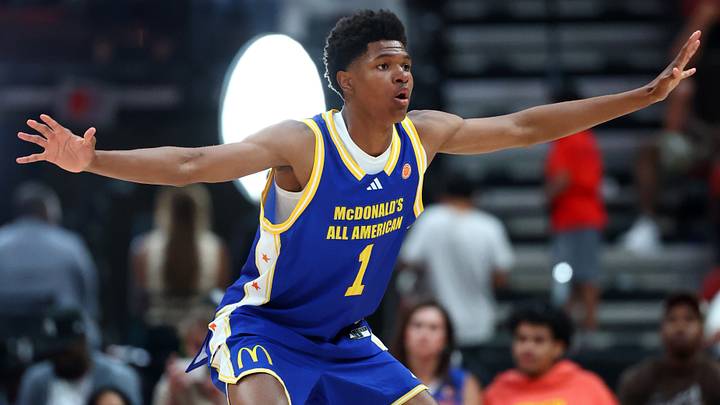
Duke’s Cameron Williams Has One Major Question Hanging Over Him, and It Could Change Everything for Jon Scheyer
Duke has assembled another roster loaded with talent, experience and NBA-caliber potential, but even the deepest teams have questions that need to be answered before the season begins.
For Jon Scheyer, one of those questions could involve one of the most highly touted freshmen arriving in Durham.
Cameron Williams has the physical tools and offensive talent to become an important piece of Duke’s 2026-27 team. The five-star freshman is expected to compete for a prominent role immediately, and his combination of size, length and scoring ability gives the Blue Devils another intriguing option in the frontcourt.
But there is one concern surrounding Williams that could determine just how quickly he earns Scheyer’s trust.
It isn’t his talent.
It isn’t his potential.
It is what happens when Duke doesn’t have the ball.
A recent evaluation from On3’s Jamie Shaw highlighted concerns about Williams’ defensive consistency, rebounding and overall physical positioning. Shaw noted that Williams sometimes played upright in high school, lost leverage and was inconsistent on the glass while struggling defensively. (Ball Durham)
For most programs, those might be areas that can be developed over time.
At Duke, they could directly affect playing time.
Williams has everything Duke wants physically
It is important not to mistake one area of concern for an indictment of Williams as a prospect.
Quite the opposite.
There is plenty to like about the incoming freshman.
Williams possesses the kind of positional size and athleticism that immediately catches attention. He can operate around the perimeter, attack mismatches and score from multiple areas of the floor.
His versatility is one of the reasons he has generated so much excitement heading into his freshman season.
Duke is not recruiting Williams simply because he is big.
The Blue Devils believe he can eventually become a highly skilled two-way player.
Recent evaluations have continued to highlight his upside, with Sports Illustrated noting his stock heading into his freshman campaign and pointing to his potential as a rebounder and shot blocker. (SI)
That potential explains why Williams is expected to have an opportunity to compete for major minutes.
The question is whether he can immediately meet the defensive standard Scheyer demands.
At Duke, defense isn’t optional
This is where the concern becomes particularly relevant.
Scheyer has established a clear identity for Duke since taking over as head coach.
The Blue Devils are expected to defend.
They are expected to communicate.
They are expected to rebound.
And they are expected to compete on every possession.
Duke’s defensive success under Scheyer has been one of the most consistent aspects of the program. The Blue Devils finished the 2025-26 season with a 35-3 record and reached the Elite Eight, continuing a run of strong defensive teams under Scheyer. (Wikipedia)
That creates an obvious challenge for Williams.
He may be able to score.
He may be able to stretch the floor.
He may possess the athletic ability to make spectacular plays.
But if he struggles to consistently defend his assignment or finish possessions with rebounds, Scheyer will have difficult decisions to make.
A freshman’s offensive potential can earn opportunities.
Defensive reliability can determine whether those opportunities continue.
The frontcourt battle makes this even more important
Williams is not entering a situation where Duke desperately needs someone to play 30-plus minutes every night.
That changes everything.
Scheyer has options.
Patrick Ngongba II returns as an established piece in the frontcourt, while Joaquim Boumtje-Boumtje has generated significant attention heading into his freshman season.
Duke also added Belmont transfer Drew Scharnowski, giving Scheyer another experienced frontcourt option. The overall roster has been constructed through a combination of returning players, transfers and highly regarded freshmen. (Jim Sumner Sports)
That means Williams will have to earn his minutes.
He cannot simply rely on his recruiting ranking.
He cannot assume that his offensive skill will automatically keep him on the floor.
If another player is consistently defending better, rebounding harder and making fewer mistakes, Scheyer has enough depth to adjust the rotation.
That is what makes the defensive concern so significant.
Joaquim Boumtje-Boumtje could make the competition fascinating
The most obvious player who could complicate Williams’ path to the starting lineup is Boumtje-Boumtje.
The highly regarded international big man committed to Duke after developing with FC Barcelona and has been viewed as one of the most intriguing players in the 2026 recruiting class. (Wikipedia)
The two freshmen offer different possibilities.
Williams brings perimeter skill and positional versatility.
Boumtje-Boumtje provides size, physicality and a more traditional interior presence.
If Boumtje-Boumtje proves to be the more dependable defender early in the season, Scheyer may have little hesitation about giving him a larger role.
That doesn’t mean Williams would disappear.
It could simply mean that his minutes come in different situations.
He could play more at the four.
He could slide to the three against certain lineups.
He could become an offensive weapon used to exploit particular matchups.
And he could gradually earn more responsibility as his defense improves.
Duke doesn’t need Williams to be perfect immediately
This is where the situation is actually encouraging for the freshman.
Williams doesn’t have to arrive in Durham as a finished product.
Duke has enough talent around him to allow Scheyer to develop him without putting the entire frontcourt on his shoulders.
That could be extremely beneficial.
Instead of asking Williams to immediately become the team’s defensive anchor, Duke can place him in situations where his strengths are maximized while experienced players cover some of his weaknesses.
The presence of Ngongba and the other frontcourt options gives Scheyer flexibility.
That flexibility could ultimately help Williams.
A freshman who is allowed to make mistakes while learning Duke’s defensive system can develop much faster than one who is constantly being asked to cover for an inexperienced roster.
But the rebounding issue cannot be ignored
Defense isn’t limited to staying in front of an opponent.
For a player with Williams’ size, rebounding is equally important.
A defensive possession is not finished when the opponent misses.
It is finished when Duke secures the ball.
If Williams is playing power forward, Scheyer will expect him to contribute on the glass.
Failing to do so can create second-chance opportunities for opponents and force Duke’s guards to compensate.
That becomes especially problematic against physical ACC teams.
Duke will face teams capable of attacking the glass relentlessly.
If Williams is playing alongside another big, he must understand where his responsibilities are and consistently make contact.
That is part of the adjustment from high school to college basketball.
The players are stronger.
The pace is faster.
The margin for error is smaller.
And every weakness gets targeted.
His offensive talent could still make him difficult to keep off the floor
The good news for Williams is that his offensive ability gives Scheyer a compelling reason to be patient.
A player who can score from all three levels creates problems for opposing defenses.
Williams’ ability to operate away from the basket is particularly intriguing.
If opponents put a traditional big man on him, he can potentially pull that defender away from the rim.
If they use a smaller player, Williams can potentially take advantage of his size.
That versatility is valuable.
And it is one of the reasons Duke recruited him in the first place.
The challenge is finding the right balance.
Scheyer needs Williams’ offense without allowing his defensive weaknesses to undermine the team.
The veteran presence of Drew Scharnowski could be crucial
This is where Duke’s decision to add Scharnowski becomes even more important.
The Belmont transfer gives Scheyer an experienced big who can provide dependable minutes while the freshmen develop. Duke’s roster construction has deliberately given the coaching staff multiple ways to handle the frontcourt. (Wikipedia)
If Williams struggles defensively early in the year, Scheyer doesn’t necessarily have to force the issue.
He can reduce Williams’ minutes.
He can change the matchups.
He can use Scharnowski.
He can lean on Ngongba.
He can give Boumtje-Boumtje an opportunity.
That competition should make every frontcourt player better.
And it could ultimately benefit Williams more than it hurts him.
The rotation could be decided by defense
The most interesting question heading into the season may not be who starts.
It may be who Scheyer trusts late in games.
Starting lineups are important, but Duke’s most important rotation decisions will likely come during high-pressure moments.
Who gets the final defensive possession?
Who guards the opponent’s best forward?
Who can stay on the floor without being targeted?
Who can rebound when the game gets physical?
Those are the questions Williams will have to answer.
If he handles them well, his talent could make him one of Duke’s most important players.
If he struggles, Scheyer has enough depth to look elsewhere.
That is the reality facing every freshman on a loaded roster.
Williams has the tools to turn the concern into a strength
The encouraging part is that the concerns identified by Shaw are not necessarily permanent flaws.
They are areas of development.
Playing with better leverage can be taught.
Defensive positioning can improve.
Rebounding technique can improve.
Physical strength can improve.
Understanding college defensive concepts takes time.
And Duke has a coaching staff built to develop players.
Williams is walking into a program where defensive expectations are established from day one.
There will be no ambiguity about what Scheyer wants.
That clarity can help.
Instead of wondering why his role changes, Williams will know exactly what he needs to improve.
The NBA implications are worth watching too
Williams’ long-term ceiling will also be influenced by how quickly he addresses these issues.
NBA scouts are not simply evaluating offensive talent.
A modern forward needs to defend multiple positions, rebound and make intelligent decisions without the ball.
Williams’ size and athleticism give him an intriguing foundation.
But becoming a reliable defender could be the difference between being an interesting prospect and becoming a legitimate NBA-level prospect.
That makes his freshman season about much more than how many points he scores.
If Williams becomes a dependable defender, his stock could rise quickly.
If the concerns remain, teams may question whether his offensive strengths are enough to offset them.
Duke may have the perfect environment for him
Ultimately, Williams may have landed in exactly the right place.
Duke has the talent to compete immediately.
It has experienced players who can help carry the workload.
It has multiple frontcourt options.
And it has a coach who has demonstrated that defense will remain a priority.
That combination gives Williams room to grow.
He doesn’t need to become everything at once.
He simply needs to improve.
And if he does, Duke could have another dangerous weapon by the time March arrives.
The Cameron Williams question could shape Duke’s ceiling
There is a temptation to look at Duke’s roster and assume everything will work automatically.
It won’t.
Even elite teams have weaknesses.
For the Blue Devils, one of the most fascinating storylines will be whether Williams can turn his enormous physical and offensive potential into consistent two-way production.
The talent is obvious.
The opportunity is there.
The competition will be intense.
But the standard will be even higher.
Scheyer has built Duke into a program where defense earns trust.
Williams now has the opportunity to prove that he can meet that standard.
If he does, the conversation surrounding him could change quickly.
Instead of discussing whether his defensive issues might limit his role, people could be talking about how quickly Duke has helped him become one of the most complete young forwards in college basketball.
For now, though, there is one question hanging over the highly touted freshman:
Can Cameron Williams defend well enough to earn the kind of role his offensive talent suggests he deserves?
The answer could have a major impact on Duke’s rotation—and potentially on just how high this loaded Blue Devils team can climb in 2026-27. (Ball Durham)