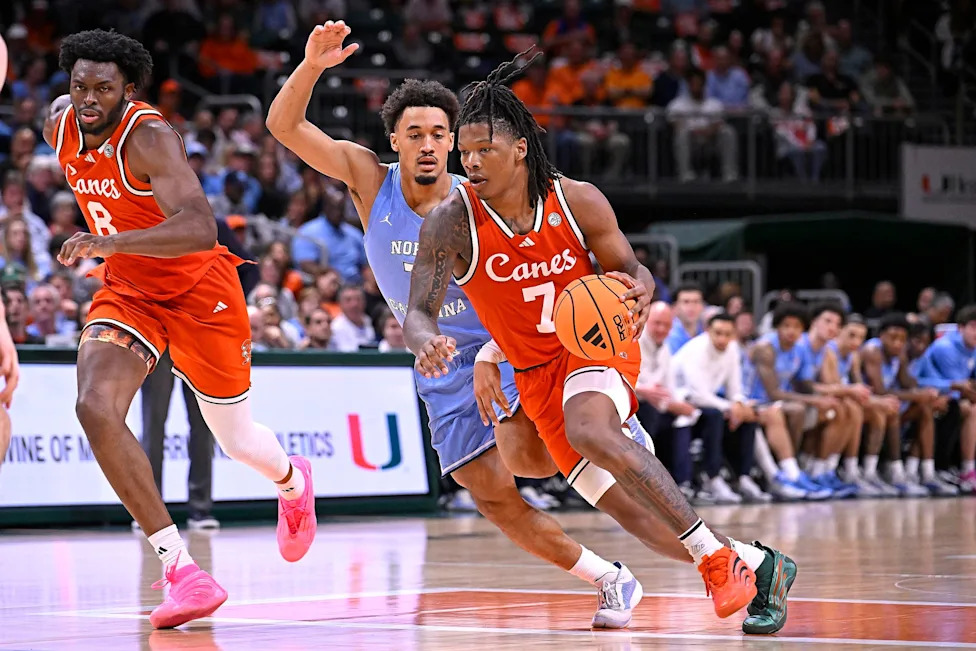
The Atlantic Coast Conference race could be getting much more interesting as the late summer approaches. Recent court rulings allowing players from the 2022 recruiting class to receive a fifth year of eligibility have created opportunities for several teams to strengthen their rosters, and Miami and Louisville are among the biggest beneficiaries.
While Duke remains the clear team to beat, the Blue Devils may have more legitimate challengers than they did just a few weeks ago. Louisville has already added former North Carolina standout Seth Trimble and could potentially bring in former Michigan State forward Jaxon Kohler. Meanwhile, Miami could receive an enormous boost if Malik Reneau is allowed to return for another season.
The question is whether those additions are enough to close the gap on Duke.
LOUISVILLE IS MAKING A SERIOUS PUSH
Louisville has been one of the more intriguing teams in the ACC, and the addition of Trimble gives the Cardinals another proven player who understands the league and has experience playing at a high level.
The possibility of adding Kohler would make the situation even more interesting. The former Michigan State forward could provide Louisville with additional size, physicality and experience in the frontcourt.
However, Louisville still has plenty to prove before it can be considered Duke’s equal.
For one thing, the Cardinals have struggled against the Blue Devils for quite some time. Duke has won nine straight meetings against Louisville, although that streak must be viewed in the context of Louisville’s significant program turmoil over the past several seasons.
This version of Louisville is different, though. If the Cardinals can quickly integrate their late additions and establish strong chemistry, they could become a dangerous opponent when ACC play begins.
MIAMI COULD BE THE BIGGEST THREAT
Miami’s situation might be even more fascinating because of Reneau.
If Reneau ultimately prevails in his legal battle and decides to return, the Hurricanes would suddenly have a player they did not originally expect to have on their roster. That is a massive potential addition for a team that already has legitimate ACC aspirations.
Reneau is not an unknown commodity. Miami would not be trying to figure out whether he can contribute at this level. The Hurricanes already know what he brings, which could make his potential return much easier to handle than adding a completely new player.
There is still a complication, however.
Miami has spent the offseason preparing for a roster without Reneau. Other players have been developing roles, learning offensive responsibilities and building chemistry with one another. If Reneau returns late, head coach Jim Larrañaga and his staff would have to determine how to adjust those plans without disrupting what has already been established.
That could be challenging, but having too much talent is generally a problem coaches would rather have than the alternative.
UNC AND LOUISVILLE FACE A SIMILAR CHALLENGE
North Carolina has also benefited from the new eligibility developments, adding South Dakota center Cameron Fens. The Tar Heels needed help in the frontcourt, and Fens could provide valuable size and experience.
But just like Louisville and potentially Miami, UNC must deal with the difficulty of incorporating a new player late in the offseason.
Talent alone does not guarantee success.
Teams need time to establish rotations, understand defensive responsibilities and develop chemistry. Adding an important piece in August can give a team more talent while simultaneously creating uncertainty about how that talent fits together.
That is the biggest reason why Duke should remain the favorite.
DUKE STILL HAS THE ADVANTAGE
Even if everything goes perfectly for Louisville, Miami and North Carolina, catching Duke will be a difficult task.
The Blue Devils have the combination that every championship contender wants: size, talent, depth and quality coaching.
Duke can withstand injuries and inconsistent performances better than most teams because of its depth. The Blue Devils also have multiple players capable of creating offense, while their size gives them advantages on both ends of the floor.
That makes Duke much harder to knock off over the course of an entire ACC season.
And while Miami, Louisville and UNC may have improved their rosters, they still have to prove that their new pieces can quickly become productive parts of their teams.
Virginia should not be forgotten, either. The Cavaliers could make the ACC race even more competitive and potentially turn what looks like a four-team conversation into an even larger battle.
THE ACC RACE JUST GOT MORE INTERESTING
So, have the late-summer additions changed the ACC race?
Absolutely.
Have they made Duke vulnerable?
Perhaps—but not necessarily.
Louisville has improved, Miami could receive a major boost from Reneau, and North Carolina has addressed an important need with Fens. If Kohler also joins Louisville and Reneau returns to Miami, the conference could have several teams capable of challenging Duke.
Still, the Blue Devils remain the team everyone else has to catch.
The late additions have made the ACC race more exciting, but Duke’s combination of talent, depth, size and coaching means the road to the top still runs through Durham.
The challengers are getting stronger. Now they have to prove they can actually knock Duke off the throne.