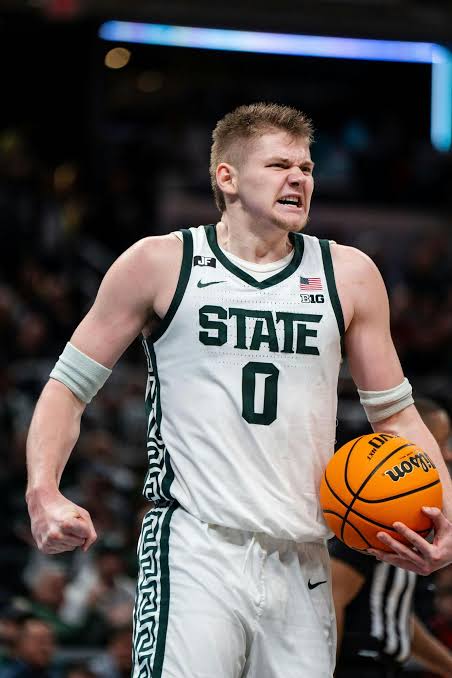
Jaxon Kohler’s decision to choose BYU over Kentucky may have looked straightforward from the outside, but comments from his father, Jeff Kohler, have revealed just how complicated and frustrating the recruitment became behind the scenes.
For weeks, Kentucky fans watched the situation unfold with growing curiosity. The Wildcats had emerged as one of the major programs pursuing Kohler after the former Michigan State big man became available for another season of college basketball. With Mark Pope and his staff rebuilding Kentucky, adding an experienced frontcourt player like Kohler appeared to make considerable sense.
But there was one major problem.
Because of the eligibility situation surrounding Kohler, schools were unable to communicate with him normally during much of the process.
That created an unusual recruiting environment in which the player and his family had to make decisions while dealing with limited direct communication from programs.
According to Jeff Kohler, that made the entire process extremely difficult.
And when the family began following the conversation surrounding Kentucky, things became even more complicated.
The Kentucky Connection Was Never Simple
Jeff Kohler was confident that Kentucky would have interest in his son if Jaxon eventually became eligible for the upcoming season.
That confidence is understandable.
Jaxon had developed into an experienced and productive frontcourt player at Michigan State, bringing size, rebounding ability, interior scoring and an increasingly reliable perimeter game.
For Kentucky, those qualities could have been valuable.
But according to his father, the family began hearing and seeing plenty of speculation suggesting that Jaxon was not necessarily Kentucky’s first choice.
That outside noise became increasingly difficult to navigate.
Instead of being able to simply call Kentucky’s coaching staff and ask where Jaxon stood, the family had to follow what was being reported and what Kentucky supporters were saying publicly.
And that is where things became frustrating.
Jeff explained that the family followed the Kentucky fan base to try to understand the tone surrounding his son.
What they encountered, however, was anything but reassuring.
“It’s Been Kind of a Nightmare”
The strongest part of Jeff Kohler’s comments was his description of the recruitment as a “nightmare.”
Speaking to the Lexington Herald-Leader, he explained that the family did not have the ability to hear directly from Kentucky’s coaching staff and therefore had to navigate the process through outside information.
“They haven’t really officially been able to talk to us, right?” Jeff said.
That single point helps explain why the recruitment became so difficult.
Imagine being a player trying to make one of the biggest decisions of your college career while not being able to have a normal conversation with every program involved.
Then imagine seeing reports, fan discussions and speculation suggesting that another player might be a school’s preferred option.
That creates uncertainty.
And uncertainty can make a player hesitant.
Jeff explained that following the fan base simply to understand the general tone surrounding his son became incredibly difficult.
“And a lot gets lost when you don’t actually get to hear these things from the coach,” he said.
That is perhaps the biggest takeaway from his comments.
For the Kohler family, the issue wasn’t necessarily that Kentucky did not want Jaxon.
It was that they didn’t have enough direct communication to understand exactly where he stood.
The First-Option Question
This is where the situation becomes particularly interesting.
Jeff explained that if a player believes another recruit is already a school’s first option, it becomes difficult to confidently make a decision.
“Because if you think that somebody else is their first option or whatnot, then you’d be kind of reluctant to make that decision,” he said.
That statement provides important context surrounding Kohler’s eventual choice.
From the outside, recruiting can often look like a simple competition between schools.
One school makes an offer.
Another school makes an offer.
The player chooses one.
But situations like this demonstrate how much more complicated the process can be.
A player isn’t simply deciding which school has the biggest name or which coach has the most impressive pitch.
They also want to know whether the program genuinely wants them.
They want to know whether they are a priority.
They want to know what their role will be.
They want to know whether the coaching staff sees them as an important piece of the roster or merely an alternative if another target doesn’t work out.
For Kohler, that uncertainty appears to have mattered.
Kentucky Had Other Options
Another important element of the story is Kentucky’s broader roster situation.
Mark Pope and his staff were evaluating multiple possibilities as they attempted to finalize their roster.
That is completely normal during the transfer-portal era.
Coaches rarely pursue only one player at a position.
Instead, they identify multiple targets and evaluate different possibilities depending on availability, eligibility, fit and timing.
But from the player’s perspective, knowing that a school has other options can create uncertainty.
And according to Jeff Kohler, that was precisely the problem.
If the family believed Kentucky had someone else ahead of Jaxon, they would naturally be hesitant to make Kentucky the final choice.
After all, nobody wants to commit to a program believing they are Plan B.
That becomes even more significant when the player is preparing for what could be his final season of college basketball.
The Communication Problem Changed Everything
Perhaps the most fascinating aspect of this entire situation is the role communication—or the lack of it—played in Kohler’s recruitment.
Normally, a player considering a transfer can speak directly with coaches.
They can ask questions.
They can discuss playing time.
They can learn about offensive systems.
They can understand what the coaching staff expects.
They can build relationships.
In Kohler’s situation, that process was severely restricted.
As Jeff explained, it became difficult to navigate when schools could not officially call his son.
That left the family relying heavily on outside information.
And outside information can be incredibly unpredictable.
One report might suggest Kentucky was strongly interested.
Another might suggest the Wildcats were prioritizing somebody else.
A fan discussion could create another narrative entirely.
For a family trying to make an important decision, separating reliable information from speculation can become exhausting.
Jeff’s comments suggest that was exactly what happened.
Why BYU Ultimately Won
Kohler eventually chose BYU over Kentucky.
And while the decision certainly had a strong connection to his Utah roots and the opportunity to return home, the circumstances surrounding Kentucky’s recruitment provide another layer to the story.
BYU was able to present Kohler with a situation in which he could clearly understand where he stood.
That clarity matters.
For a player entering the final stage of his college career, knowing that a program wants him and understands how he fits into its plans can be incredibly important.
Kentucky may have been interested.
The Wildcats may have made a strong pitch.
But if the Kohler family wasn’t completely convinced that Jaxon was a priority, that uncertainty could have influenced the final decision.
It would be unfair to say that Kentucky’s communication situation alone caused Kohler to choose BYU.
There were clearly multiple factors involved.
But Jeff’s comments suggest that it was part of the overall equation.
Kentucky Fans May See the Situation Differently Now
For Kentucky supporters, the revelation may change the way they view the recruitment.
Many fans may have assumed that Kohler simply preferred BYU.
Others may have believed that Kentucky’s pitch wasn’t strong enough.
Some may have wondered whether the Wildcats had prioritized another frontcourt player.
Now, Jeff’s comments provide a glimpse into what the family was hearing and feeling during the process.
The key point is that the Kohlers were paying attention.
They were watching the Kentucky fan base.
They were trying to determine how the program viewed Jaxon.
And they were attempting to make a major decision without the normal level of communication between a player and a coaching staff.
That is an incredibly difficult position.
This Wasn’t Necessarily a Rejection of Kentucky
One of the most important distinctions to make is that Kohler’s decision should not automatically be interpreted as a rejection of Kentucky or Mark Pope.
The Wildcats were clearly involved.
Kentucky had an opportunity to recruit him.
Kohler was reportedly considering the program seriously.
But recruitment decisions are rarely about one single factor.
In this case, there appears to have been a combination of home, fit, communication, timing and perceived priority.
And when those factors were weighed together, BYU ultimately came out on top.
That makes the situation much more nuanced than simply saying that Kentucky “lost” Kohler.
The Bigger Lesson for Modern Recruiting
Kohler’s recruitment also highlights one of the strangest realities of modern college basketball.
The transfer portal has dramatically changed how players move between programs.
Eligibility rules, legal decisions and roster construction can create situations that would have been difficult to imagine only a few years ago.
Players and families sometimes have to make major decisions while dealing with complicated restrictions.
Coaches are simultaneously trying to recruit multiple players while managing their existing rosters.
And fans are constantly analyzing every development.
That combination can create enormous amounts of speculation.
Kohler’s situation is a perfect example.
A player was waiting to learn whether he could play another season.
Programs were interested.
Fans were debating potential destinations.
Reports were circulating.
And yet, according to his father, the family could not simply pick up the phone and get all the answers directly from the coaching staff.
That is why the process became so challenging.
The Final Decision
In the end, Jaxon Kohler chose BYU.
For Kentucky, it was a disappointing conclusion to a recruitment that had generated real hope among the fan base.
But Jeff Kohler’s comments suggest there was much more happening behind the scenes than fans could see.
The family wanted clarity.
They wanted to know whether Kentucky genuinely viewed Jaxon as a priority.
They wanted to hear directly from the coaching staff rather than trying to interpret what fans and reports were saying.
Instead, they were forced to navigate uncertainty.
And when a player is deciding where to spend what could be his final college season, uncertainty can be decisive.
The story does not necessarily mean Kentucky mishandled the recruitment.
It does not prove that Jaxon would have chosen Kentucky if communication had been different.
And it certainly does not erase the importance of BYU’s other advantages, particularly the opportunity for Kohler to return closer to home.
But it does reveal something that had previously been difficult to see.
The Kohler family was never completely comfortable with where Kentucky stood in the recruitment.
That hesitation mattered.
And when the time came to make the final decision, BYU ultimately offered the combination of clarity, familiarity and opportunity that Kentucky could not overcome.
For Kentucky fans, it is a painful “what if?”
What if the Wildcats had been able to communicate more directly?
What if Kohler had known for certain that he was a top priority?
What if the outside noise surrounding Kentucky’s other options had never entered the picture?
We’ll never know.
What we do know is that Jaxon Kohler chose BYU, and his father’s comments provide a fascinating look at just how difficult the road to that decision really was.
The recruitment wasn’t
simply about Kentucky versus BYU.
It was about trust, communication, timing, fit and the feeling that a player is genuinely wanted.
And according to Jeff Kohler, navigating those questions without direct communication turned the entire process into what he described as a “nightmare.”