


The Kentucky Wildcats have experienced another frustrating turn in the transfer portal, and this time, the disappointment came with a familiar face at the center of the story.
Mark Mitchell, a Missouri forward who had previously committed to Mark Pope and Kentucky, has decided against joining the Wildcats and will instead return to Missouri. The unexpected change of plans has added another layer of frustration to what has already been a difficult offseason for Kentucky in the transfer portal.
And just hours after the news broke, Mark Pope had a message for his team.
Pope addressed his players ahead of practice Monday, delivering a passionate speech centered around one simple idea: Kentucky cannot wait for anyone to give it an opportunity.
The Wildcats have to go out and earn it.
That message immediately caught the attention of Kentucky fans, particularly because of the timing.
Mitchell’s decision had just become public, and fans quickly connected Pope’s emotional message with the latest setback.
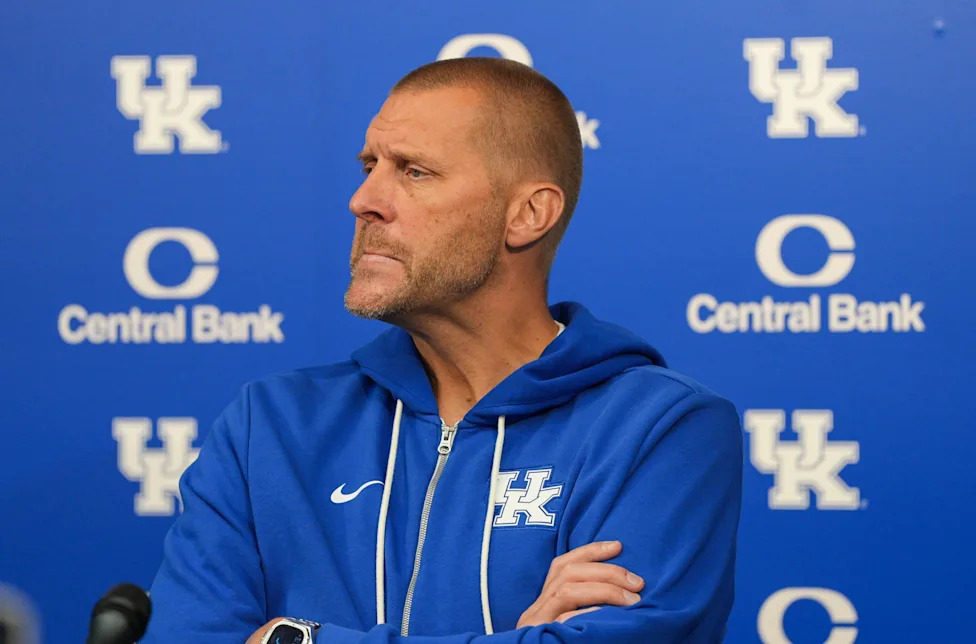
Some supporters viewed the speech as exactly what Kentucky needed to hear. Others saw something different, interpreting Pope’s expression and tone as evidence of the frustration that comes with watching another transfer target choose a different path.
One fan wrote that “you can see the pain in his eyes” as Pope tried to convince his players that he believed in them after the Mitchell news.
Another fan questioned the current state of Kentucky basketball, arguing that the program has fallen from the dominant position it once occupied.
Others were even more blunt, suggesting that Pope is struggling to build the roster he wants.
But regardless of how fans interpreted his emotions, Pope’s actual message to his players was unmistakable.
He was not asking them to feel sorry for themselves.
He was telling them to fight.
“The great thing about sport is that nobody is going to give you anything,” Pope told his team. “You never look for a break. You’re just going to take everything that you want. You have to go take it and earn it. There are no shortcuts, there’s no easy way. You just eat what you kill. That’s it.”
It was a message about accountability, toughness and refusing to wait for circumstances to become favorable.
And given what Kentucky had just experienced, the timing made the speech even more powerful.
Mitchell’s decision represented another transfer portal disappointment for the Wildcats this offseason.
Kentucky had hoped to add Mitchell to its roster, but his situation became complicated after he sought an additional year of eligibility. After missing the primary transfer window and facing the possibility of severe SEC penalties connected to conference transfer rules, Mitchell ultimately decided to return to Missouri instead.
For Kentucky, that meant another potential addition disappearing from the roster.
Mitchell became the fourth notable player to turn down Kentucky this offseason.
Michigan State transfer Jaxon Kohler chose BYU. Syracuse transfer Donnie Freeman committed to St. John’s. Tyran Stokes chose Kansas. And now Mitchell has decided to stay at Missouri.
Each decision carries its own circumstances, but the cumulative effect has naturally led to questions among Kentucky supporters.
Kentucky is one of the biggest names in college basketball. The Wildcats have enormous national recognition and significant NIL resources, with the program reportedly operating with a budget of around $22 million.
That makes the transfer portal misses particularly noticeable.
When a program with Kentucky’s resources fails to land multiple highly sought-after players, fans are naturally going to ask questions.
Why did the players choose somewhere else?
Is the issue recruiting?
Is it roster fit?
Is it eligibility uncertainty?
Is it the changing nature of college basketball?
Or is it simply a reflection of how unpredictable the transfer portal has become?
There is no single answer to all of those questions.
The transfer portal has transformed roster construction. Players can change schools for a variety of reasons, including playing time, eligibility, relationships, NIL opportunities, location and professional development.
A commitment can also change when circumstances change.
That appears to be particularly relevant in Mitchell’s case.
Kentucky believed it had landed the Missouri forward, but the situation surrounding his eligibility ultimately became complicated enough that Mitchell reversed course.
For Pope and his staff, that is undoubtedly a frustrating outcome.
But Pope’s response was not to publicly dwell on the disappointment.
Instead, he turned his attention toward the players already in the building.
His message was essentially that Kentucky’s success cannot depend on someone else deciding to make things easier.
The Wildcats have to create their own opportunities.
That philosophy is especially important in an offseason when the roster has gone through significant change.
Pope is attempting to build a team capable of competing at the highest level, and that means finding the right combination of talent, experience and chemistry.
The transfer portal can provide immediate talent, but it can also produce uncertainty.
One day, a player appears to be heading to your program.
The next day, circumstances change.
That is why Pope’s message about earning everything may have been directed at more than just the latest disappointment.
It can also be viewed as a broader philosophy for the season ahead.
Kentucky cannot control which players choose another school.
It cannot control every eligibility decision.
It cannot control how other programs approach the transfer portal.
What it can control is what happens once the players are inside the Kentucky program.
That was the heart of Pope’s message.
Nobody is going to hand Kentucky success.
Nobody is going to give the Wildcats a break simply because of the program’s history.
Nobody is going to care that Kentucky has traditionally been one of the most recognizable names in college basketball.
The current team has to prove itself.
That is why the statement from the Kentucky basketball account following the Mitchell news also stood out.
“Take it and earn it.”
Those words perfectly summarized the mentality Pope was trying to instill.
For Kentucky fans, however, the emotional reaction to the situation remains understandable.
The Wildcats have experienced several recruiting disappointments, and Mitchell’s decision was the latest one.
Fans have watched other programs land players Kentucky pursued, and that inevitably creates frustration.
One supporter described being “genuinely perplexed” by the current state of Kentucky basketball, comparing the program’s present situation with the dominant Kentucky teams of the past.
Another fan simply mocked Pope’s appearance, saying he looked sad.
Not everyone was negative, though.
Some fans appreciated the message and the mentality behind it.
And that distinction matters.
A coach can be disappointed by losing a recruit while simultaneously believing strongly in the players already on his roster.
In fact, Pope’s speech suggests exactly that.
Rather than allowing the Mitchell situation to become the defining story of the day, he challenged his players to focus on what they can control.
That could ultimately be the most important takeaway for Kentucky.
The transfer portal will always produce winners and losers.
Some players will commit and stay.
Others will change their minds.
Some recruits will choose Kentucky.
Others will choose Louisville, Kansas, BYU, Missouri, St. John’s or another program.
Kentucky cannot control every decision.
But Pope can control the culture he creates.
And his message on Monday was clear: the Wildcats are not going to wait for somebody else to make their path easier.
They have to build their own path.
That could become particularly important once the season begins.
At that point, nobody will care about which transfers Kentucky landed or failed to land.
Nobody will care how much money was available in NIL.
Nobody will care which recruiting battles were won or lost.
The only thing that will matter is what happens on the basketball court.
Pope knows that.
His players know that.
And now Kentucky fans have been reminded of it as well.
The loss of Mitchell certainly hurts, particularly because Kentucky had already believed it was adding him to the roster.
But the Wildcats still have a season to play.
They still have players who chose Kentucky.
They still have an opportunity to build chemistry.
And they still have the chance to prove that one transfer portal disappointment—or even several of them—does not determine the fate of an entire season.
That appears to be exactly what Pope wanted his team to understand.
The message was not “feel sorry for yourselves.”
It was the opposite.
Go take it. Go earn it.
And after another difficult transfer portal development, Kentucky’s season will ultimately be judged not by who said no to the Wildcats, but by what the players who remained in Lexington do when they finally get their chance.




