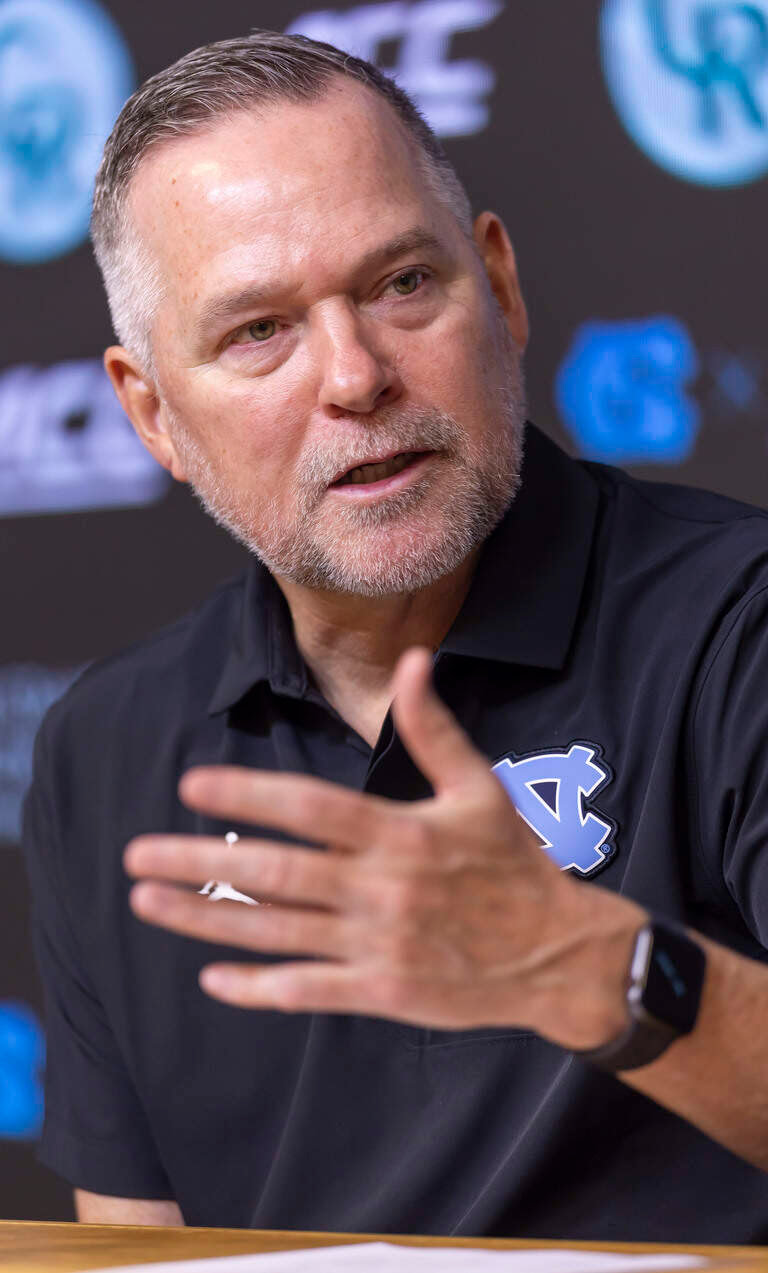
CHAPEL HILL — Michael Malone is officially settling into life as the head coach of the North Carolina Tar Heels, and after five months away from the public spotlight, he finally opened up about his first few months in Chapel Hill.
There is plenty to talk about.
From building a completely new roster to navigating the ever-changing world of college basketball, Malone is discovering that returning to the college game after 25 years in the NBA comes with a learning curve of its own.
And while Malone has spent much of his coaching career working with some of the best basketball players in the world, his first season at North Carolina is going to require something very different.
It will require patience, adaptability, recruiting, player development and, perhaps most importantly, an understanding of how quickly college basketball can change.
When Malone spoke Tuesday, the significance of his new position was impossible to miss.
Just a few feet away were large photographs of Dean Smith and Roy Williams, two legendary figures whose names are permanently connected to the standard of North Carolina basketball.
Those images serve as a constant reminder of what comes with being the head coach at one of college basketball’s most recognizable programs.
For Malone, however, the challenge appears to be something he is embracing.
Malone gets honest about the biggest challenge
One of the biggest adjustments for Malone has nothing to do with X’s and O’s.
It is the changing landscape of college athletics.
The transfer portal, recruiting, roster movement and constantly evolving rules have created an environment that can be difficult even for experienced coaches to navigate.
Malone admitted that the unpredictable nature of college basketball has been one of the hardest parts of his transition back to the college game.
“What is strange about college athletics is that it seems like the rules change every day, like literally every day,” Malone said.
That reality has forced coaches across the country to constantly adjust their strategies.
A roster that looks complete one day can suddenly look different the next. A recruiting target can change his mind. A transfer can enter the portal. New rules can alter how programs operate.
For someone who spent the last quarter-century in the NBA, the adjustment is particularly significant.
Malone knows basketball.
That part is not new.
But the structure surrounding college basketball is dramatically different from what he experienced during his NBA career.
He acknowledged that while he had a good idea of what recruiting and the transfer portal would involve, the constant changes have made the job more complicated.
And that may be one of the biggest challenges facing his first UNC team.
Learning to see the college game differently
Malone also admitted that he has had to retrain himself when evaluating younger players.
After 25 years in the NBA and 12 years as an NBA head coach, Malone became accustomed to coaching experienced professionals.
Now, he is dealing with players who are still developing physically, mentally and emotionally.
That requires a different perspective.
“You’ve got to remember, I was in the NBA for 25 years and was a head coach for the last 12,” Malone explained.
He said he has had to “train my eyes” because he is no longer evaluating players who have already spent years developing at the highest level.
Instead, he is looking at younger prospects and trying to determine what they could become.
That is an important distinction.
At the NBA level, coaches often work with players who already understand the demands of professional basketball.
At the college level, development is much more central to the process.
Malone will have to identify talent while also figuring out which players can develop into the type of athletes capable of succeeding at North Carolina.
Defense could define Malone’s first UNC team
If there is one thing Malone appears determined to establish immediately, it is a defensive identity.
The 2026-27 Tar Heels will feature plenty of new faces, with 11 newcomers joining five returning players.
That level of roster turnover means Malone cannot simply rely on familiarity.
He has to build a culture.
And according to Malone, that culture begins on defense.
“Defense is going to be the most important thing,” Malone said.
That philosophy should not come as a surprise to anyone familiar with his coaching background.
Malone has long emphasized defensive intensity, accountability and toughness.
He believes that for North Carolina to play the offensive style he wants, the Tar Heels first have to be able to get stops.
“I’m a firm believer that defense wins championships,” Malone said.
That message is already being emphasized during practices.
The Tar Heels have offensive talent in the backcourt, including Terrence Brown, Matt Able and Neo Avdalas, while several big men will compete for opportunities in the frontcourt.
But talent alone will not determine how quickly this team comes together.
Malone wants his players to understand that effort on the defensive end will determine how much freedom they ultimately have offensively.
A roster still searching for its identity
This first roster was never expected to be Malone’s finished product.
The Tar Heels lost NBA-level talent in Caleb Wilson and Henri Veesaar following last season, and the program entered a new era after Hubert Davis was dismissed.
Malone was then tasked with putting together a roster capable of competing immediately while simultaneously establishing his own culture.
That is no easy assignment.
The transfer portal has made roster construction more unpredictable than ever, and coaches must now balance recruiting high-level talent with retaining the players already in the program.
Malone’s first UNC roster reflects that reality.
There are experienced transfers, young talent and returning players who now have an opportunity to establish themselves under a new coaching staff.
One player drawing particular attention is 7-foot South Dakota graduate transfer Cameron Fens.
His eligibility remains unresolved, but he has continued working out with the team.
Malone’s description of Fens as a “grown-ass man” illustrates what he values in a frontcourt player: physicality, toughness and maturity.
Malone is learning the Carolina spotlight
There is another adjustment Malone is experiencing away from the basketball court.
He is becoming a recognizable figure around Chapel Hill.
When he first arrived, Malone could move around the community relatively unnoticed.
That has changed.
His daughter Bridget plays volleyball at UNC, and Malone has embraced being both a basketball coach and a father supporting his daughter.
During a recent trip to Davidson for a UNC volleyball match, Malone joked that there were “Tar Heels everywhere.”
The visibility comes with the territory.
Being the head basketball coach at North Carolina means being more than a basketball coach.
It means representing the university, interacting with fans, attending events and serving as an ambassador for the program.
Malone acknowledged that reality and said he welcomes it.
While his NBA career was heavily focused on winning games, his UNC role comes with a much broader responsibility.
He understands that fans want to meet him, talk to him and take pictures with him.
For a coach leading a program with North Carolina’s tradition, that connection matters.
Accountability without losing the human element
Perhaps the most revealing part of Malone’s press conference involved his coaching philosophy.
Former UNC star Antawn Jamison recently highlighted Malone’s willingness to hold everyone accountable, regardless of their status.
That included superstar LeBron James during Malone’s time with the Cleveland Cavaliers.
According to Jamison, Malone did not treat James differently from everyone else.
That same mentality is now coming to Chapel Hill.
Malone wants his players to understand that expectations will be extremely high.
But he also wants them to know that his demanding approach comes from a place of genuine care.
He explained that he has challenged himself to be demanding and hold players accountable while also making sure they know he loves them and has their backs.
That philosophy is rooted partly in his relationship with his late father, former NBA coach Brendan Malone.
Malone said his father taught him that one of the greatest gifts a coach can give a player is confidence.
That lesson appears to be shaping the way he approaches his new job.
He wants to push his players.
He wants to demand more from them.
But he also wants them to believe in themselves.
The beginning of a new era
There is still a long way to go before anyone knows exactly what Michael Malone’s tenure at North Carolina will become.
His first roster is still developing.
The players are learning his system.
Malone is learning the college landscape all over again.
And North Carolina fans are learning what their new coach will demand from the program.
But his message so far is clear.
Defense matters.
Accountability matters.
Confidence matters.
And building relationships matters just as much as drawing up plays.
The Tar Heels will open their home schedule Nov. 2 against Western Carolina, giving Malone his first opportunity to experience a full game inside the Smith Center as North Carolina’s head coach.
By then, the expectations will be enormous.
That comes with the territory at UNC.
The photographs of Dean Smith and Roy Williams may serve as reminders of the past, but Malone is focused on creating his own chapter.
His first roster may not be his best.
His first season may come with challenges.
And the college basketball landscape may continue changing almost every day.
But Malone appears ready for the challenge.
Now, Tar Heel Nation gets to find out what his vision looks like once the games begin.