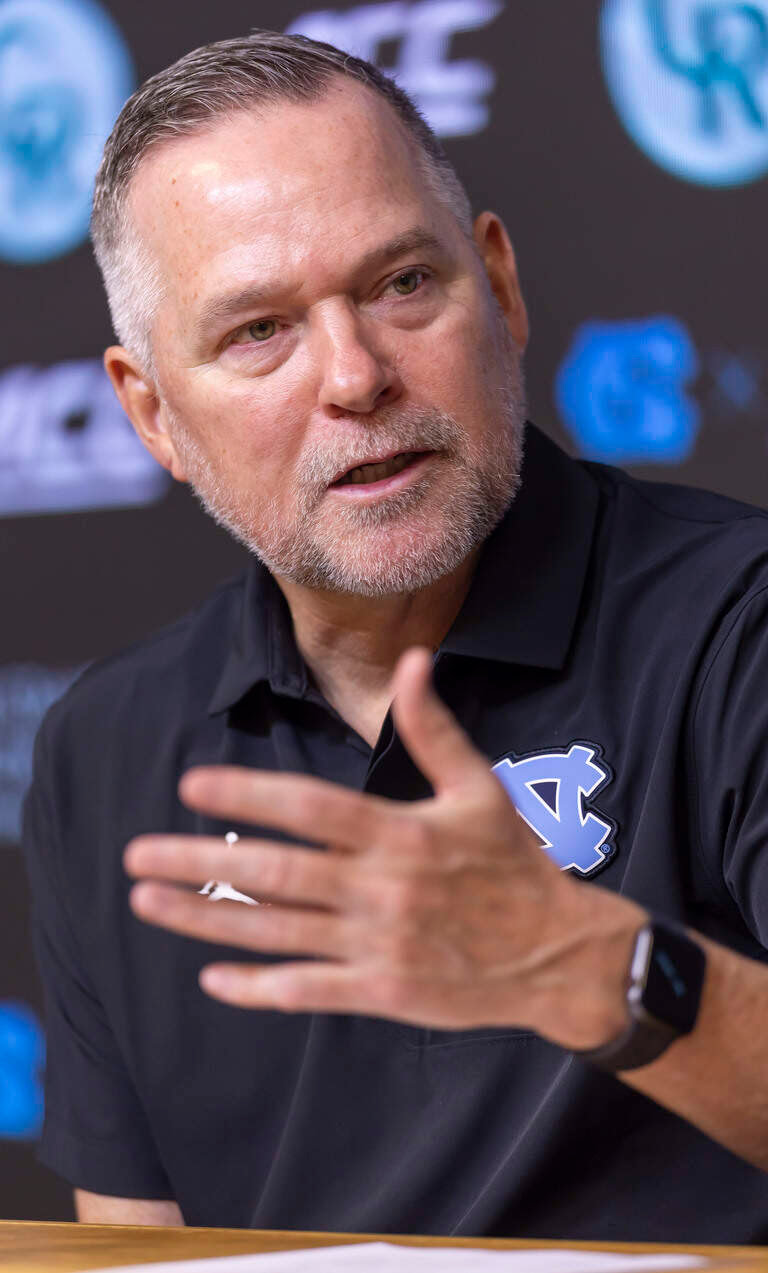
North Carolina basketball has entered a completely different era.
When Michael Malone arrived in Chapel Hill, he inherited more than just one of the most recognizable programs in college basketball. He inherited a roster that needed to be rebuilt almost immediately, a transfer portal that was moving at breakneck speed, a new financial reality in college athletics and a fan base expecting results.
And somehow, in a remarkably short period of time, Malone and his staff put together a roster that has reportedly been valued at around $20 million.
That number alone is enough to make people stop and ask questions.
Where did the money go?
Why did UNC decide to spend at this level?
How did Malone convince so many players to come to Chapel Hill?
And perhaps most importantly: Does spending approximately $20 million actually give North Carolina the roster it needs to compete for championships?
The answers reveal just how dramatically college basketball has changed.
Michael Malone Didn’t Have the Luxury of Time
Malone’s arrival at North Carolina was already one of the biggest coaching stories in college basketball.
The former NBA champion head coach signed a six-year, $50 million contract with UNC, giving him the resources and expectations associated with one of the biggest jobs in the sport. His first-year salary was reported at $7.5 million, while UNC’s agreement also included a commitment of at least $6.75 million toward revenue sharing and as much as $4 million for assistant coaches and support staff.
But money wasn’t the only challenge.
The timing was brutal.
Malone was taking over a program that needed significant roster reconstruction, and the transfer portal was already becoming the center of the college basketball offseason.
There was no traditional luxury of spending an entire year evaluating his players before making major changes.
He had to act.
Fast.
And he did.
The New UNC Roster Looks Nothing Like a Traditional Rebuild
North Carolina’s official 2026-27 roster contains 16 players, with only five players returning from the previous season and 11 newcomers joining Malone’s first team in Chapel Hill.
That group includes four freshmen, six college transfers and one international addition.
That is an enormous amount of turnover.
Among the returning players are Jarin Stevenson, Jaydon Young, Evan Smith, John Holbrook and Isaiah Denis.
The newcomers include transfer additions such as Terrence Brown, Matt Able, Neoklis Avdalas, Angelo Brizzi and Cameron Fens, along with international talent Alexandros Samodurov and Sayon Keita.
UNC also added freshmen Maximo Adams, Kevin Thomas and Malloy Smith, among others.
It is a roster that combines experience, youth, size, international talent and players coming from very different basketball environments.
And that was intentional.
Malone wasn’t simply trying to find the biggest names available.
He was trying to build a team.
Malone Went Looking Everywhere
One of the most fascinating aspects of UNC’s roster construction was how quickly Malone and his staff adjusted to their new reality.
Malone came from the NBA, where scouting players involves an entirely different process.
Suddenly, he had to evaluate teenagers, high school prospects, international players and college transfers.
He acknowledged that he had to essentially “train his eyes” when evaluating younger players.
That transition could have been a major obstacle.
Instead, Malone used his NBA experience as a recruiting advantage.
He can tell recruits what it takes to reach the NBA because he has spent years coaching at the highest level.
He coached Nikola Jokic.
He coached All-Stars.
He won an NBA championship with Denver.
And now he can take that experience and sell it to young players who want to reach the next level.
That is a powerful recruiting pitch.
Malone has also made it clear that he doesn’t intend to rely exclusively on the transfer portal.
He wants UNC to remain a destination for elite high school talent while also using the portal when necessary.
That balance could become one of the defining characteristics of his tenure.
The $20 Million Question
But here’s where things get really interesting.
Building a roster is one thing.
Building an expensive roster is another.
The reported $20 million figure illustrates how different the financial structure of college basketball has become.
There was a time when fans primarily thought about scholarships, facilities and coaching salaries when evaluating the financial side of a college basketball program.
Now, roster construction itself has become a major financial operation.
Players have value.
Transfers have value.
Experience has value.
Production has value.
And schools are increasingly competing for players in a marketplace where financial resources can influence where those players decide to play.
UNC has chosen to compete.
And compete aggressively.
The reported $20 million valuation isn’t simply about buying talent. It’s about building an infrastructure capable of attracting talent while giving Malone enough resources to construct the roster he believes can win.
The Roster Has a Fascinating Mix
Look at the makeup of this team and it becomes easier to understand why Malone and his staff were willing to invest so heavily.
Terrence Brown arrives after averaging nearly 20 points per game at Utah and gives UNC an experienced scoring option.
Matt Able provides another transfer piece from NC State.
Neoklis Avdalas gives UNC an international and versatile element after his time at Virginia Tech.
Angelo Brizzi and Cameron Fens were among the later additions to the roster.
Then there are the international players.
Samodurov, a 6-foot-11 forward, joins the Tar Heels after playing professionally with Panathinaikos in Greece.
Sayon Keita, a 7-foot-1 freshman, arrives after playing at the U18 level for FC Barcelona.
Both players were eventually cleared to compete for UNC after the program completed the necessary international eligibility process. ([On3][4])
That international component is particularly intriguing.
UNC is not simply recruiting from the traditional American college basketball pipeline anymore.
Malone and his staff are looking globally.
This Isn’t Just About Talent—It’s About Fit
One of the biggest questions surrounding a roster this expensive is whether the individual pieces can actually function together.
That’s where coaching becomes critical.
You can spend millions assembling players.
You cannot spend millions to guarantee chemistry.
You cannot simply purchase defensive communication.
You cannot buy toughness.
And you cannot guarantee that a group of talented players will sacrifice individual statistics for the success of the team.
That will be Malone’s biggest challenge.
His NBA background could help tremendously.
His Denver teams were built around movement, unselfishness and maximizing the strengths of their best players.
Now he has to translate that philosophy to college basketball.
The players are younger.
The season is different.
The schedule is different.
The roster can change dramatically from year to year.
And the pressure at North Carolina is enormous.
The Expectations Are Already Sky-High
There is another reason the $20 million figure matters.
It raises expectations.
If UNC had assembled an inexpensive roster filled primarily with developmental players, fans could reasonably expect Malone to need time.
But when the reported investment approaches $20 million, patience becomes much harder to sell.
The question won’t simply be:
“Is Malone building something?”
It will become:
“Why isn’t this team winning?”
That is the reality of modern college basketball.
Money creates opportunities.
It also creates pressure.
Malone understands that.
When discussing his first season, he has emphasized that the immediate objective isn’t simply to announce that UNC is trying to win a championship.
Every program says that.
Instead, Malone wants his team to improve every day, establish an identity and play in a way that makes the fan base proud.
That sounds simple.
At North Carolina, it is anything but.
UNC Has Officially Entered the New Era
Perhaps the biggest takeaway from this roster isn’t even the $20 million figure.
It’s what the figure represents.
North Carolina has accepted the new reality of college basketball.
The Tar Heels aren’t sitting back and hoping their traditional brand alone will be enough.
They are investing.
They are recruiting nationally.
They are recruiting internationally.
They are using the transfer portal.
They are developing high school players.
And they are giving a championship-level coach the resources necessary to build the roster he wants.
The 2026-27 roster is the clearest evidence yet.
Only five players returned.
Eleven new players came through the door.
The team includes transfers, freshmen and international players.
And at the center of it all is Michael Malone, an NBA champion attempting to prove that his basketball philosophy can translate from the professional game to one of college basketball’s most demanding programs.
But Now Comes the Hard Part
Building the roster was the first challenge.
Coaching it is the next one.
UNC has spent the money.
Malone has recruited the players.
The staff has been assembled.
The roster is now officially set.
But none of that guarantees a championship.
The players still have to defend.
They have to rebound.
They have to share the basketball.
They have to stay healthy.
They have to handle pressure.
And Malone has to figure out which combinations work best.
That is what makes this UNC season so fascinating.
The Tar Heels aren’t simply starting another season.
They are beginning an entirely new experiment in what happens when one of college basketball’s most historic programs gives an NBA championship coach the resources to build a modern roster from the ground up.
And if the reported $20 million investment produces the results UNC expects, it could become a blueprint for the future of college basketball.
If it doesn’t?
The questions will become even louder.
For now, one thing is undeniable:
Michael Malone didn’t come to Chapel Hill to play it safe.
He came to rebuild North Carolina aggressively—and the $20 million roster may be the biggest statement yet that the Tar Heels intend to compete with everyone in the new era of college basketball.