


The Mark Mitchell situation may have delivered a frustrating blow to Kentucky basketball, but Mark Pope is looking at the bigger picture.
While the Wildcats were among the programs directly affected by the Southeastern Conference’s increasingly strict approach to intra-conference transfers, Pope says the recent developments have given him something he has desperately wanted as a college basketball coach: clarity.
That might sound surprising considering Kentucky has been caught in the middle of one of the most complicated roster situations of the offseason. But Pope’s message is not about whether the latest rules benefited Kentucky. In fact, he openly acknowledged that the Wildcats have not been the beneficiaries of the SEC’s recent decisions.
Instead, Pope believes the conference has finally taken an important step toward establishing a system in which coaches know exactly what is allowed, what is prohibited and what consequences they face if they cross the line.
And for Pope, that is ultimately what matters most.
His message was remarkably straightforward:
“Just tell me the rules that I need to play by and let me play by them.”
That statement perfectly captures Pope’s frustration with the uncertainty surrounding college basketball’s current transfer landscape — and his optimism that the situation is finally beginning to stabilize.
Mark Mitchell situation puts Kentucky in the middle of SEC chaos
The controversy surrounding Mark Mitchell has been one of the biggest examples of how complicated the current college basketball environment has become.
Mitchell, a two-time All-SEC talent, attempted to move from Missouri to Kentucky. But the SEC made it clear that intra-conference transfers occurring outside the designated portal windows would not simply be treated like ordinary roster moves.
That put Kentucky and Pope in an uncomfortable position.
The Wildcats had an opportunity to add an established SEC player who could have made a significant impact on the roster, but the conference’s position created another layer of uncertainty.
Mitchell was able to obtain temporary relief allowing him to play for the time being, but the larger question surrounding intra-conference movement remained.
The SEC also made its position clear regarding potential violations, with significant penalties hanging over programs that refused to follow conference rules.
For coaches, that creates an enormous dilemma.
Every coach in the country is expected to be competitive. Every coach is expected to find legal ways to improve his roster. And every coach knows that failing to improve can have serious consequences when expectations are high.
That is why Pope says the uncertainty has been so difficult.
It is not simply about Kentucky.
It is about knowing where the boundaries are.
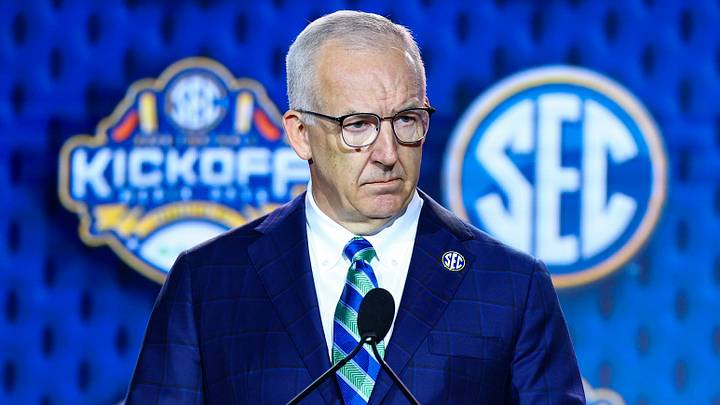
Pope surprisingly praises Greg Sankey
Despite the fact that the SEC’s position has created a problem for Kentucky, Pope offered strong praise for commissioner Greg Sankey.
That is perhaps the most surprising part of his comments.
Pope essentially acknowledged that Sankey has been a thorn in Kentucky’s side this offseason, but he also believes Sankey has done something important by forcing the conference to establish a clearer position.
According to Pope, coaches have spent far too much time trying to determine which rules actually apply.
Is it an NCAA rule?
Is it an SEC rule?
Is it a court ruling?
And what happens when those different authorities appear to conflict?
Those questions have become increasingly important as lawsuits and court decisions have changed the landscape of college athletics.
Pope believes that situation cannot continue indefinitely.
Instead, coaches need a framework they can understand.
They need rules they can read, interpret and follow.
And they need to know the consequences before making decisions.
That is why Pope described the SEC’s recent actions as encouraging even though Kentucky itself has been negatively affected.
“Just tell me the rules”
Pope’s central message could hardly be clearer.
He does not want special treatment.
He does not want Kentucky to receive an advantage that other programs do not have.
And he does not want to operate outside the rules.
What he wants is consistency.
If the NCAA and SEC establish a rule, Pope wants to know what that rule is. Once he knows it, he says he can compete within that framework and use his creativity to build Kentucky into the program he believes it can become.
That is an important distinction.
Pope isn’t arguing that coaches should be prevented from finding advantages. Quite the opposite.
He believes coaches should be allowed to be as creative and competitive as possible — provided they know exactly where the line is.
The problem, in his view, has been that the line keeps moving.
That has created an environment where coaches can make decisions they believe are legal, only to discover later that a different authority views the situation differently.
For a coach responsible for building a roster capable of competing for championships, that uncertainty can be extremely costly.
The “Wild Wild West” era of college basketball
College basketball’s transfer environment has changed dramatically.
The traditional model of recruiting high school players and developing them over several years has been supplemented by an increasingly aggressive transfer market.
Players can move between programs, NIL opportunities have transformed recruiting and schools are constantly trying to figure out how to construct rosters under changing regulations.
Pope essentially described the environment as the **“Wild Wild West.”**
That description has resonated with many college basketball fans because the offseason has often felt exactly that way.
Rules have been challenged.
Court cases have changed expectations.
Conference policies have created additional restrictions.
And coaches have been forced to make decisions without always knowing what the final legal or regulatory interpretation will be.
Kentucky’s experience with Mitchell is just one example of a much larger issue.
Pope believes the recent SEC developments could represent the beginning of a more predictable era.
Not necessarily an easier era.
Not necessarily one that favors Kentucky.
But one where everybody understands the playing field.
Kentucky’s leadership has Pope’s confidence
Pope also made it clear that he appreciates the support and direction he has received from Kentucky’s leadership.
He specifically pointed toward university president Eli Capilouto and athletic director J Batt as leaders who have provided guidance during an extremely complicated period.
That matters because coaches cannot operate in a vacuum.
When rules are unclear and legal challenges are happening simultaneously, the athletic department has to provide direction.
Pope’s comments suggest that Kentucky’s leadership has been actively involved in making sure the basketball program understands what it can and cannot do.
For Pope, that is essential.
He does not want to be known as the coach who intentionally pushes Kentucky into trouble simply to gain an advantage.
He wants to build the Wildcats aggressively, but within a framework that protects the program.
That is why his comments about Sankey are particularly notable.
Rather than attacking the SEC commissioner for creating obstacles, Pope appears to believe that establishing firm rules is ultimately good for everyone.
The next battle could be in Washington
Pope also acknowledged that the SEC’s efforts are only one part of a much larger battle.
College athletics is still searching for broader federal legislation that could establish national standards for issues involving transfers, NIL and other aspects of the modern collegiate model.
Pope said coaches and players were preparing to make their voices heard on Capitol Hill.
That means the uncertainty is not finished.
There are still major questions ahead.
But Pope believes there is finally some movement toward a system in which everyone understands the rules.
And that could be particularly important for Kentucky.
The Wildcats operate in one of the nation’s most demanding basketball environments. Expectations are enormous, recruiting competition is fierce and every roster decision receives intense attention from Big Blue Nation.
Pope understands that.
He also understands that Kentucky cannot afford to sit on the sidelines while other programs aggressively build their teams.
But he wants to compete knowing that the rules are the same for everyone.
## What this means for Mark Pope and Kentucky
The irony of the situation is difficult to miss.
Kentucky may have lost an immediate roster opportunity because of the SEC’s stance on Mitchell’s move, yet Pope is publicly praising the same conference leadership responsible for the restriction.
That tells you how important clarity has become.
Pope is thinking beyond one player.
He is thinking beyond one offseason.
He is thinking about the long-term future of college basketball.
For Kentucky, the goal remains unchanged: build a roster capable of competing for championships.
But Pope believes the best way to accomplish that is to know exactly what he is allowed to do.
The Wildcats may not always win every recruiting battle.
They may not always benefit from every new rule.
They may even be hurt by certain decisions, as Pope acknowledged has happened during the current offseason.
But if the rules are clear, Kentucky can adjust.
And that is exactly what Pope wants.
The Mark Mitchell situation may have created frustration in Lexington, but Pope’s latest comments reveal something else — he believes the chaotic transfer era is slowly becoming more manageable.
The message to the SEC is simple.
Give him the rules.
Then let Mark Pope compete.
And if the rules are finally clear, Big Blue Nation will expect him to do exactly what he was hired to do: build Kentucky into a championship contender.




