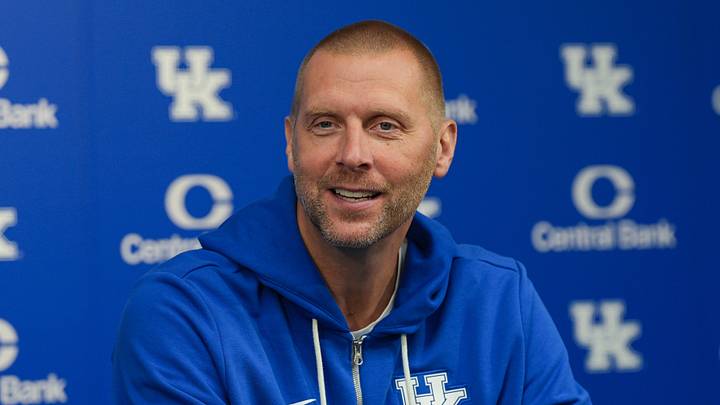
Mark Pope has finally offered his full thoughts on one of the most complicated and controversial issues surrounding college basketball this offseason, and his message may surprise some Kentucky fans.
The Kentucky head coach has been directly affected by the eligibility chaos surrounding the NCAA, the SEC and the so-called fifth-year eligibility situation. The Wildcats appeared to benefit from the possibility of adding Mark Mitchell, but the situation eventually became far more complicated after the SEC stepped in and enforced its position on intra-conference transfers.
Yet despite Kentucky being on the wrong side of the situation, Pope is not using his latest appearance to attack SEC Commissioner Greg Sankey.
Instead, Pope actually praised Sankey for bringing something coaches across college basketball have been desperately asking for: **clarity.**
And that might be the biggest takeaway from Pope’s comments.
## A chaotic offseason reaches Kentucky
The 2026 offseason has been anything but normal for college sports.
The eligibility situation surrounding athletes from the 2022 recruiting class created an enormous amount of uncertainty. A court ruling involving fifth-year eligibility opened the door for players to potentially return for another season, while additional legal challenges followed from athletes who had not entered the transfer portal during the traditional window.
That created a complicated environment for coaches.
Programs were suddenly forced to determine which players could legally return, which players could transfer and whether court decisions could override existing NCAA or conference rules.
Kentucky became directly involved when Mark Mitchell’s eligibility situation developed into a legal battle.
Mitchell, a talented forward and established SEC player, eventually received a favorable ruling that allowed him to continue pursuing his college career. Kentucky then became part of the picture, creating the possibility of Mitchell joining Pope’s roster.
But the situation did not end there.
The SEC ultimately enforced its longstanding position concerning players transferring between conference schools outside the designated transfer-portal window.
Mitchell had not entered the portal during that original window, and the SEC made it clear that the move from Missouri to Kentucky would not simply be permitted.
The result was a major setback for Kentucky.
Mitchell eventually returned to Missouri, leaving Pope without a player the Wildcats had hoped to add to their roster.
Under normal circumstances, that would be enough to make a coach furious.
But Pope’s reaction has been considerably more measured.
Pope’s surprising message about Greg Sankey
Appearing on the Paul Finebaum Show, Pope explained that the biggest problem coaches have faced is not necessarily the existence of rules.
It is the uncertainty surrounding them.
Coaches are expected to be incredibly competitive. They are expected to find every legal way possible to improve their rosters, recruit talented players and put their programs in position to compete for championships.
But that becomes extremely difficult when nobody knows exactly which rules apply.
Pope admitted that Kentucky has not been the beneficiary of the SEC’s recent push for clarity.
In fact, he said it has hurt the Wildcats.
Nevertheless, he believes the recent actions taken by the SEC represent progress.
Pope specifically praised Sankey for being willing to make difficult decisions and establish clear expectations for member schools.
His argument is simple: coaches can live with rules they don’t necessarily like as long as they know what those rules are.
That is why Pope’s comments have attracted so much attention.
“Just tell me the rules”
Pope’s philosophy can essentially be summed up in one sentence:
“Just tell me the rules that I need to play by and let me play by them.”
That is what he believes coaches desperately need.
For years, college basketball has operated in an environment where NCAA regulations, conference policies, court rulings and changing interpretations have sometimes collided.
A coach could believe something was permissible based on one set of rules, only to discover that another authority had a completely different interpretation.
That creates an impossible situation.
If a coach refuses to pursue an opportunity because he is worried about a potential violation, another program may take advantage of that hesitation.
But if a coach aggressively pursues every possible opportunity and the rules later change, the program could face serious consequences.
Pope believes coaches should not have to operate under those circumstances.
He wants to know where the line is.
Once that line is established, he wants the freedom to compete as aggressively as possible within it.
The SEC’s tougher approach
The SEC’s recent approach has demonstrated that the conference is willing to enforce its policies.
The controversy has extended beyond Mitchell.
The conference has also taken a strong position against schools attempting to use eligibility rulings or other legal avenues to push the boundaries of who can compete.
The situation involving LSU became another major example of how seriously the SEC is treating eligibility questions.
The message from conference leadership has become increasingly clear: schools cannot simply ignore conference policies because they believe they have discovered a legal or competitive loophole.
The potential penalties are severe.
Among the consequences discussed for coaches and programs that violate certain SEC restrictions are a half-season suspension for a head coach, significant financial penalties and the loss of SEC voting privileges on business matters.
That level of punishment demonstrates why coaches have been paying close attention.
For Pope, however, the severity of the penalties is not necessarily the problem.
The bigger issue is knowing exactly what conduct triggers those penalties.
Pope doesn’t want to be the “bad guy”
Interestingly, Pope also made it clear that Kentucky is not trying to become the program that deliberately pushes the SEC beyond its limits.
He emphasized the leadership provided by Kentucky’s administration and indicated that he appreciates having clear direction from the university.
That is significant because Kentucky’s expectations are enormous.
Pope knows that Big Blue Nation expects the Wildcats to compete for championships every season.
At the same time, he understands that Kentucky has to protect itself while navigating a rapidly changing college sports landscape.
He does not want the Wildcats to gain an advantage by intentionally breaking rules.
He wants to gain an advantage by being better at operating within them.
That means recruiting intelligently, building relationships, developing players and finding creative ways to construct the roster without crossing established boundaries.
The “Wild Wild West” is slowly changing
College basketball has often felt like the “Wild Wild West” during the transfer-portal and NIL era.
Rules have changed quickly.
Court cases have created new possibilities.
Players have challenged restrictions.
Schools have searched for loopholes.
And conferences have been forced to respond.
Pope believes that chaos is slowly giving way to something more predictable.
He still expects plenty of challenges ahead, including the possibility of federal legislation that could reshape college athletics again.
But he sees the SEC’s recent actions as evidence that conference leadership can establish rules and successfully defend them through the legal process.
For Kentucky, that could ultimately be a positive development.
The Wildcats may have lost Mitchell in the short term, but Pope believes the lessons from the situation could help coaches make better decisions moving forward.
What this means for Kentucky moving forward
Pope’s comments reveal a coach who is thinking about much more than one player.
Yes, losing Mitchell was significant.
Yes, Kentucky was directly affected.
And yes, the situation created plenty of frustration.
But Pope appears to believe that the long-term solution is more important than the short-term disappointment.
If the NCAA and SEC can establish clear guidelines, coaches will know how to operate.
Recruiters will know which players they can pursue.
Athletic departments will understand the risks.
And players will have a better understanding of their options.
That certainty could be extremely valuable for Kentucky.
Pope’s job is to build a championship-caliber program, and he believes he can do that more effectively when he knows exactly what the rules are.
For now, the biggest message coming out of Lexington is not anger toward Greg Sankey.
It is actually appreciation for the fact that the SEC is finally drawing clearer boundaries.
Kentucky may have been hurt by the latest developments, but Pope is looking beyond that setback.
The Wildcats still have championships to chase, rosters to build and recruits to pursue.
And Pope’s message is unmistakable:
Give him the rules.
Then let him compete.
And if the rules are finally clear, Mark Pope believes Kentucky can get back to doing what it does best — building a program capable of competing at the highest level.