


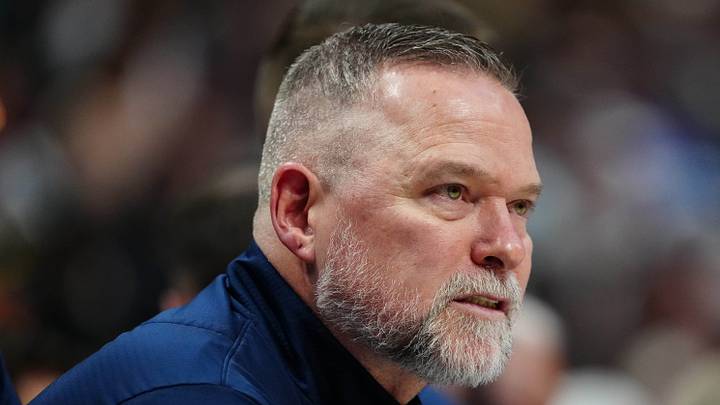
A new era has arrived in Chapel Hill, and according to one of North Carolina’s returning stars, Michael Malone is already making his presence felt.
The North Carolina Tar Heels are preparing for a dramatically different 2026-27 college basketball season with Malone taking over as head coach. While the results of his first season will ultimately be determined on the court, the early signs suggest that the former NBA coach has wasted little time establishing his expectations, demanding accountability and creating a new identity around the program.
For guard Terrence Brown, the difference has been impossible to miss.
Brown recently sat down with Jones Angell and Adam Lucas to discuss the upcoming season, and his description of Malone offered an intriguing glimpse into what life has been like under the new Tar Heels head coach.
According to Brown, Malone has brought an intense, highly detailed approach to practices while simultaneously emphasizing relationships and team chemistry away from the court.
“He’s really intense. He’s super detail oriented,” Brown said.
That attention to detail appears to be one of the defining characteristics of Malone’s early tenure in Chapel Hill.
MALONE’S INTENSITY IS ALREADY MAKING AN IMPACT
Coming from the NBA, Malone brings experience from the highest level of professional basketball. That background has naturally influenced the way he approaches practices, preparation and execution.
Brown explained that Malone expects players to understand exactly what they are being asked to do and then execute those instructions correctly.
“He comes from the NBA, so the highest level,” Brown said. “He just wants everything crisp, and he wants everybody to do things the right way when he explains it, so attention to detail.”
For a program looking to establish a new identity, that philosophy could prove particularly important.
Rather than simply emphasizing talent, Malone appears intent on creating habits. Every possession, defensive rotation and offensive action has a purpose, and players are expected to understand their responsibilities.
But there is another side to Malone that Brown believes is equally important.
Despite the intensity Malone displays on the court, Brown described him as someone who genuinely cares about his players away from basketball.
“Off the court, he’s just a great person,” Brown said. “A caring person that loves to build bonds with everybody around him.”
Brown’s comments suggest that Malone’s approach isn’t simply about demanding more from his players. He is also attempting to establish personal connections that can strengthen the team as a whole.
“You’d think he’s hard off the court, but he’s really just a great person, and he cares about everybody’s feelings and how everybody feels about each other,” Brown added.
That combination of intensity and relationship-building could become one of the defining features of North Carolina’s new era.
DEFENSE COULD BECOME THE FOUNDATION
One of the biggest areas of focus for Malone will be North Carolina’s defense.
The Tar Heels struggled with defensive discipline last season, and Malone has made it clear during the offseason that improvement on that end of the floor will be central to the team’s development.
The philosophy is straightforward: defend, generate stops and use those stops to create transition opportunities.
That approach could significantly alter the way North Carolina plays.
Instead of relying primarily on half-court offense, the Tar Heels could look to turn defensive pressure into immediate offensive opportunities. A faster tempo would also suit a roster featuring athletic guards capable of attacking open space.
Malone’s expectations on defense could therefore have an impact far beyond simply reducing opponents’ scoring numbers. Better defense could fundamentally influence North Carolina’s offensive identity.
A NEW-LOOK TAR HEELS BACKCOURT
Perhaps the most intriguing part of North Carolina’s roster is its backcourt.
The Tar Heels added Terrence Brown, Neoklis Avdalas and Matt Able through the transfer portal, creating a collection of perimeter talent that could give Malone several options.
Brown arrives after averaging 19.9 points per game last season while shooting 45.3 percent from the field and 32.7 percent from three-point range.
Those numbers already demonstrate his scoring ability, but Malone’s system could potentially give him different opportunities.
With Avdalas capable of helping run the offense, Brown could spend more time operating away from the ball. That could allow him to use his athleticism to attack closeouts, cut toward the basket and find opportunities created by defensive attention elsewhere.
At the same time, Brown could have opportunities to demonstrate that he is more than simply a scorer.
If he can consistently create opportunities for teammates, defenses may be forced to respect another dimension of his game. That could create additional driving lanes and make him more difficult to defend.
ACE COULD BECOME A MAJOR STORYLINE
The makeup of North Carolina’s roster could also encourage a much faster style of basketball.
A backcourt-heavy team with athletic guards naturally lends itself to transition basketball. If Malone can establish the defensive identity he has emphasized, the Tar Heels could have plenty of opportunities to run.
For Brown in particular, that could be significant.
His athleticism makes him dangerous when he has space to attack, and an aggressive transition-oriented system could allow him to play to those strengths.
But the biggest challenge will be consistency.
A faster pace can create exciting offensive possessions, but it also requires discipline. Turnovers, poor defensive balance and rushed decisions can quickly turn an advantage into a problem.
That is where Malone’s emphasis on detail could become especially important.
The same coach demanding precision in practice will need his players to maintain that discipline when games become chaotic.
A DIFFERENT NORTH CAROLINA IS TAKING SHAPE
There is still plenty that remains unknown.
Malone has yet to coach an official game for the Tar Heels, and preseason optimism can only reveal so much. The real test will come when North Carolina faces opponents and must translate its new philosophy into consistent performances.
Still, Brown’s comments provide an interesting look at the transformation taking place inside the program.
Malone is demanding precision.
He is emphasizing defense.
He is building relationships.
And he appears determined to create a team that plays with pace, toughness and discipline.
For North Carolina, those changes could represent much more than a coaching adjustment. They could signal the beginning of an entirely new basketball identity in Chapel Hill.
And if Malone’s philosophy translates the way the Tar Heels hope it will, players such as Brown could find themselves at the center of a fascinating first season under their new head coach.
For now, the message from inside the program is clear: Michael Malone is demanding more, paying attention to the smallest details and working to bring his players together.
The results will ultimately determine how successful the transition becomes.
But before the first meaningful game of the 2026-27 season even arrives, Malone has already begun changing the way the Tar Heels think, prepare and play.




