


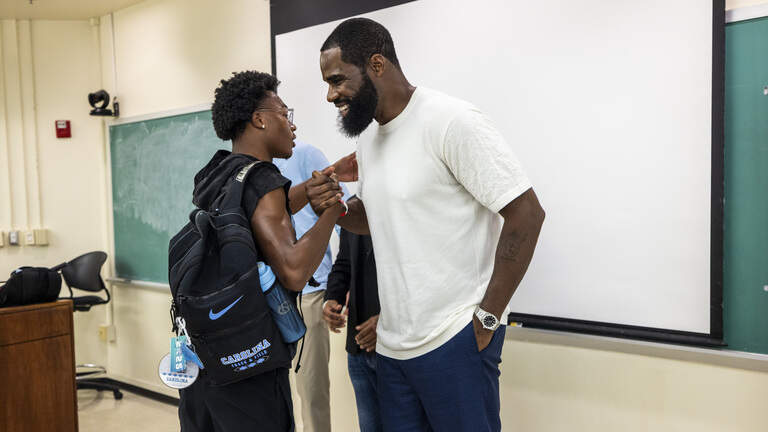
For Antawn Jamison, returning to the University of North Carolina was always going to carry a special meaning.
But even the former Tar Heel basketball star probably could not have imagined that one day he would return to Chapel Hill not as a player, not as an NBA veteran, and not simply as a basketball ambassador, but as a professor.
That is exactly where Jamison finds himself now.
The former North Carolina standout and 16-year NBA veteran has stepped into an unexpected new chapter as a visiting professor of the practice for sports communication at UNC-Chapel Hill. And while the classroom may look very different from the basketball court where Jamison once became a Tar Heel legend, the purpose behind his return is deeply connected to the lessons he learned during his time at Carolina.
Jamison recently sat in front of a classroom filled with 33 students in Carroll Hall, helping teach MEJO 206: Sports Communication alongside Livis Freeman, UNC Hussman School of Journalism and Media distinguished associate professor of sports communication.
For someone who once spent his college years dreaming about basketball, the idea of standing in front of students as their professor might have seemed almost unbelievable.
Jamison himself admitted that his younger college self probably would have thought the entire situation was crazy.
But life has a way of bringing people back to places that shaped them.
And for Jamison, UNC has always been one of those places.
His connection to Carolina goes far beyond basketball.
Jamison arrived at UNC in the 1990s and eventually became one of the most recognizable players in the program’s history. His No. 33 jersey hangs in the Dean E. Smith Center alongside the names and numbers of other Tar Heel greats.
Now, years after his playing career ended, Jamison is finding another way to contribute.
This time, his audience is not a packed basketball arena.
It is a classroom.
And his lessons are not limited to jump shots, defensive schemes or NBA preparation.
They are about sports communication, careers, relationships, leadership and the experiences he accumulated during decades around professional basketball.
One of the most interesting aspects of Jamison’s return to the classroom is the perspective he can offer students.
He has experienced the sports industry from multiple angles.
He was a college basketball star.
He became a first-round NBA draft pick.
He spent 16 seasons playing professionally.
He played alongside and against some of the biggest names in basketball.
And after retiring, he moved into scouting and front-office roles with organizations including the Los Angeles Lakers and Washington Wizards before also working as a television analyst.
That combination gives Jamison an unusually broad understanding of the sports business.
He knows what it is like to be the athlete.
He knows what it is like to work behind the scenes.
And he knows what it is like to communicate with an audience through television.
Now, he is bringing those experiences into the classroom.
But there is another reason his return to UNC feels especially meaningful.
Jamison has five children, and his perspective on education has changed over the years.
The former basketball star who once focused primarily on competing now sees another responsibility: helping the next generation.
And that philosophy traces back to one of the most influential figures in his life, legendary UNC coach Dean Smith.
Jamison has recalled Smith’s message to his players about giving back to the university.
Rather than simply focusing on financial contributions, Smith emphasized the importance of giving time and being there for the institution that had supported them.
That lesson clearly stayed with Jamison.
When UNC needed him, he wanted to be available.
And that willingness to help eventually placed him in another remarkable position.
Earlier this year, Jamison was part of UNC’s search committee tasked with identifying the school’s next men’s basketball coach.
The decision would ultimately lead to the hiring of Michael Malone, the former NBA head coach who arrived in Chapel Hill with an impressive professional résumé.
For Jamison, the connection was not random.
He had firsthand experience with Malone.
The two crossed paths during the 2009-10 NBA season when Jamison joined the Cleveland Cavaliers late in the campaign. Malone was an assistant coach on that staff, and Jamison had an opportunity to see how he interacted with players.
What stood out to Jamison was Malone’s ability to connect with everyone.
Not just the stars.
Not just the players receiving the most attention.
Everyone.
Jamison specifically remembered Malone’s ability to communicate with players at the end of the bench while also building relationships with stars such as LeBron James.
That mattered.
After spending 16 years in the NBA and working around numerous head coaches and assistant coaches, Jamison had plenty of experience with different coaching personalities.
He knew what separated certain coaches from others.
And he believed Malone possessed qualities that could translate particularly well to college basketball.
There was also something else that appealed to Jamison.
Teaching.
College coaching is not simply about drawing up plays.
It involves developing young people, communicating with them, helping them understand expectations and preparing them for life beyond basketball.
Jamison believed that aspect of coaching could fit Malone particularly well.
At one point, Jamison had even watched Michigan preparing for the national championship and found himself frustrated that Carolina was not in that position.
He wanted to see the Tar Heels competing on that stage again.
And when Malone became a serious possibility, Jamison became increasingly enthusiastic about the possibility.
He was so invested in the process that he joked about repeatedly contacting athletic director Steve Newmark to ask whether he could help.
The search ultimately ended with Malone coming to Chapel Hill.
And Jamison could not have been happier to play a role.
Now, as Jamison returns to the classroom, the connection between his past and present seems almost perfect.
He spent his youth learning from coaches.
Now he is teaching students.
He once represented UNC on the basketball court.
Now he represents the university in an entirely different environment.
He once dreamed about Carolina competing for championships.
Now he is helping shape conversations around the future of the university.
And perhaps most importantly, he is following the example of the people who helped shape him.
Jamison has spoken about thinking of Dean Smith and Bill Guthridge during this period of his life.
Those coaches were not simply basketball figures to him. They were teachers.
They helped prepare him for life beyond the court.
And now Jamison is doing something similar for another generation.
There is also a wonderful full-circle element to his classroom experience.
During one class, Jamison and Freeman welcomed another legendary Tar Heel, Tyler Hansbrough, as a special guest.
Both Jamison and Hansbrough have had their jerseys retired at the Dean E. Smith Center.
Yet they were now standing in a classroom speaking to students about sports communication.
The contrast says plenty about the evolution of their lives after basketball.
The students sitting in that classroom did not grow up watching Jamison dominate college basketball.
For many of them, his playing career belongs to another era.
But that does not make his story less valuable.
If anything, it gives him a different role.
He can tell them what happens after the spotlight fades.
He can explain how athletes can build careers beyond playing.
He can discuss the importance of relationships, communication and preparation.
And he can demonstrate that a successful career in sports does not have to end when an athlete leaves the court.
For UNC fans, however, perhaps the most exciting part of the story is that Jamison remains deeply connected to the basketball program he loves.
His fingerprints are now connected to both the classroom and the basketball program.
He helped UNC during its coaching search.
He supported the arrival of Malone.
And he has returned to the university as an educator.
Jamison even joked about what could happen if Malone’s tenure produces championships.
“Wait until we win a couple championships,” he said.
For now, those championships remain in the future.
But the enthusiasm behind the comment captures how much Jamison still cares about Carolina.
He is no longer wearing No. 33 and stepping onto the court at the Smith Center.
His role has changed.
His responsibilities have changed.
But the connection has not.
Years after leaving Chapel Hill, Antawn Jamison is still finding ways to give back to the university that helped shape him.
And perhaps that is the most fitting chapter of all.
The player who once learned from Carolina’s legendary teachers has now become a teacher himself.
The Tar Heel who once helped build his legacy on the basketball court is now helping build the next generation away from it.
And with his involvement in UNC’s coaching search, his connection to Michael Malone and his new role in the classroom, Jamison’s return to Chapel Hill may be much bigger than anyone i
nitially expected.
For a man who once would have thought the idea of becoming a professor was crazy, this unexpected chapter could turn out to be one of the most meaningful achievements of his post-playing life.




