


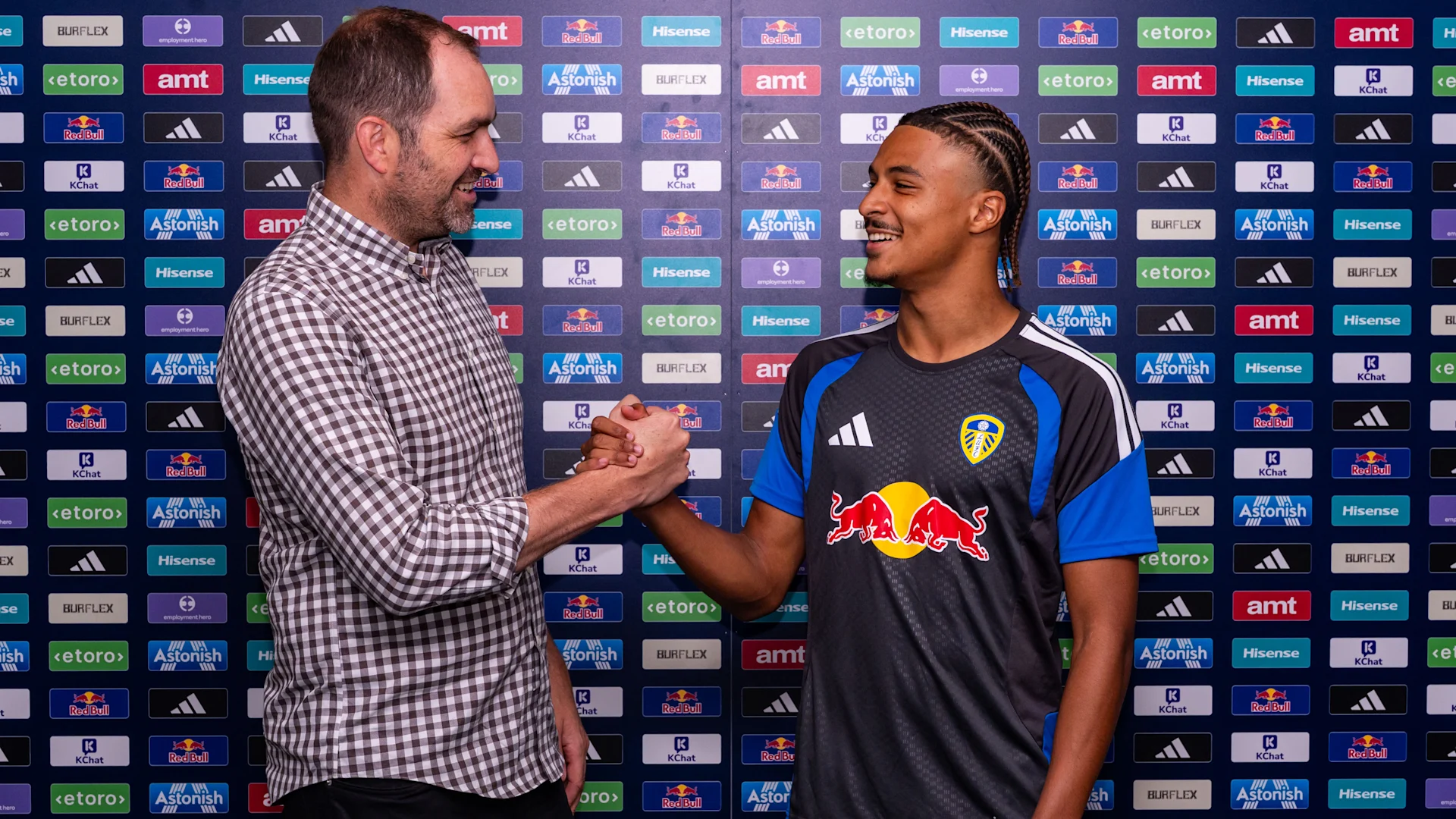
Deadline day is one of football’s most unpredictable occasions. It can produce excitement, frustration and, sometimes, complete chaos. At Leeds United, the final day of the 2026 summer transfer window brought all three emotions as the club completed late deals for Melvin Bard and Jean-Mattéo Bahoya.
Inside Elland Road and Thorp Arch, deadline day has developed a reputation of its own. Asked what the phrase means to one senior Leeds official, the joking response was simply: “PTSD.”
Leeds had no intention of making deadline day central to their summer strategy. Managing Director Robbie Evans has previously made it clear that relying on the final hours of the window is not an ideal approach.
Yet circumstances dictated otherwise.
Bard had been on Leeds’ radar for more than a year, and the club’s interest intensified after Joe Rodon’s injury. Sporting Director Adam Underwood explained that the defensive situation made the need for another player increasingly important.
“We had Bard agreed for all intent and purpose the day before,” Underwood said.
The agreement with Nice and the player was reached on August 31, leaving Leeds to complete the medical and paperwork on deadline day. Bard arrived at Leeds Bradford Airport shortly before 1pm and began his medical soon afterwards.
Behind the scenes, Head of First Team Operations Matt Robertshaw and his team had already prepared for the possibility of arrivals. Hotel rooms, transport, medical appointments and flights had all been arranged in anticipation of a busy final day.
But while Bard was completing his medical, Leeds’ attention quickly shifted to another part of the squad.
The club had explored the possibility of signing Mykhailo Mudryk from Chelsea, but the structure of the proposed deal proved difficult to resolve. With Mudryk ultimately moving to Tottenham on loan, Leeds had to turn to alternative targets.
The departure of Willy Gnonto to Fiorentina increased the urgency. Gnonto was already in Florence awaiting confirmation of his transfer, meaning Leeds needed to find a replacement.
Three winger options were discussed throughout the morning. Two were eventually ruled out, while Bahoya emerged as the preferred candidate.
The Frankfurt winger had been monitored for some time and was already known to Daniel Farke and his coaching staff. Leeds viewed him as a player with the potential to develop into a future starter.
Negotiations with Eintracht Frankfurt began after 1pm. Leeds’ existing relationship with the Bundesliga club proved useful, particularly after Underwood had worked with Frankfurt on the transfer of goalkeeper Michael Zetterer.
This time, Leeds were able to negotiate a loan deal with an obligation to buy based on conditions that gave them additional flexibility.
Bahoya was training when he learned about Leeds’ interest. He spoke with his family and agent before speaking with Farke and chairman Paraag Marathe.
The decision was eventually made.
“For me it was a good project,” Bahoya said. “It was just a top opportunity, and I was happy to take it.”
The biggest challenge was now completing the transfer before the deadline.
Because Bahoya could not travel to England in time for a traditional medical, Leeds’ medical department worked with Frankfurt to gather the necessary information. Existing relationships between medical staff at the two clubs helped provide confidence in the process.
The paperwork, however, proved considerably more complicated.
Club Secretary Hannah Cox and Assistant Club Secretary Abbie Stenton worked through the transfer documentation, immigration requirements and international registration. Because Bahoya’s move included an obligation to buy, additional agreements had to be prepared.
Leeds eventually needed a deal sheet to gain extra time.
While the administrative work continued, Robertshaw and his team were also dealing with the practical details of getting Bahoya to Yorkshire. There was even an unexpected complication: the player’s family wanted to bring their dog.
“I was speaking to the operator of the aircraft to ask how we could get the dog in the country and Googling dog passports and vaccination status,” Robertshaw recalled.
Bard’s own transfer was also taking longer than expected. Despite the agreement being reached the previous evening, the paperwork was not completed until around 10:13pm. His signing was announced shortly afterwards.
Then came the final push for Bahoya.
Leeds had until midnight to complete the necessary international transfer procedures. The deal sheet provided an additional hour, but the club still had to work against the clock.
Eventually, everything was approved with just six minutes remaining.
The relief inside the club was enormous.
Cox described the final moments as “terrifying,” explaining that she could not relax until the Premier League and FA had approved the registration and the player was officially eligible.
Bahoya was announced shortly after midnight, with Leeds’ digital team even using a French version of their familiar “Don’t go to bed just yet” message.
At around 1:30am, Evans gathered members of staff for a toast to celebrate the completion of an extraordinary evening.
Bahoya arrived in Yorkshire the following morning and trained with the squad later that day. His dog followed later in the week.
For Leeds, the final day had delivered two signings despite the club’s desire to avoid relying on deadline-day business.
Underwood believes the real judgment, however, will come much later.
“The only way that we can judge any work done is when you’re done,” he said.
With a Premier League season of 38 games and potential cup runs ahead, Leeds know the summer transfer window will ultimately be judged by what happens on the pitch—not simply by what occurred during one dramatic night in September.




