


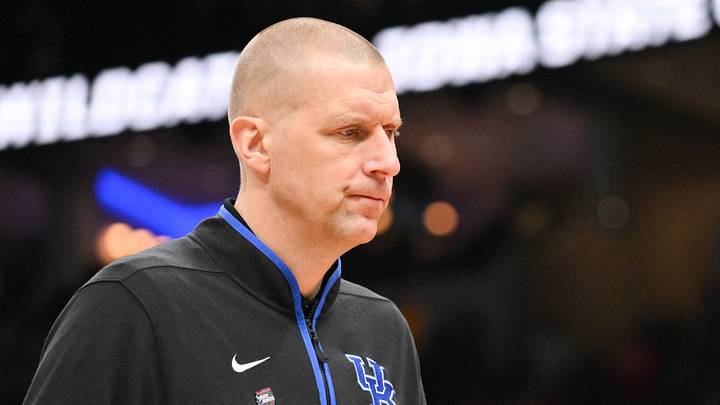
Kentucky basketball is known for its championship tradition, legendary players and unforgettable moments. But as the Wildcats prepare for the 2026-27 season, there is another fascinating story hiding in plain sight: the numbers on their jerseys.
For some players, choosing a jersey number is about honoring a childhood hero. For others, it is a family tradition, a personal superstition or simply a number that feels right. But at Kentucky, where basketball history carries enormous significance, a jersey number can also become a connection to the program’s legendary past.
And one returning Wildcat has made that connection especially clear.
Junior guard Trent Noah wears No. 9, a number he selected after his preferred No. 2 was unavailable when he arrived in Lexington. Rather than changing back to No. 2 when the opportunity eventually opened, Noah decided to keep the number that represents his hope of seeing Kentucky capture another national championship.
The decision offers a glimpse into the way Kentucky’s history influences its players, even in details that might initially seem insignificant.
Noah is not alone. From childhood inspirations and family connections to NBA superstars and former Kentucky legends, the Wildcats’ jersey numbers tell stories that stretch well beyond the basketball court.
TRENT NOAH’S NO. 9 HAS A SPECIAL MEANING
For Noah, the decision to wear No. 9 was about more than finding an available jersey.
Growing up as a Kentucky fan, he understood the importance of the program’s championship history. When No. 2 was unavailable during his freshman season because transfer Jaxson Robinson wore it, Noah decided to try something different.
His reasoning was straightforward: Kentucky had won eight national championships, and he liked the idea of wearing a number that reflected the program’s pursuit of another title.
Rather than treating No. 9 as a temporary choice, Noah embraced it.
Even after Robinson left Kentucky, Noah decided to keep the number instead of returning to his original preference.
That decision says something about his connection to the program. He has turned an initially practical choice into a personal reminder of what Kentucky basketball is trying to accomplish.
The number also carries historical significance. For many years, NCAA basketball rules prohibited players from wearing numbers 6 through 9 because officials used hand signals to communicate fouls. Those restrictions were eventually removed, allowing players to wear those numbers again.
At Kentucky, No. 9 had not been worn since 1944 before Noah brought it back.
Two former Wildcats, James Goforth and Kenneth England, wore the number during the early 1940s. Both later died in military service during World War II.
That history makes Noah’s jersey choice particularly interesting. His number connects the present-day Wildcats with a distant period in the program’s history while also reflecting his hope for its future.
ZYON HAWTHORNE CHOSE NO. 0 BECAUSE OF AN NBA SUPERSTAR
Some players select their numbers because they admire someone who made the number famous.
For Zyon Hawthorne, that inspiration was Russell Westbrook.
Hawthorne explained that he admired Westbrook’s intensity and aggressive approach to basketball when he was growing up. Those qualities helped draw him toward No. 0.
Westbrook built a reputation as one of the NBA’s most energetic competitors, making the number a recognizable part of his basketball identity.
Hawthorne’s decision reflects the influence professional players can have on young athletes. A number seen on television can become something a child wants to carry throughout his own basketball journey.
Kentucky also has a history with No. 0.
De’Aaron Fox was the first Wildcat to wear the single-zero jersey in a game and remains one of the program’s most memorable players to use it. Quade Green, Ashton Hagans, Jacob Toppin and Rob Dillingham also wore the number.
That gives Hawthorne a recognizable group of predecessors as he begins his own chapter in Lexington.
JERONE MORTON BELIEVES HISTORY CAN REPEAT ITSELF
Jerone Morton has a particularly personal reason for wearing No. 1.
He previously wore No. 11 at George Rogers Clark High School, but that number was unavailable when he began his college career at Morehead State.
He switched to No. 1 and immediately found success.
Rather than abandoning the number when he moved to Washington State and later Kentucky, Morton decided to keep it.
His explanation was simple: he wanted to continue a tradition that had worked for him.
That is an example of how a number can become associated with confidence and positive memories.
Kentucky’s history with No. 1 includes several notable players. Darius Miller enjoyed a successful career wearing the number, while Devin Booker became a particularly recognizable name because of his subsequent NBA success.
Cliff Hawkins also helped bring the number back into use after a lengthy gap.
Morton now has the opportunity to create his own memories in a jersey with an established Kentucky history.
BRAYDON HAWTHORNE’S NO. 2 HONORS KYRIE IRVING
Braydon Hawthorne has worn No. 2 for much of his basketball career, and the number has a connection to NBA star Kyrie Irving.
Although Hawthorne believes he may have been assigned the number randomly when he was younger, he eventually decided to keep it because of his admiration for Irving.
He wore No. 22 while redshirting at Kentucky before returning to No. 2.
The choice is particularly interesting because No. 2 has experienced both memorable success and difficult stretches in Kentucky basketball.
Aaron Harrison became one of the most celebrated players to wear the number. During Kentucky’s remarkable 2014 NCAA Tournament run, Harrison delivered several clutch shots that helped propel the Wildcats to the national championship game.
However, other players who wore No. 2 in subsequent seasons experienced injuries, inconsistent performances or limited opportunities.
Hawthorne will hope to establish a different chapter in the number’s history.
With Kentucky’s demanding expectations, his challenge will be to make the jersey memorable through his own performances rather than simply following the footsteps of those who came before him.
KAM WILLIAMS TURNED NO. 3 INTO HIS OWN IDENTITY
Kam Williams’ jersey choice began with a family connection.
He originally wanted to wear No. 4 in high school, following his older brother Greg, who wore that number at St. John’s.
When No. 4 was unavailable, Williams selected No. 3 instead.
He has continued wearing it throughout his basketball journey and even uses the nickname K3 in his Kentucky player biography.
Kentucky has had several important players wear No. 3.
Rex Chapman scored 1,073 points in just two seasons with the Wildcats. Tyler Ulis wore the number while earning first-team All-America honors in 2016 and setting Kentucky’s single-season assists record.
More recently, NBA standouts Bam Adebayo, Keldon Johnson and Tyrese Maxey also wore No. 3 during their Kentucky careers.
That history gives Williams plenty of examples of players who made the number part of their identity.
As he continues his career in Lexington, the goal will be to build a story of his own.
MASON WILLIAMS HAS A RAJON RONDO CONNECTION
Mason Williams originally preferred No. 2, a number he wore in high school and one associated with his father, Kentucky assistant coach Mo Williams, during his NBA career with the Cleveland Cavaliers.
But when that option was unavailable, Mason selected No. 4.
His inspiration was former Kentucky and NBA star Rajon Rondo.
Williams admitted that he did not initially love the number’s appearance, but he has gradually grown more comfortable with it.
Kentucky’s history with No. 4 includes Rondo, although Kyle Macy has an especially strong claim to being the program’s most accomplished player in that jersey.
Macy was a three-time All-American and the 1980 SEC Player of the Year.
For Mason Williams, the number provides an opportunity to honor a player whose career he admires while establishing his own identity at Kentucky.
ZOOM DIALLO’S NO. 5 IS A FAMILY TRADITION
Zoom Diallo’s choice of No. 5 began with his older brother.
Diallo wore the number while winning two high school state championships, making it part of some important memories from his early basketball career.
When he arrived at Washington, however, No. 5 was already taken.
He chose No. 9 instead, combining his brother’s No. 5 with his father’s No. 4.
Eventually, Diallo returned to No. 5, a number he associates with the journey that brought him to this point in his career.
Kentucky’s No. 5 history includes several prominent guards.
Wayne Turner remains the program’s career leader in steals and victories, while Travis Ford also made a significant impact wearing the number.
During the John Calipari era, Andrew Harrison, Malik Monk, Kevin Knox and Immanuel Quickley all wore No. 5.
Diallo now has the opportunity to add his name to that history.
JUSTIN MCBRIDE’S NO. 21 HONORS HIS FAMILY
Justin McBride’s choice is rooted in baseball rather than basketball.
His great-uncle, Bake McBride, wore No. 21 while playing professional baseball for the St. Louis Cardinals.
Bake McBride won National League Rookie of the Year honors in 1974 and was selected as an All-Star in 1976.
For Justin, the number has been a family tradition throughout his life.
Kentucky basketball has its own impressive history with No. 21. Jack “Goose” Givens scored 2,038 points while wearing the number, while Tayshaun Prince recorded 1,775 points during his Wildcat career.
McBride’s choice demonstrates how a jersey number can connect different sports and generations of the same family.
MALACHI MORENO AND MILAN MOMCILOVIC HAVE PERSONAL REASONS
Malachi Moreno has three reasons for wearing No. 24.
His older brother wore the number, his birthday falls on October 24, and he admired Kobe Bryant, who wore No. 24 during part of his NBA career.
That combination made the choice an easy one.
Kentucky’s history with No. 24 includes Jamal Mashburn, Johnny Cox and Antoine Walker. Mashburn, in particular, remains one of the program’s most accomplished players, ranking sixth on Kentucky’s career scoring list despite playing only three seasons.
Milan Momcilovic’s choice of No. 22 is more straightforward: his birthday is September 22.
But the number carries a remarkable Kentucky legacy of its own.
Jerry Bird and Mike Pratt have had their No. 22 jerseys retired, while Shai Gilgeous-Alexander wore the number during his lone season with the Wildcats.
The same jersey number can therefore represent something deeply personal to one player while connecting another to generations of Kentucky basketball history.
REECE POTTER’S NO. 33 WAS INSPIRED BY ANOTHER BIG MAN
Reece Potter’s number choice came from watching another basketball player.
While playing at Lexington Catholic, Potter noticed a big man who could shoot three-pointers and whose name had a double E. That player wore No. 33, inspiring Potter to select the same number.
Potter also liked the way the number worked visually with his name.
Kentucky’s most accomplished No. 33 is Ron Mercer, who earned consensus first-team All-America honors in 1997 and was named to the All-Final Four Team in 1996.
Randolph Morris also earned All-SEC honors while wearing No. 33.
Potter now has a chance to give the number another chapter in Kentucky’s basketball story.
MORE THAN JUST NUMBERS FOR THE WILDCATS
Kentucky’s jersey choices reveal something fascinating about the players preparing to represent the program.
Some numbers honor NBA idols. Others celebrate family members, birthdays or successful experiences from earlier in a player’s career. In Noah’s case, a number that was initially a backup option became a symbol of the championship standard he hopes Kentucky will reach.
These choices do not determine what happens during a game, but they show how players connect their personal histories with the program they represent.
And at Kentucky, where the past is never far from the present, even a jersey number can carry a story worth telling.
For BBN, the most interesting discovery may be that the numbers on the Wildcats’ backs are not simply uniform choices. They are reminders of family traditions, basketball heroes, historic players and the championship ambition that continues to define Kentucky basketball.




