


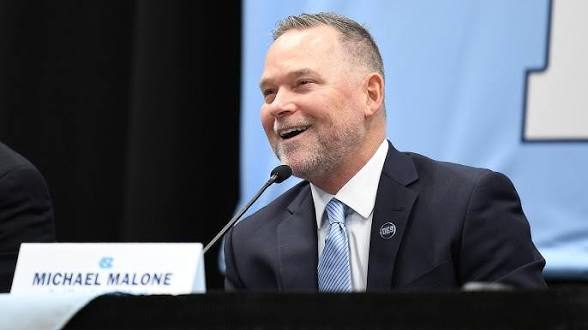
The Michael Malone era at North Carolina is entering a new phase, and one of the biggest storylines surrounding the Tar Heels is how the former NBA championship coach plans to build his offense in Chapel Hill.
Malone was officially hired as UNC’s 21st men’s basketball head coach in April 2026 after a 12-year NBA head-coaching career that included 10 seasons with the Denver Nuggets and the franchise’s 2023 NBA championship. �
University of North Carolina Athletics +1
Now, with his first Tar Heel roster assembled, attention is turning toward what his system could look like once the games begin.
More Than Just Set Plays
One of the most interesting aspects of Malone’s offensive philosophy is that his teams have historically emphasized concepts, movement and decision-making rather than simply running a long list of predetermined plays.
During his time in Denver, Malone’s offenses frequently used cutting, spacing, ball movement and two-man actions to create opportunities. CBS Sports noted that the Nuggets’ movement-oriented offense was built around concepts that allowed players to read the defense and react rather than simply follow rigid patterns. �
CBS Sports
That philosophy could translate naturally to college basketball.
Instead of asking every player to memorize where to stand on every possession, Malone can give his players principles that encourage them to recognize defensive mistakes and exploit open space.
For UNC, that could mean an offense where passing, cutting and movement away from the ball become just as important as the player controlling it.
The Nikola Jokić Influence
Malone’s Denver teams provide perhaps the clearest example of his offensive thinking.
With Nikola Jokić at the center of the Nuggets’ attack, Denver developed an offense built around passing, cutting and reading defensive reactions. Teammates learned to move into open spaces because Jokić could find them with passes from virtually anywhere on the floor. �
CBS Sports
Obviously, UNC does not have Jokić.
But Malone isn’t expected to simply copy the Nuggets’ NBA offense and transfer it directly to college basketball. Instead, the broader principles — spacing, unselfishness, movement and decision-making — can be adapted to the players available to him.
Malone has already emphasized the importance of playing for one another and sharing the basketball.
An Up-Tempo Identity
Another major component of Malone’s philosophy is pace.
When he introduced his vision for UNC, Malone said he wanted the Tar Heels to defend, rebound and then use those possessions to get out and attack before opposing defenses could become fully organized. �
Yahoo Sports +1
That creates a direct connection between UNC’s defense and offense.
A defensive stop can become a transition opportunity. A defensive rebound can immediately turn into an outlet pass. A turnover can create a numbers advantage.
Rather than waiting for a defense to establish itself, Malone wants his team to attack early.
That could make UNC particularly interesting to watch if the Tar Heels can consistently generate stops and rebounds.
The Backcourt Could Be Central
The personnel UNC assembled for the 2026-27 season also gives Malone several guards and perimeter players who can help execute his philosophy.
Terrence Brown, Matt Able and Neo Avdalas are among the perimeter pieces expected to play important roles. Sports Illustrated recently highlighted UNC’s reworked backcourt and suggested that the roster’s guard-heavy construction could fit Malone’s desire for a faster style. �
SI
Brown, in particular, could have an important role because of his ability to create with the ball while also playing away from it.
That distinction matters.
A player doesn’t necessarily have to dominate the ball to have a major offensive impact in Malone’s system. Moving without the ball, cutting behind an aggressive defender, setting a screen or making the extra pass can create the opening for someone else.
Spacing and Ball Movement
Spacing is another important piece of the puzzle.
If UNC can place multiple capable shooters and decision-makers around the floor, defenses will have more difficult choices to make.
Help too aggressively, and another player could become available.
Stay home on shooters, and the ball-handler may have room to attack.
Collapse toward the paint, and another pass could create an open perimeter opportunity.
That type of chain reaction is at the heart of many modern offenses.
Malone has also stressed the importance of sharing the basketball. His stated philosophy is that ball movement helps create unity within a team, while his broader offensive approach emphasizes players making decisions rather than simply waiting for instructions. �
Carolina Blitz +1
Jarin Stevenson Could Benefit
The system could also create opportunities for UNC’s frontcourt players.
Jarin Stevenson is one player who could benefit from playing alongside a group of capable guards. Sports Illustrated recently examined how Stevenson’s role could expand under Malone, particularly because of his ability to score in different ways. �
SI
If the Tar Heel guards can consistently draw defensive attention, frontcourt players could find more opportunities through cuts, offensive rebounds, spot-up attempts and attacks against rotating defenders.
That is where an offense based on movement becomes particularly valuable.
Players don’t necessarily need to create everything themselves.
They can create advantages for one another.
Film Room: What to Watch
When UNC begins playing under Malone, there are several things worth watching closely.
First: player movement.
Are players cutting when teammates drive? Are they relocating after making passes?
Second: spacing.
Does UNC maintain enough distance between players to create driving lanes?
Third: ball reversals.
Can the Tar Heels move the ball from one side of the court to the other and force defenses to rotate?
Fourth: transition.
How quickly does UNC attack after defensive rebounds and turnovers?
Fifth: decision-making.
Are players making quick reads, or are possessions becoming stagnant?
These details could tell the story of Malone’s offensive system better than any individual play.
Defense Still Starts the Offense
Perhaps the biggest misconception would be to view Malone’s philosophy as offense-first simply because his Denver teams were known for efficient offensive basketball.
Malone has repeatedly emphasized defense.
At UNC, he has made it clear that defense and rebounding are foundational because they allow his team to play the fast-paced offensive style he wants. �
Yahoo Sports +1
That creates a four-part identity: defend, rebound, run and share the ball.
If those pieces work together, UNC can generate offense from more than traditional half-court possessions.
A New Offensive Chapter in Chapel Hill
Michael Malone’s arrival represents a major change for North Carolina basketball.
His NBA background doesn’t guarantee that everything will immediately translate to the college game, but his previous teams provide a clear indication of the principles he values.
Movement.
Spacing.
Passing.
Decision-making.
Transition basketball.
And perhaps most importantly, playing for one another.
The coming season will reveal how successfully those ideas translate to the Tar Heels’ personnel. For now, the film-room discussion offers an intriguing look at what Malone is attempting to build in Chapel Hill.
UNC basketball is entering a new era, and Michael Malone’s offensive system could be one of the defining storylines of the 2026-27 Tar Heel season.




